
Claude — the artificial intelligence assistant from Anthropic — shows mixed availability today as users across locations report errors and interruptions even though core infrastructure appears active. If you’ve been checking is Claude down right now?, here’s a full update on the AI’s condition and what’s behind the reports of problems.
Current status indicators suggest that Claude’s main services are running. Yet community reports and third-party monitoring tools reflect sporadic elevated error rates, meaning some people may be experiencing connection failures, slow responses, or system glitches at this very moment.
Below, we break down what’s happening, contrasting official uptime data with what users are encountering, and outline how this affects people who rely on Claude for work, school, creative tasks, or development projects.
Claude’s Overall Service Status: Official Indicators
According to status dashboards dedicated to monitoring the system’s performance, Claude’s key back-end services — including the primary AI platform, API access, and code tools — are currently shown as operational. Status pages record uptime percentages consistently high for March so far, and no major outages are listed at this moment.
These monitors categorize issues into several states — operational, degraded performance, partial outage, and major outage — and as of the latest data, Claude’s services are in the operational category, indicating that the platform itself has not been taken offline.
This means that for much of the global user base, Claude should be reachable and functional in basic use cases.
Why Some Users Are Seeing Problems Right Now
Despite the official status being “up,” real-time third-party incident aggregators are tracking elevated errors on Claude’s primary domain. These platforms have flagged ongoing issues stemming from today that include error spikes affecting interactions with the AI models and intermittent failed connections.
In particular, certain subcomponents like Opus 4.5 and Sonnet 4.5 (parts of Claude’s model lineup) have exhibited higher-than-normal error rates, leading to degraded experiences for some users. These errors don’t appear to be widespread outages, but they have prompted some platforms to list incidents as “investigating.”
This kind of discrepancy is not unusual: status pages often reflect infrastructure health overall, while real-time monitoring can reveal brief bursts of errors that affect a subset of users before they’re widely acknowledged or corrected.
User Reports Highlight Fragmented Experiences
Across community forums and social feeds, numbers of users have reported being unable to connect to certain Claude features, receiving “failed request” notifications, lagging interface load times, and abrupt shutdowns during sessions. These anecdotes suggest that while the service remains technically online, performance issues are affecting user perception of availability.
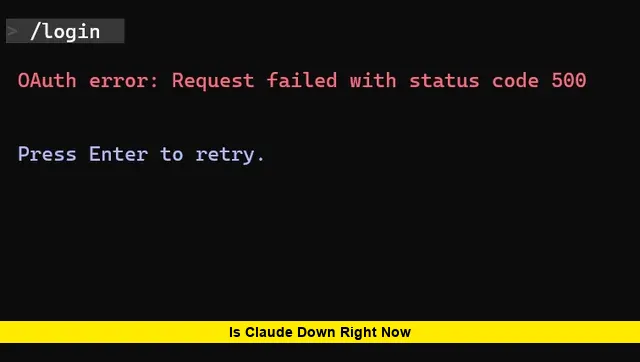
Some reports describe error 500 server failures or login interruptions, especially on web and desktop app versions, though these incidents are not mirrored in official outage listings. These user accounts underscore a gap between infrastructure status and real-world experience when partial faults or model-specific errors crop up.
A Snapshot of Recent Service Fluctuations
In the week preceding today’s activity, Claude’s status history recorded several brief incidents where error rates rose significantly or individual components experienced temporary disruptions. In some cases, elevated errors persisted for hours before being resolved. While these were logged as intermittent events rather than full outages, they did result in downtime for portions of the user base during those periods.
These previous issues, combined with today’s reported elevated errors, show that Claude has encountered performance variability in recent days, even if the overall system has remained live.
How to Interpret “Operational” Versus Real-World Experience
When a service shows as operational on a status page, it means the core servers and networks are live and responding. However, operational status doesn’t guarantee a uniformly smooth experience for all users at every moment. Intermittent spikes in error rates, model-specific hitches, or temporary networking glitches between your device and the server can all create the impression of downtime even when the platform as a whole is running.
For example, a regional routing issue can prevent some users from connecting without ever registering as a service-wide outage. Similarly, if only a particular model in Claude’s suite has errors, users might experience trouble with certain tasks while others work fine.
That’s why disparate reports — some users saying Claude appears down while status dashboards say it’s operational — can both be accurate from their own perspectives.
What Users Can Do if Claude Appears Unreachable
If you’re encountering trouble even though service monitors indicate Claude is running, try a few troubleshooting steps:
- Refresh the session or reload the web app. Temporary caching issues can disrupt interactions.
- Test on a different network or device. This can reveal whether local connectivity problems are at play.
- Check API keys or integrations. For developers, invalid tokens or configuration errors can mimic service failure.
- Wait and retry after a short interval. Intermittent elevated errors often resolve quickly as engineers deploy patches or rollback faulty updates.
Because the elevated error conditions being tracked right now appear to affect parts of Claude’s system without shutting it down entirely, these simple steps can often help restore normal usage.
Context: Claude’s Role in the Broader AI Ecosystem
Claude remains one of the leading AI assistants in terms of adoption and integration across sectors, competing directly with other major models in both consumer and enterprise settings. Even with occasional performance fluctuations, many developers and businesses build workflows around Claude’s capabilities, underlining the practical importance of monitoring its uptime closely.
Despite recent occasional service hiccups, the broader trend for Claude’s reliability shows consistent uptime, indicating that intermittent user-side errors are more likely than systemic platform outages.
Expectations Going Forward
With today’s elevated error reports and the background context of recent performance irregularities, observers expect Claude’s engineers to continue fine-tuning stability. Elevated error rates flagged by monitoring services usually trigger internal diagnostics and fixes before broader outages ever occur.
Given the ongoing demand for AI assistance tools and Claude’s significant user base, platform performance remains a priority — and most indicators suggest that while some users are currently facing issues, a wider outage has not taken place.