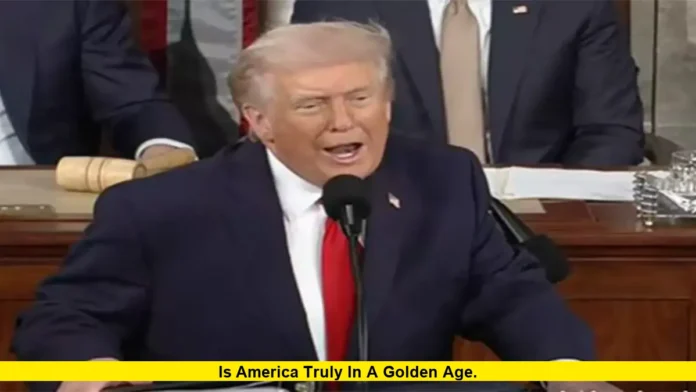

President Donald Trump stood before a joint session of Congress on Tuesday night and declared that the golden age of America is now upon us — a sweeping claim that defined his entire 2026 State of the Union address and instantly ignited a national debate about where this country truly stands.
If you’ve been wondering what’s really happening with the U.S. economy and America’s future, this article breaks it all down — keep reading.
A Record-Setting Speech Full of Big Promises
Trump’s address on February 24, 2026 was, by every measure, the longest State of the Union in at least six decades — running nearly two hours. The president used every minute to paint a picture of a resurgent nation. He claimed the border is now the most secure in American history, that inflation is plummeting, that incomes are rising fast, and that the Dow Jones Industrial Average broke 50,000 — a milestone he said was expected to take four more years to reach.
“Our nation is back, bigger, better, richer and stronger than ever before,” Trump told lawmakers, drawing thunderous applause from Republicans while Democrats largely sat in stony silence. “This is the golden age of America,” he declared, echoing nearly word for word the opening line of his 2025 inaugural address, where he first announced that such an age had begun.
The speech also highlighted Trump’s tariff policy as a key driver of economic growth. Trump credited those tariffs with bringing in hundreds of billions of dollars and forcing countries that had long taken advantage of the United States to renegotiate on more favorable terms. He called the resulting economic turnaround “the biggest in history” and took direct aim at the 22 Nobel Prize-winning economists who, he argued, got it completely wrong when they predicted tariff-driven economic disaster.
The Supreme Court, Tariffs, and a Pivotal Legal Blow
One of the most notable moments in the speech came when Trump addressed a Supreme Court ruling handed down just four days earlier that struck down his sweeping tariff authority. He called it an “unfortunate ruling” but quickly tried to reassure the country — and the markets — that most trading partners are choosing to honor their existing deals anyway, fearing that a new round of negotiations under revised legal terms could be even less favorable to them.
This moment underscored the precarious position Trump finds himself in heading into the 2026 midterms. His economic agenda has been built substantially on tariff revenue and aggressive trade renegotiations, and a high court decision limiting those powers creates real uncertainty going forward.
What the Numbers Actually Show
The picture Trump painted is not entirely without factual grounding. Egg prices did fall significantly — down roughly 48% between January 2025 and January 2026, according to federal labor statistics. Core inflation has dropped to some of its lowest levels in recent years. Real wages for private-sector workers have outpaced inflation during Trump’s first year back in office, putting roughly $1,400 more in workers’ pockets compared to what they had at the end of the Biden administration.
Violent crime has also fallen sharply in many cities. Murder rates in major urban centers hit their lowest point in over a century in 2025, according to White House data. Border crossings remain at historic lows. And three million children have already signed up for the new “Trump Accounts” — a savings program that starts every child born between 2025 and 2028 with a $1,000 deposit from the U.S. Treasury.
However, not every claim held up to scrutiny. Beef prices hit all-time highs as recently as last month, with ground beef reaching $6.75 per pound. Trump’s assertion that grocery prices broadly are lower drew immediate pushback from fact-checkers and Democratic lawmakers alike. Multiple independent analysts noted that while some prices have eased, the overall cost of living remains a major pressure point for American families.
Polling Tells a Different Story
Even as Trump declared America’s golden age in full bloom, the polling data tells a more complicated story. For the first time in his political career, voters have lost trust in Trump specifically on the economy — a striking reversal for a president who has long enjoyed strong marks on economic handling. Approval ratings have slipped heading into a midterm election cycle that Republicans view with growing anxiety.
Democrats have seized on this opening. Their strategy heading into November centers on economic frustration felt by ordinary Americans — voters who may hear a president proclaim a golden age but still struggle at the grocery store, at the gas pump, or under the weight of healthcare costs.
The speech itself became increasingly contentious in its second hour, with several Democratic members interrupting Trump’s remarks. Rep. Al Green of Texas was escorted from the chamber after holding up a protest sign near the speech’s opening. Reps. Ilhan Omar and Rashida Tlaib also called out during Trump’s remarks, turning portions of the address into a tense back-and-forth unusual even by today’s polarized standards.
Immigration, Iran, and the Road Ahead
Beyond economics, Trump used the speech to tout his immigration record, praising what he described as the most secure southern border in history and highlighting deportation efforts targeting violent criminal offenders. He also addressed foreign policy, expressing a preference for a diplomatic solution with Iran while making clear that military action remains on the table.
The Homeland Security Department remains in partial shutdown due to Democratic opposition over what critics describe as government overreach by federal law enforcement. Trump’s standoff with the judiciary over executive authority — including the pending Supreme Court case over Federal Reserve oversight — adds further complexity to a second term that has been anything but quiet.
For the American public, the picture that emerges from the 2026 State of the Union is one of genuine competing realities. Some economic indicators have genuinely improved. Crime in many cities is down. The border is more controlled than it was two years ago. But costs remain high in key categories, legal challenges are reshaping the president’s agenda, and public confidence in the administration’s economic stewardship has taken a measurable hit.
Whether this moment truly marks the golden age of America — or simply the administration’s most ambitious attempt to brand it as one — may ultimately be decided not in Congress, but at the ballot box this November.
What do you think — is America living in a golden age right now, or does the reality feel different where you live? Drop your thoughts in the comments below.