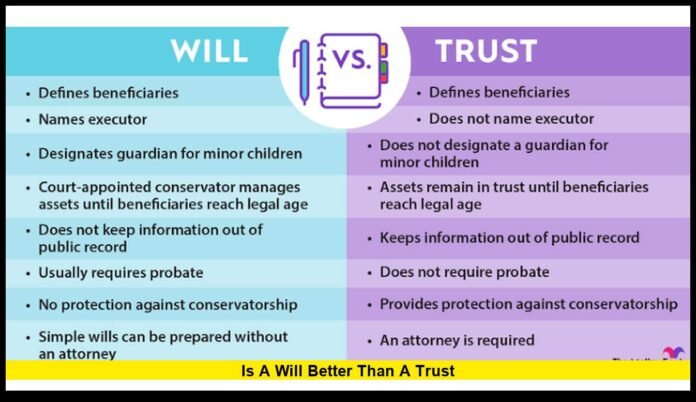

Is a will better than a trust? The answer depends on your financial situation, family needs, property ownership, and plans for passing assets to your loved ones. A will provides instructions for distributing property after death, while a revocable living trust can manage assets during your lifetime and help transfer eligible property without probate.
Both options play important roles in estate planning in the United States. A will may be sufficient for someone with a straightforward estate, but a trust can offer additional privacy, greater control over inheritance distributions, and continuity in financial management during incapacity.
Choosing between these documents requires more than comparing their initial costs. Understanding how each works can help you protect your property, provide for your family, and make informed decisions about your estate.
What Is a Will?
A will, also called a last will and testament, is a legal document that explains how you want your probate estate distributed after your death. It allows you to name beneficiaries, nominate guardians for minor children, and appoint an executor to handle estate administration.
The executor generally takes responsibility for identifying estate assets, addressing valid debts and expenses, completing required administrative steps, and distributing property according to the will and applicable law.
A will can also specify who should receive particular belongings, financial assets, and other property that forms part of the probate estate.
One important limitation is that a will does not automatically avoid probate. Property governed by the will generally passes through the applicable probate process unless a legal exception or simplified procedure applies.
A will also does not independently provide ongoing financial management if you become incapacitated during your lifetime.
For people with uncomplicated inheritance plans, however, a properly prepared will can provide a clear and practical foundation for estate planning.
What Is a Trust?
A trust is a legal arrangement that allows a trustee to hold and manage property for beneficiaries under written instructions.
A revocable living trust is established during the creator’s lifetime. The person creating the trust, known as the grantor or settlor, can generally serve as the initial trustee and retain control over the assets.
As long as the creator has the necessary legal capacity and follows the trust’s terms, a revocable trust can generally be amended or revoked.
The trust document explains how assets should be managed during the creator’s lifetime and distributed after death. It also identifies a successor trustee who can take over when the original trustee can no longer serve.
Unlike a will, a properly funded living trust can generally transfer assets to beneficiaries without ordinary probate administration for those assets.
However, establishing a trust does not automatically place every asset inside it. Property must be transferred or otherwise properly arranged to receive the intended benefits.
Is a Will Better Than a Trust for Your Situation?
A will may be the more practical option for someone who wants to establish basic inheritance instructions without managing a separate trust arrangement.
For example, a person with a relatively simple estate may want to leave property to a spouse, children, or other relatives. A will can communicate those wishes and identify the person responsible for administering the estate.
A trust may be more suitable for someone who wants to avoid probate for eligible assets, protect privacy, manage property during incapacity, or control how beneficiaries receive an inheritance.
The decision is not determined solely by wealth. A person with a modest estate may still benefit from a trust because of property ownership, family circumstances, or the need for long-term asset management.
Likewise, someone with substantial assets may find that a carefully prepared will and other estate-planning documents meet many of their needs.
The most appropriate choice depends on your priorities and the laws governing your estate.
Will vs. Trust: Understanding the Main Differences
The following comparison highlights the most important distinctions.
| Feature | Will | Revocable Living Trust |
|---|---|---|
| Primary purpose | Directs the distribution of probate property after death | Manages trust assets during life and after death |
| Probate | Generally applies to property governed by the will | Properly funded assets generally avoid probate |
| Privacy | Probate records may become publicly accessible | Generally provides greater privacy |
| Incapacity planning | Does not independently manage assets during incapacity | A successor trustee can manage trust property under the document’s terms |
| Minor children | Can nominate guardians | Can manage assets inherited by children |
| Inheritance control | Directs distributions through the estate process | Can establish continuing management and distribution conditions |
| Initial cost | Often lower for a straightforward document | Often higher because of drafting and funding requirements |
| Maintenance | Requires periodic review and updates | Requires periodic review, records, and appropriate asset funding |
State laws, document provisions, and individual circumstances can affect how these differences apply.
Advantages of Choosing a Will
A will offers several benefits that make it a useful estate-planning document.
1. Clear Instructions for Beneficiaries
A will allows you to identify the people or organizations that should receive your probate property. You can specify particular gifts and establish instructions for distributing the remaining estate.
These directions can help family members understand your intentions and provide an organized framework for estate administration.
2. Naming a Guardian for Minor Children
Parents can use a will to nominate a guardian for their minor children if they die while the children still need a legal guardian.
The court generally retains authority to make the final decision under applicable law. Nevertheless, a nomination gives parents an opportunity to express their preference.
This consideration can make a will particularly important for families with young children, even when they also have a trust.
3. Lower Initial Preparation Costs
A straightforward will often costs less to prepare than a living trust. The document may require fewer administrative steps, especially when the estate and inheritance arrangements are uncomplicated.
Actual costs vary according to the state, attorney, document complexity, and services provided.
4. A Practical Starting Point
A will can provide an accessible starting point for people who have not yet completed their estate planning.
It allows them to identify beneficiaries and nominate an executor without immediately establishing a trust.
However, a will should still be coordinated with beneficiary designations, property ownership, and other legal arrangements.
Advantages of Choosing a Trust
A trust offers several features that may make it more suitable for particular families.
1. Avoiding Probate for Properly Funded Assets
Probate involves the legal administration of an estate. Depending on the state and the circumstances, the process may require court filings, professional assistance, and time before beneficiaries receive property.
A properly funded living trust can allow its successor trustee to distribute trust assets according to the document’s instructions without ordinary probate for those assets.
This can simplify the transfer of eligible property.
However, a trust does not automatically eliminate probate for assets that remain outside it. Other estate matters may also require court involvement.
2. Protecting Privacy
When a will enters probate, its contents and related filings may become available through public court records.
A living trust generally offers greater privacy for assets held within it because ordinary trust administration usually does not require the same probate filings.
This can be useful for families who prefer to keep details about their property and inheritance arrangements private.
Nevertheless, trust information is not guaranteed to remain confidential in every circumstance.
3. Providing Continuity During Incapacity
A properly structured trust can establish who manages trust assets if the original trustee becomes unable to serve.
For example, a successor trustee may manage investments or property according to the trust’s terms when the creator becomes incapacitated.
This arrangement can reduce disruption in managing assets held by the trust.
A financial power of attorney may still be necessary to address assets outside the trust and other financial matters. Health care directives serve separate medical decision-making purposes.
4. Controlling When Beneficiaries Receive Money
A trust can establish a schedule or conditions for inheritance distributions.
For example, a trust may provide for payments at specified ages or authorize the trustee to use assets for education, health care, and living expenses.
This approach can help beneficiaries who are too young to manage a large inheritance independently or who need continuing financial support.
The trustee must follow the trust’s provisions and applicable fiduciary duties.
5. Planning for Real Estate in Multiple States
People who own real estate in several states may encounter additional probate requirements when they die.
Depending on the circumstances, property located outside the owner’s home state can require an additional proceeding.
Placing eligible real estate into a properly structured trust may help avoid separate probate proceedings for that property.
The transfer requires appropriate legal documentation and consideration of property ownership, mortgages, insurance, and tax implications.
How Much Does a Will Cost Compared With a Trust?
The cost of estate planning depends on the documents needed, the complexity of the estate, and the professional services involved.
A simple will generally requires less initial work than a living trust. A trust often involves additional drafting, asset transfers, and instructions for future management.
However, initial preparation fees do not tell the entire story.
A will-based estate may incur probate expenses, court costs, executor fees, and professional administration charges. A trust may involve trustee compensation, recordkeeping, tax preparation, and other administrative expenses.
Consider the following factors before making a decision:
- Legal preparation: The cost of drafting depends on the attorney and the complexity of the documents.
- Asset transfers: Funding a trust may require deeds, account changes, or additional paperwork.
- Probate administration: Costs vary by state and by the circumstances of the estate.
- Ongoing management: A trust may require professional assistance and continuing administrative work.
- Future revisions: Changes in family circumstances or financial arrangements may require updates.
Neither option guarantees lower total costs in every case. Comparing the complete costs of establishing and administering each plan provides a better basis for deciding.
Does a Trust Offer Better Tax Benefits Than a Will?
A basic revocable living trust does not automatically reduce federal estate taxes. Property in such a trust generally remains part of the creator’s taxable estate.
Certain specialized trusts can support estate-tax planning, but the outcome depends on the arrangement, the assets involved, and applicable tax rules.
For individuals who die in 2026, the federal estate tax basic exclusion amount is $15 million under current federal law. Prior taxable gifts and other applicable rules can affect the calculation.
Some states also impose estate or inheritance taxes under separate rules.
People with substantial assets or complicated financial arrangements should consult a qualified estate-planning professional before choosing a trust primarily for tax purposes.
Can You Have Both a Will and a Trust?
Yes. A will and a trust can work together to create a more complete estate plan.
One common arrangement combines a revocable living trust with a pour-over will.
The trust manages assets transferred into it during the owner’s lifetime. The pour-over will directs certain eligible assets left outside the trust at death to the trust, subject to probate and applicable law.
This arrangement can help address assets that were not transferred into the trust before death.
However, a pour-over will does not automatically move those assets into the trust without the required legal process. Assets outside the trust may still need probate.
A will can also nominate guardians for minor children, while the trust manages inherited property under specified conditions.
Coordinating the documents helps reduce the risk of conflicting instructions and unintended results.
What Happens If You Die Without a Will or Trust?
If you die without a valid will, state intestacy laws generally determine who inherits probate property that does not pass through another arrangement.
The distribution may not match your preferences. For example, the law may provide different inheritance shares than you intended for certain relatives or may not provide the outcome you wanted for an unmarried partner.
Some assets pass outside the probate estate through beneficiary designations or ownership arrangements. Examples can include life insurance proceeds, retirement accounts with valid beneficiaries, and certain jointly owned property with survivorship rights.
The exact result depends on the asset, the ownership arrangement, and applicable law.
Reviewing beneficiary designations and property records is therefore an important part of estate planning, whether you choose a will, a trust, or both.
How to Decide Which Estate Plan Is Right for You
Before choosing between a will and a trust, consider your priorities and the needs of your family.
A will may be suitable if your estate is relatively straightforward, your main goal is to direct inheritance, and you are comfortable with the probate process that applies to your assets.
A trust may deserve closer consideration if you want eligible property to avoid probate, need continuity during incapacity, own real estate in multiple states, or want to control inheritance distributions over time.
Ask yourself these questions:
- Do I want eligible assets to transfer outside probate?
- Would someone need to manage my assets if I became incapacitated?
- Do I want to control when beneficiaries receive their inheritance?
- Do I own property in more than one state?
- Do I have minor children or beneficiaries who need long-term support?
- Have I reviewed the beneficiaries on my financial accounts?
- What are the complete costs of preparing and maintaining each option?
An estate-planning attorney licensed in your state can explain the relevant legal requirements and help you choose suitable documents.
Review your plan after major life changes, including marriage, divorce, the birth or adoption of a child, a significant inheritance, or a substantial change in assets.
Final Verdict: Is a Will Better Than a Trust?
A will can be the right choice for people who want straightforward instructions for distributing property and nominating guardians for minor children. A revocable living trust can provide additional benefits, including privacy, probate avoidance for properly funded assets, and continuity in managing trust property during incapacity.
Neither option is universally better. Your decision should reflect your family circumstances, property ownership, financial priorities, and state law.
For many Americans, a coordinated estate plan that includes a will, a trust when appropriate, and updated beneficiary designations offers a practical way to protect their wishes and help their families manage future transitions.
Do you think a will or a trust is the better option for protecting your family’s future? Share your thoughts in the comments and stay informed about estate-planning developments.