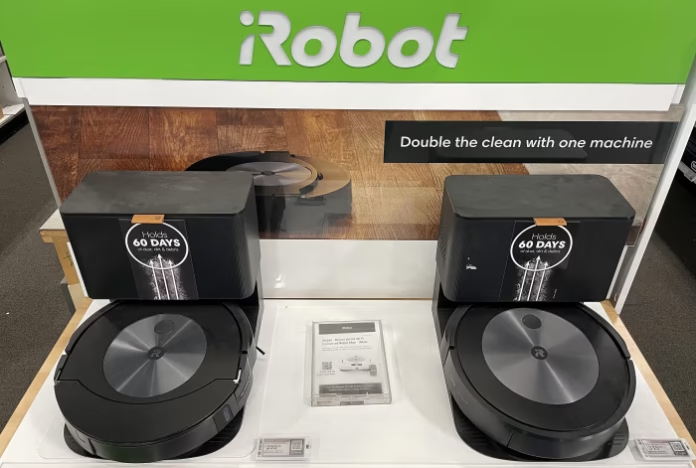

iRobot bankruptcies have officially entered the record as the once-dominant robotics company behind the Roomba vacuum moves through Chapter 11 restructuring in the United States. The filing represents a major transformation for a brand that helped introduce autonomous cleaning technology into millions of American homes. While the company continues operating, the restructuring reshapes ownership, investor outcomes, and iRobot’s long-term position in a fiercely competitive global market.
From Robotics Pioneer to Financial Restructuring
iRobot’s story is closely tied to the rise of consumer robotics in the U.S. Founded in 1990, the company built its reputation on advanced engineering and real-world applications of autonomous technology. Early work in robotics eventually gave way to household innovation, culminating in the launch of the Roomba robotic vacuum.
That product alone changed consumer expectations. For the first time, a mainstream device could clean floors independently, navigating around furniture and adapting to home layouts. Over the years, Roomba models evolved with improved sensors, mapping, connectivity, and app-based controls. The brand became so recognizable that “Roomba” was often used generically to describe robotic vacuums.
Despite this legacy, the business environment around iRobot changed rapidly. Market conditions shifted, competition intensified, and financial pressures mounted. The Chapter 11 filing confirms how difficult it has become for even established technology brands to sustain growth without structural change.
The Confirmed Chapter 11 Process
iRobot filed for Chapter 11 bankruptcy protection in the U.S. Bankruptcy Court for the District of Delaware in mid-December 2025. The filing allows the company to restructure its financial obligations while continuing to operate its business.
Unlike liquidation, Chapter 11 is designed to preserve enterprise value. iRobot remains active, shipping products, supporting customers, and maintaining its workforce during the court-supervised process. The restructuring centers on a pre-arranged agreement with the company’s primary manufacturer and secured lender, Shenzhen Picea Robotics Co., Ltd., along with its affiliated entity.
Under this plan, iRobot’s outstanding debt will be converted into ownership, resulting in full control transferring to Picea once the restructuring is finalized. The transition is expected to conclude in early 2026, subject to court approval.
End of an Era as a Public Company
One of the most significant outcomes of the restructuring is iRobot’s exit from public markets. After decades as a publicly traded company, its shares will be delisted, and existing equity interests will be canceled.
For shareholders, this outcome represents a complete loss of investment value. While difficult, this step clears the company’s balance sheet and reduces long-term financial strain. From the company’s perspective, moving into private ownership under a strategic manufacturing partner provides stability and operational backing that was no longer available through public markets.
This shift also reflects broader trends in the technology sector, where hardware companies face increasing difficulty meeting investor expectations while navigating pricing pressure and rising costs.
Why Financial Pressure Became Unavoidable
Several interconnected factors led iRobot to this point.
A previously announced acquisition agreement with a major technology company collapsed after extended regulatory scrutiny. That deal was expected to deliver both capital and strategic alignment. When it failed, iRobot was left without a crucial growth path and had to continue independently with limited resources.
Revenue declines followed. Sales slowed as consumers faced broader economic pressures and as competitors flooded the market with lower-priced alternatives. Operating losses widened, and cash reserves shrank, making it increasingly difficult to fund operations and future development.
Competitive dynamics played a major role. Manufacturers from overseas entered the U.S. market aggressively, offering robotic vacuums with similar features at significantly lower prices. This undercut iRobot’s ability to maintain premium pricing, compressing margins and weakening its financial position.
At the same time, manufacturing and logistics costs remained elevated. Tariffs, supply chain complexity, and production expenses further eroded profitability. These conditions combined to make a restructuring unavoidable.
What the Restructuring Means for Employees and Partners
During the Chapter 11 process, iRobot continues to employ its workforce and honor commitments to suppliers and partners. Employee wages and benefits remain in place, and the company operates under court authorization to maintain normal business functions.
Supplier relationships are particularly important. With manufacturing central to iRobot’s business, continuity ensures that products continue to reach retailers and consumers without interruption. The involvement of the primary manufacturing partner as the future owner is designed to strengthen this continuity rather than disrupt it.
This structure distinguishes iRobot’s bankruptcy from scenarios where operations cease or assets are sold off piecemeal.
Impact on Consumers and Product Support
For customers, the immediate concern is whether the restructuring affects product usability. Based on confirmed company actions, iRobot devices remain fully functional, and customer-facing services continue.
Key areas expected to remain stable include:
- Mobile app functionality and cloud services
- Software and firmware updates
- Customer support and service channels
- Warranty coverage under existing policies
This continuity is especially important for connected devices that rely on ongoing software support. iRobot has made it clear that maintaining customer trust is essential during the restructuring period.
Consumers should not experience interruptions in daily use, nor should they need to replace devices due to the bankruptcy process.
What This Signals for the Robotics Market
The restructuring highlights broader realities in the consumer robotics industry. Innovation alone is no longer enough to guarantee long-term success. Pricing pressure, global manufacturing efficiency, and scale now play decisive roles.
iRobot’s challenges mirror those faced by many U.S. hardware companies competing in global markets. As technology matures, differentiation becomes harder, and cost advantages can outweigh brand recognition.
At the same time, the market for robotic vacuums remains active. Demand for smart home devices continues, but consumer expectations around affordability and performance have shifted. Companies must now balance advanced features with accessible pricing to stay competitive.
The Role of New Ownership
With ownership transferring to Picea, iRobot enters a new phase. The company gains a parent organization deeply embedded in manufacturing, supply chain management, and cost control. This relationship may allow iRobot to streamline operations and stabilize production.
The Roomba brand remains a powerful asset. Brand recognition, existing customer loyalty, and intellectual property still hold value. How these assets are managed under new leadership will determine whether iRobot can reestablish itself as a sustainable competitor.
While the restructuring does not promise immediate growth, it provides breathing room and structural support that were no longer available under the previous financial model.
Long-Term Outlook After Chapter 11
Once the Chapter 11 process concludes, iRobot will emerge as a privately held company with a restructured balance sheet. Reduced debt obligations may allow for more disciplined investment decisions and clearer strategic focus.
Future priorities are likely to include cost efficiency, product reliability, and selective innovation rather than aggressive expansion. The goal will be to operate profitably in a crowded market rather than dominate it at any cost.
For U.S. consumers, the Roomba brand is likely to remain present, though its trajectory may be more measured than in earlier decades.
Why iRobot’s Restructuring Matters
The confirmation of iRobot bankruptcies serves as a case study in how legacy technology companies must adapt to survive. It underscores the risks of rapid market shifts, intense competition, and reliance on high-stakes corporate deals.
At the same time, it shows that bankruptcy does not necessarily mean failure. For iRobot, Chapter 11 represents a reset—an opportunity to preserve a well-known brand while acknowledging financial realities.
As the restructuring progresses and ownership officially changes, iRobot’s next chapter will be defined by execution, discipline, and its ability to meet modern consumer expectations in an unforgiving market.