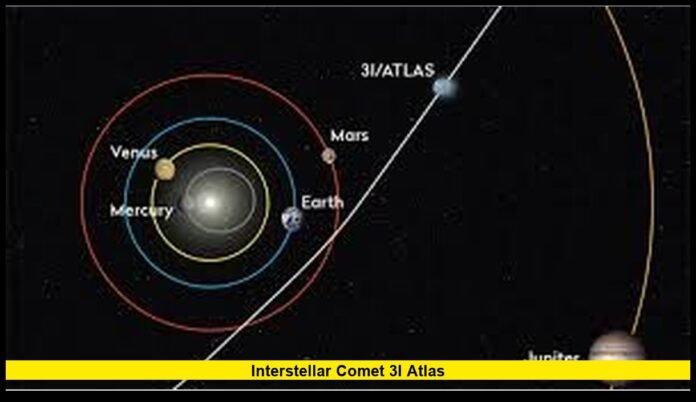

The arrival of interstellar comet 3I/ATLAS has captured the attention of astronomers and sky-watchers across the United States. Discovered in July 2025, this extraordinary object is only the third confirmed interstellar visitor ever recorded passing through our solar system — and recent observations are providing fresh insight into its origin, behaviour and future.
What Is Interstellar Comet 3I/ATLAS?
In July 2025, the Asteroid Terrestrial-impact Last Alert System (ATLAS) in Chile detected an object designated C/2025 N1 (ATLAS). Further analysis revealed that it follows a hyperbolic trajectory, meaning it is not bound by the Sun’s gravity and is travelling through the solar system from beyond. That designation led to the title 3I/ATLAS — “3I” standing for the third interstellar object.
With an inbound speed significantly higher than previous interstellar objects (~130,000 mph or more), 3I/ATLAS entered the inner solar system at a tilt and velocity that told scientists it came from far beyond our own system. Its origin lies somewhere in the distant stars, likely ejected from its home star system eons ago.
Key Characteristics and Recent Findings
Orbit and Approach
- 3I/ATLAS passed perihelion (closest to the Sun) around late October 2025 at about 1.36 astronomical units (AU) from the Sun — roughly 130 million miles.
- It will not come closer than around 1.8 AU (170 million miles) to Earth, so there is no threat to our planet.
- Its orbit is retrograde and shows a high eccentricity, confirming it is making a one-time pass through our solar system rather than settling into an orbit.
Composition and Activity
- Spectroscopic analysis indicates 3I/ATLAS is unusually rich in carbon dioxide (CO₂) relative to water vapour compared to typical solar system comets.
- Dust particle studies suggest larger grains dominate the coma (the cloud of gas and dust around the nucleus), hinting at different formation or ageing processes.
- Novel observations have revealed evidence that the object may have undergone heavy exposure to cosmic rays, signaling that it travelled for billions of years in interstellar space.
Behaviour and Anomalies
- The comet exhibited non-gravitational acceleration — small deviations in its path likely caused by jets of gas expelled from its surface.
- Observers have noted an anti-tail phenomenon in recent images — a tail pointed toward the Sun instead of directly away, an effect typically caused by large dust grains and specific viewing geometry.
- Some astronomers suggest a rapid brightening and possible fragmentation during perihelion, which could point to structural changes or partial breakup under solar heating.
Why It Matters to U.S. Observers
For astronomy enthusiasts in the U.S., 3I/ATLAS offers a rare chance to study a visitor not from our solar system. U.S. observatories at sites like Flagstaff (Arizona), Mauna Kea (Hawaii), and other locations are actively tracking the comet and contributing key data. Amateur astronomers with moderate telescopes can also participate now that the object is re-emerging in morning skies.
Beyond viewing, the scientific implications for U.S. research communities are substantial:
- Understanding interstellar objects helps refine models of how material is exchanged between star systems.
- It deepens knowledge about comet composition and evolution — comparing local comets with one born around another star.
- It offers potential clues to pre-solar system environments and the building blocks of planets across the galaxy.
How to Spot 3I/ATLAS in the Sky
Here’s a simple guide for U.S. sky-watchers:
- When: Early morning twilight from November through December 2025.
- Where: Look to the east before dawn, under a clear horizon and minimal light pollution.
- Equipment: A telescope with at least a 6-inch aperture or strong binoculars will help.
- What to expect: A faint, fuzzy patch of light (magnitude ~10-12) rather than a bright streak or dramatic tail.
While naked-eye visibility is unlikely, the chance to capture a comet from another star system is rare and rewarding for dedicated observers.
What We’re Learning — and What’s Next
Insights Already Gained
- The high CO₂ ratio suggests formation in an extremely cold, outer region of its original star system — far colder than most comets we know.
- The non-gravitational jets provide direct evidence of active behaviour for centuries-old interstellar bodies.
- The potential fragmentation during perihelion may reveal how aging comets break apart when subjected to increased solar heating.
Upcoming Observations
- Space-based telescopes such as Hubble and the upcoming JWST (James Webb Space Telescope) are scheduled to observe 3I/ATLAS as it recedes.
- Ground observatories will continue to monitor tail morphology, dust grain size, and gas emission patterns to track how the comet evolves as solar heating decreases.
- Researchers are modelling backward the comet’s path to infer the type of star system it came from, though a precise origin remains elusive.
Putting 3I/ATLAS in Context
Here’s how 3I/ATLAS compares to the previous interstellar visitors:
| Object | Discovery Year | Type | Notable Feature |
|---|---|---|---|
| 1I/ʻOumuamua | 2017 | Asteroid-like | Highly elongated, bizarre light curve |
| 2I/Borisov | 2019 | Comet | Typical comet behaviour, extrasolar source |
| 3I/ATLAS | 2025 | Comet | Large size, high CO₂ ratio, fragmentation |
The fact that 3I/ATLAS behaves like a comet but with distinctly different traits emphasizes the diversity of material in our galaxy and the value of observing each interstellar visitor in detail.
Challenges & Considerations
Despite its intrigue, observing and interpreting 3I/ATLAS presents challenges:
- Its brightness is modest, so only well-equipped observers under dark skies will capture meaningful detail.
- The window for optimal viewing is limited; its solar elongation will increase and it will gradually fade in brightness.
- Origin-tracking remains speculative; even with advanced modelling, pinning down its parent star system may remain out of reach.
Takeaway for U.S. Audience
For U.S. readers, this is a moment of both spectacle and science. From backyard telescopes to flagship observatories, Americans have a front-row seat to a cosmic event that stretches far beyond our solar neighbourhood. The arrival of interstellar comet 3I/ATLAS reminds us that our Sun’s domain is not isolated — material from distant stars can and does pass through, offering a chance to glimpse what lies beyond.
If you have access to a telescope, particularly before daylight, consider pointing east-northeast before sunrise toward the faint glow of 3I/ATLAS. And whether you catch a glimpse or follow the science, this is a story worth watching as the comet fades into interstellar space once more.
Have you spotted interstellar comet 3I/ATLAS yet, or are you planning to try? Share your experience and stay tuned for more updates as this rare interstellar visitor continues its journey.