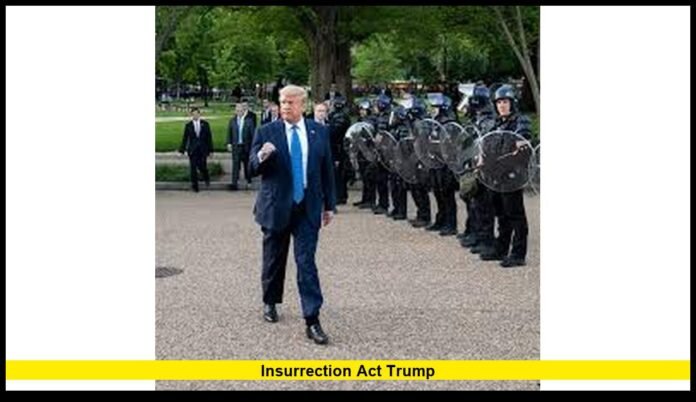

Insurrection Act Trump entered the national spotlight after President Donald Trump warned he could use the centuries-old law to deploy military forces inside the United States following escalating protests tied to federal immigration operations in Minneapolis. The statement immediately reignited debate over the limits of executive power, the role of the armed forces in domestic affairs, and the constitutional balance between federal and state authority.
The warning came amid growing confrontations between demonstrators and federal officers, particularly around Immigration and Customs Enforcement facilities and other government buildings. As crowds swelled and tensions intensified, the White House argued that local leaders were failing to protect federal personnel and ensure the enforcement of federal law. State officials countered that heavy-handed federal tactics had fueled unrest and that military involvement would only deepen the crisis.
Why the Insurrection Act Holds Such Power
The Insurrection Act, first enacted in 1807, gives the president authority to deploy the U.S. military or federalize state National Guard units within the country under narrowly defined conditions. These conditions include situations where state authorities cannot or will not suppress rebellion, protect constitutional rights, or enforce federal law.
Under normal circumstances, U.S. law sharply restricts the use of the military in civilian law enforcement. The Insurrection Act stands as one of the few legal exceptions, allowing troops to assist in policing, securing infrastructure, and restoring order when civil institutions are overwhelmed or paralyzed.
Because the law permits actions that would otherwise be unconstitutional, its use carries profound legal and political weight. Any move to activate it signals that the federal government believes civil order has broken down to an extraordinary degree.
Events That Led to Trump’s Warning
In Minneapolis, federal immigration operations in densely populated neighborhoods sparked large demonstrations. Protesters accused federal agencies of conducting aggressive raids and detentions, while federal officials reported interference with lawful operations and threats to officers.
As crowds grew, incidents included:
- Blockades of streets surrounding federal facilities
- Attempts to prevent the transport of detainees
- Physical confrontations between demonstrators and officers
- Vandalism and damage to government property
The White House publicly stated that federal law enforcement was operating under dangerous conditions and that state and city leaders were not doing enough to guarantee access, security, and operational continuity.
It was in this context that President Trump warned that the federal government could invoke the Insurrection Act if order was not restored and if federal functions continued to be obstructed.
What Invoking the Law Would Allow
If the Insurrection Act were formally activated, the president could:
- Deploy active-duty Army or Marine units to U.S. cities
- Place state National Guard units under federal command
- Authorize troops to assist in arrests and crowd control
- Secure federal buildings, courts, and detention centers
- Support immigration enforcement operations directly
Such actions would place military personnel in direct contact with civilians, a scenario rarely seen in modern American history outside natural disasters or extraordinary emergencies.
Federal Justification for Considering Its Use
Administration officials framed the potential use of the law as a matter of constitutional obligation. The federal government, they argued, must ensure that its laws can be executed and that its officers can perform their duties without intimidation or obstruction.
From this perspective:
- Immigration enforcement is a federal responsibility
- Federal facilities must remain accessible and secure
- Attacks on officers constitute interference with national authority
- State inaction can trigger federal intervention
The president’s authority under the Insurrection Act does not require a governor’s request if federal law is being blocked. That legal structure gives the executive branch unilateral power to act when it determines that state protections have failed.
Resistance From State and City Leadership
Minnesota officials strongly opposed any suggestion of military deployment. They argued that:
- Local police and the state National Guard were capable of maintaining order
- Federal operations had escalated tensions unnecessarily
- Military involvement would intimidate communities and inflame protests
- Civilian control should remain in civilian hands
City leaders also warned that the presence of soldiers in residential areas could deepen fear, discourage lawful protest, and create conditions for accidental violence.
The standoff reflected a deeper disagreement over who defines “failure of order” and at what point federal authority should override state governance.
Civil Liberties and Public Concern
The prospect of invoking the Insurrection Act Trump raised immediate alarms among civil rights advocates. Their concerns centered on:
- The risk of excessive force by troops trained for combat, not policing
- Potential suppression of peaceful assembly
- Blurring the constitutional line between military and civilian authority
- Long-term precedents for executive power during unrest
Supporters of the administration countered that the Constitution obligates the federal government to act when federal law is under sustained attack and that the Insurrection Act exists precisely for such scenarios.
Historical Use and Modern Sensitivity
While the law has been used in the past, its application has always followed intense national crises. Presidents invoked it during the struggle to enforce school desegregation, during large-scale urban riots, and when state authorities openly resisted federal court orders.
In each case, the justification rested on two claims: that constitutional rights were being denied and that state governments were either unwilling or unable to correct the situation.
What makes the current situation distinct is the political and social environment. Immigration enforcement, mass protest movements, and deep partisan divisions create a context in which any military involvement would carry symbolic and practical consequences far beyond the immediate security objective.
The Role of the National Guard
One alternative to deploying active-duty forces would be federalizing the Minnesota National Guard. Under this arrangement:
- Guard units would remain in the state but answer directly to the president
- Federal command could assign them to protect federal sites
- State leaders would temporarily lose operational control
- Guardsmen could assist in law-enforcement duties
This option is often seen as less extreme than sending in regular Army units, yet it still represents a significant shift in authority and responsibility.
Congressional and Judicial Oversight
Any formal invocation of the Insurrection Act would likely prompt immediate scrutiny from Congress and the courts. Lawmakers could hold hearings, request legal opinions, and seek to clarify or limit executive authority.
Courts, while historically deferential in matters of national security and public order, could be asked to determine whether the legal conditions for deployment had truly been met.
The outcome of such challenges would shape not only the current situation but also future interpretations of presidential power during domestic crises.
Impact on Communities
For residents of Minneapolis, the debate is not abstract. The possibility of soldiers patrolling streets raises concerns about:
- Daily life under heightened security
- The safety of children, schools, and workplaces
- The treatment of demonstrators and bystanders
- Long-term trust between communities and the government
Local leaders have emphasized that stability depends on dialogue, de-escalation, and respect for civil rights, rather than military presence.
National Political Consequences
The Insurrection Act Trump warning has become a defining issue in the broader national conversation about governance, authority, and democracy.
Supporters view the stance as a demonstration of strength and constitutional resolve. Critics see it as a step toward normalizing military involvement in political disputes.
The controversy intersects with larger questions about immigration policy, executive power, and the proper limits of federal intervention in local affairs.
Current Situation
As of now, the law has not been formally activated. Federal and state authorities continue to operate under existing legal frameworks, with law enforcement managing demonstrations and securing facilities.
However, the warning remains on the table. The administration has not withdrawn the possibility of invoking the statute if conditions worsen or if federal operations face sustained obstruction.
What Would Trigger a Final Decision
Factors that could influence whether the Insurrection Act is ultimately used include:
- Escalation in violence or destruction of federal property
- Serious injury or loss of life among federal personnel
- Breakdown of coordination between state and federal agencies
- Court rulings affecting the legality of ongoing operations
- Political negotiations that either ease or intensify tensions
Each development would be weighed against the legal thresholds written into the statute and the political consequences of crossing them.
Why This Moment Is a Turning Point
The current debate goes beyond one city or one set of protests. It tests how the United States defines internal security in an era of mass mobilization, polarized politics, and expanding federal authority.
The decision of whether to invoke the Insurrection Act Trump carries implications for:
- The future role of the military in domestic crises
- The balance of power between Washington and the states
- The protection of constitutional rights during unrest
- Public trust in democratic institutions
How this moment is resolved will shape legal interpretations and political expectations for years to come.
The nation now watches closely as federal and state leaders navigate a situation where law, order, and liberty intersect under intense pressure.
Stay connected as this story develops and share your perspective on how the Constitution should guide the use of federal power in times of civil unrest.