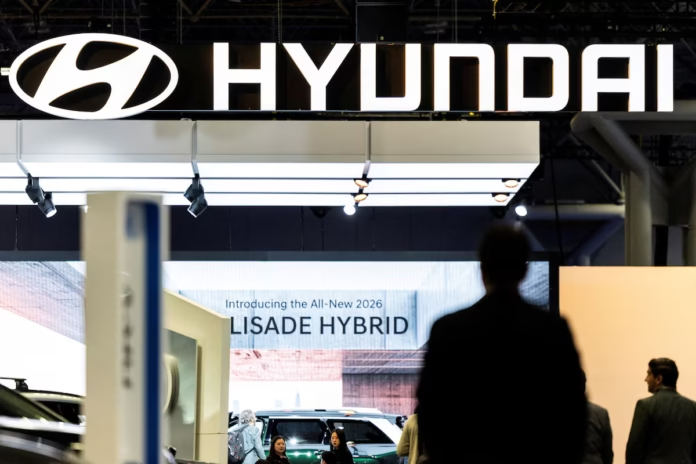

Hyundai Motor announces US$86bil investment in South Korea in a move that marks one of the largest financial commitments ever made by the country’s leading automotive group. The investment, planned for the years 2026 through 2030, reinforces the company’s intention to elevate South Korea as the core hub for its manufacturing, technology development, and global export strategy. With a new trade environment reshaping automotive economics—especially between the U.S. and South Korea—Hyundai’s multiyear investment plan positions the company for long-term competitiveness and technological leadership.
The announcement has captured global attention because it highlights a pivotal shift in Hyundai’s strategy. Instead of dispersing production across multiple regions, Hyundai is doubling down on its home base, aiming to turn South Korea into a powerhouse for innovation, electric-vehicle advancement, artificial intelligence integration, and large-scale exports. For a U.S. audience, the move is particularly significant because shifting production patterns and tariff changes will shape what vehicles arrive in American dealerships and how competitively they are priced.
A Comprehensive Breakdown of the Investment
Hyundai’s five-year, US$86-billion plan is not a single-track initiative. It’s a broad, multilayered investment blueprint designed to update factories, reinforce the supply chain, expand research capabilities, and accelerate the development of future mobility technologies.
The total amount is divided into three major branches:
- Future Business & AI Development: 50.5 trillion won will support cutting-edge mobility solutions, smart-vehicle technologies, autonomous-system upgrades, and artificial intelligence integration across Hyundai’s ecosystem.
- Research and Development: 38.5 trillion won will enhance next-generation vehicle development, including EV platforms, advanced safety systems, electric-drivetrain innovation, and software-defined vehicle programs.
- Manufacturing & Infrastructure Expansion: 36.2 trillion won is allocated for factory upgrades, new production facilities, and a major infrastructure project designed to modernize Hyundai’s operations.
For context, Hyundai’s last major multi-year investment cycle was between 2021 and 2025, during which the company invested 89.1 trillion won domestically. The new package surpasses that by a wide margin, showing the company’s heightened commitment to creating a technologically advanced and globally influential manufacturing base in South Korea.
Why the Investment Matters to U.S. Readers
Although the investment is happening in South Korea, its ripple effects will be felt strongly in the United States. Hyundai’s global business strategy is tightly connected to American market demand, U.S. auto regulations, and the country’s increasing shift toward electric vehicles and smart mobility.
Here are the key implications for U.S. consumers and the American automotive industry:
More Competitive Vehicle Pricing and Availability
A new trade agreement has lowered tariffs on South Korean-made vehicles exported to the United States. Because of this, Hyundai now sees greater value in producing vehicles in Korea and exporting them to the U.S. If production becomes more cost-efficient, U.S. consumers may experience:
- Increased model availability
- Faster delivery timelines
- More competitive pricing in certain segments
This could affect everything from sedans and SUVs to EVs, especially models that are traditionally manufactured in Korea before being brought stateside.
Stronger Competition in the EV Market
Hyundai is already among the most aggressive global players when it comes to electric-vehicle development. By investing heavily in R&D and AI technology in Korea, the company is likely to bring more advanced EV models to the American market in the coming years. This puts pressure on U.S. automakers to accelerate their innovation cycles.
A Shifting Global Supply Chain
Hyundai’s renewed emphasis on Korean manufacturing will influence how the company collaborates with suppliers worldwide. This may result in new supply-chain patterns involving technology components, battery systems, and advanced vehicle electronics—many of which ultimately flow into U.S.-bound vehicles.
The Strategic Drivers Behind Hyundai’s Decision
Hyundai’s investment isn’t just an internal push to modernize its facilities—it’s a response to several global automotive trends and economic shifts.
A Changing Trade Landscape
Reduced U.S. tariffs on South Korean vehicles have reshaped cost structures and export dynamics. With lower barriers, Korean-built vehicles are more competitive in the U.S. market. Hyundai is optimizing its strategy accordingly.
Strengthening Its Domestic Supplier Network
Hyundai relies on a large network of South Korean parts manufacturers. Many have been under pressure as global trade conditions fluctuate. The company’s new investment plan includes support measures for suppliers to ensure they can meet increasing demand and technological expectations.
Preparing for Mobility 2.0
The automotive industry is evolving into a mobility-focused ecosystem blending:
- Connected-vehicle systems
- AI-powered driving features
- Electric powertrains
- Data-driven services
Hyundai wants South Korea to become its global control center for this transformation.
Future-Proofing Its Manufacturing
The company aims to double auto exports from South Korean factories by 2030. To do this, Hyundai must modernize its factories, adopt smart-production technologies, and boost volume capability while keeping costs efficient.
A Deeper Look at the Manufacturing Transformation
One of the most notable components of the investment is the massive upgrade to Hyundai’s production facilities. These upgrades will include:
- Smart factory systems
- Automated quality-control processes
- High-tech EV production lines
- Advanced robotics
- Eco-friendly manufacturing technologies
The future Hyundai factory will be able to build not only traditional internal-combustion vehicles but also a wide range of electric and hybrid models.
This is critical because global demand for EVs is climbing rapidly. As battery production scales and technology matures, Hyundai aims to use its updated Korean plants as benchmark facilities for efficiency, innovation, and output quality.
Impact on U.S. Auto Buyers and the Market Landscape
The investment affects American drivers in several meaningful ways:
Broader EV Choices
Hyundai has increasingly targeted U.S. consumers with a variety of EV options. With new R&D investments supporting advanced EV technologies, upcoming models may feature:
- Faster charging
- Better range
- Smarter software
- Improved battery durability
- More competitive pricing
More Innovation in Vehicle Technology
With tens of billions being invested into AI and future mobility, U.S. drivers can expect the rollout of more advanced drivers-assistance systems and emerging connected-services platforms.
Competitive Pressure on U.S. Brands
When a major player invests heavily in cutting-edge technologies and advanced manufacturing, other automakers have to respond. Hyundai’s move may influence the pace of innovation among American competitors.
How This Investment Shapes Hyundai’s Global Vision
Hyundai’s long-term strategy is increasingly centered around three pillars:
- Technological leadership
- Electrification and sustainability
- Globally integrated manufacturing and export strength
By anchoring these pillars in South Korea, Hyundai is signaling that it wants its homeland to remain its primary competitive advantage. For the U.S., this means continuing to receive high-quality exports backed by some of the world’s most heavily funded automotive R&D programs.
What U.S. Industry Observers Should Watch Next
The next few years will reveal how Hyundai’s investment affects the American automotive ecosystem. Key areas to watch include:
- The types of new vehicles Hyundai exports to the U.S.
- Whether U.S. pricing trends shift
- How U.S. competitors respond with their own EV and smart-car strategies
- Whether Hyundai adjusts its manufacturing footprint inside the United States
- Progress updates on AI, battery systems, and mobility innovations developed in Korea
The U.S. remains one of Hyundai’s most important global markets, so the influence of this investment will be closely monitored across the industry.
A Turning Point for Global Mobility
The announcement that Hyundai Motor announces US$86bil investment in South Korea represents more than a financial commitment—it underscores Hyundai’s determination to lead the global transition toward electric, intelligent, and sustainable mobility. It also highlights how interconnected the U.S. and South Korean automotive landscapes have become.
As the industry evolves, Hyundai’s decision to root its most ambitious innovations at home in Korea will shape what American consumers drive, what technologies they experience, and how competitive the market becomes.
What are your thoughts on Hyundai’s massive investment and how it might shape the future of cars in the U.S.? Share your view below or check back for more updates as the story develops.