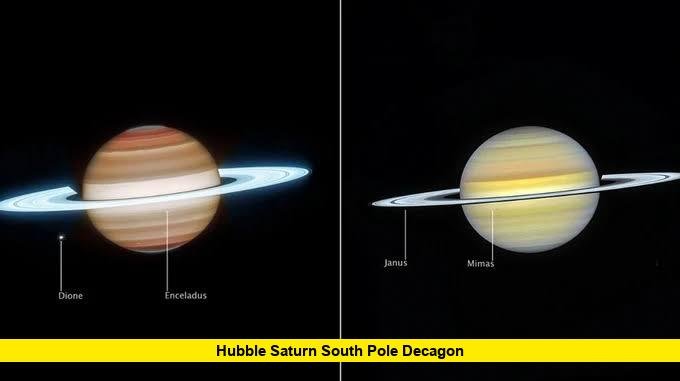

Hubble Saturn south pole decagon observations have revealed a giant, evolving 10-sided atmospheric wave around Saturn’s southern polar region, giving scientists the first confirmed view of a large regular-sided jet pattern in the planet’s southern hemisphere. NASA released the latest findings on September 2, 2026, following research published in Science Advances.
The discovery is particularly striking because Saturn is already famous for its enormous six-sided atmospheric pattern at the north pole. Scientists have now identified a very different geometric structure at the opposite pole. The newly observed decagon appears to be changing over time rather than remaining nearly stationary like the northern hexagon.
The research team describes the feature as a large atmospheric wave embedded within one of Saturn’s powerful jet streams. Hubble observations indicate that the structure extends through multiple atmospheric layers, making it more than a simple feature visible at a single cloud level.
What Is the Saturn South Pole Decagon?
A decagon is a geometric shape with 10 sides. In Saturn’s atmosphere, however, the newly identified structure is not a solid object or a sharply defined physical boundary.
It is an atmospheric wave that creates a striking 10-sided pattern within a high-speed jet stream. The wave is centered around approximately 63 degrees south latitude, while the research identifies the broader decagonal pattern across roughly 58 to 63 degrees south.
The structure became increasingly apparent when researchers compared Hubble observations collected over several years. Images from 2023 and 2024 already contained weaker indications of the pattern, while observations made later showed a much clearer decagonal form.
That progression is one of the most important aspects of the discovery. Astronomers are not simply looking at an unusual shape frozen in Saturn’s atmosphere. They have an opportunity to watch a large atmospheric pattern develop and change.
Hubble Confirmed the Pattern in Saturn’s Southern Hemisphere
The Hubble Space Telescope played a central role in confirming the discovery because it can observe Saturn above Earth’s atmosphere. That gives researchers sharper views of the planet than ground-based telescopes can normally provide.
The new findings come from Hubble’s Outer Planet Atmospheres Legacy, or OPAL, program. OPAL has monitored the outer planets, including Saturn, over many years and provides a valuable record for comparing atmospheric changes over time.
Hubble data confirmed that the decagon was already present in 2023. Researchers then compared those observations with subsequent images to determine how the pattern changed.
A particularly clear image came from Hubble observations on August 29, 2025. The Wide Field Camera 3 captured Saturn’s southern polar region through multiple filters. One wavelength produced a strong view of the 10-sided wave surrounding the darker central polar region.
The observations were released publicly in September 2026 alongside the new scientific findings.
The Decagon Was First Noticed in Ground-Based Images
Although Hubble provided crucial confirmation, the discovery did not begin entirely with the space telescope.
Agustín Sánchez-Lavega, a researcher at the University of the Basque Country in Spain and lead author of the study, examined planetary images submitted to the university’s Planetary Virtual Observatory Laboratory.
In 2024, images submitted by amateur astronomers Trevor Barry and Jean-Paul Oger contained a subtle disturbance along Saturn’s southern polar region. Researchers later recognized that the feature could be connected to the unusual structure visible in Hubble data.
Additional ground-based observations from 2025 strengthened the evidence for the developing decagon.
This combination of observations proved valuable. Ground-based astronomers helped identify the unusual atmospheric feature, while Hubble offered the resolution and consistency needed to examine it in greater detail.
Why Scientists Had Not Seen the Decagon Earlier
One major reason the feature escaped earlier detection involves Saturn’s changing seasons.
Saturn’s south pole was gradually turned away from Earth’s view beginning around 2012. The southern polar region did not return to favorable visibility until roughly 2023. This created an important observational gap.
There was also no spacecraft continuously monitoring Saturn during that period. NASA’s Cassini mission, which spent years studying Saturn and its moons, ended in 2017 when the spacecraft entered Saturn’s atmosphere. Researchers therefore had no close-up spacecraft observations covering the entire interval between Cassini’s final observations and the return of the south pole to Earth-based view.
Because of that gap, scientists cannot identify the exact moment when the decagon began forming.
The available observations establish that it existed by 2023. Researchers therefore consider the interval between 2017 and 2023 an important period for understanding its development, but the exact formation date remains unknown.
How the Saturn Decagon Differs From the Famous Northern Hexagon
The newly discovered structure naturally invites comparison with Saturn’s famous northern hexagon.
The two patterns share important characteristics. Both are atmospheric waves associated with powerful jet streams, and both produce large polygon-like shapes.
Yet the differences are just as significant.
| Feature | Northern Hexagon | Southern Decagon |
|---|---|---|
| Number of sides | Six | Ten |
| Location | Saturn’s north pole | Saturn’s south polar region |
| Long-term behavior | Nearly stationary | Moves eastward |
| Observation history | Known for more than 40 years | Confirmed in recent observations |
| Atmospheric setting | Powerful jet stream | Powerful jet stream |
| Current behavior | Long-lived and stable | Evolving and strengthening |
Saturn’s northern hexagon was first identified in observations from NASA’s Voyager spacecraft in the 1980s. Decades of observations have shown that it remains remarkably persistent.
The southern decagon is different. Researchers have measured an eastward movement of approximately 2.5 meters per second, or about 6 miles per hour. Its vertices also shift over time rather than maintaining the same fixed configuration.
Those differences indicate that the two polygonal atmospheric waves may not operate in exactly the same way.
The Decagon Is Much Larger Than It May Look
The Saturn south pole decagon is an enormous atmospheric structure.
Reports on the research indicate that a single side of the developing pattern already extends more than 10,000 miles, or approximately 16,700 kilometers. That scale makes the feature vastly larger than anything comparable in Earth’s atmosphere.
The immense size reflects Saturn’s atmospheric environment. The planet rotates rapidly and has powerful jet streams capable of organizing atmospheric disturbances across enormous distances.
Rather than behaving like a small storm, the decagon represents a planetary-scale wave interacting with Saturn’s atmospheric circulation.
The Decagon Extends Through Multiple Atmospheric Layers
Another important discovery came from observing Saturn through different wavelengths of light.
Hubble does not simply produce a two-dimensional picture of Saturn’s clouds. Different filters can reveal atmospheric material at different altitudes.
Researchers found that the apparent position of the decagonal pattern changes slightly depending on the wavelength used. This indicates that the structure has a three-dimensional component and extends through multiple layers of Saturn’s atmosphere.
The visible portion of the wave is associated with Saturn’s upper troposphere. The surrounding winds move at hundreds of kilometers per hour, illustrating the enormous atmospheric dynamics involved.
That vertical structure is especially useful to scientists because it can provide information about atmospheric circulation below the level that is immediately visible.
Why Is the Decagon Moving?
Scientists have measured the decagon moving eastward at about 2.5 meters per second.
That movement distinguishes it from Saturn’s northern hexagon, which remains nearly stationary relative to Saturn’s interior rotation.
The decagon also shows oscillations in the longitudes of its vertices. The scientific study reports a period of approximately 32 days, with oscillation amplitudes ranging from about 4.6 to 8.4 degrees.
Researchers interpret these characteristics as evidence that the feature may be a large-scale meandering atmospheric wave trapped within Saturn’s jet stream.
The jet itself moves much faster. The study reports winds of approximately 116 meters per second around 60.5 degrees south latitude. The difference between the speed of the jet and the much slower movement of the decagon is an important clue to its atmospheric behavior.
What Could Have Created the Saturn South Pole Pattern?
Scientists have not yet established exactly why the decagon formed.
The peer-reviewed study presents possible mechanisms rather than a confirmed single explanation. Computer simulations indicate that a periodic disturbance in the jet stream could have produced the wave. Another possibility involves a dark anticyclonic vortex located immediately north of the jet.
These possibilities remain part of the scientific investigation.
Researchers are particularly interested in why Saturn developed this southern polygonal wave now, after decades of observations failed to reveal a comparable feature.
The timing is especially intriguing because Saturn’s north and south poles do not appear to behave identically despite the planet’s broad north-south atmospheric symmetry.
The Research Published in Science Advances
The discovery has now moved beyond preliminary observations.
The research paper, titled A decagon wave around Saturn’s south pole, was published in Science Advances in September 2026. The paper lists Agustín Sánchez-Lavega, Amy A. Simon, Michael H. Wong, Leigh N. Fletcher and other planetary scientists among its authors.
The study is an observational research paper based on ground-based and Hubble Space Telescope observations.
Its findings establish the presence of the decagonal wave and describe its movement, oscillation, latitude range and atmospheric structure. The research also uses shallow-water modeling to investigate possible origins of the pattern.
This distinction matters because the discovery is now supported by published scientific analysis rather than simply being an unusual image circulating online.
What Scientists Still Do Not Know
Several questions remain unanswered.
Scientists know that the decagon existed by 2023 and became increasingly distinct in later observations. They do not know precisely when it first formed.
They also do not yet know how long the pattern will survive.
The northern hexagon has persisted for more than four decades of observations. The southern decagon has a much shorter observed history and is already showing movement and changes in shape.
Researchers therefore need continued observations to determine whether the feature will remain a temporary atmospheric phenomenon or become a long-lived structure.
Another unanswered question concerns why Saturn can produce such striking polygonal waves. Atmospheric waves occur on other planets, but Saturn has demonstrated a particularly unusual ability to organize them into geometric patterns.
Future Observations Could Reveal More
The newly discovered structure gives planetary scientists a rare opportunity to observe a large atmospheric feature while it is changing.
NASA researchers expect continued observations with Hubble to be valuable. The James Webb Space Telescope may also contribute observations that help scientists examine Saturn’s atmosphere at different wavelengths.
Computer modeling will remain another important part of the investigation. Researchers can compare simulated jet-stream disturbances with the actual movement and shape of the decagon.
Future observations could help establish whether the structure becomes more stable, weakens, changes its number of visible sides or eventually disappears.
For now, the most important finding is that Saturn’s southern atmosphere is capable of producing a large regular-sided wave that resembles the planet’s famous northern polygon while behaving differently.
What the Hubble Discovery Means for Saturn Science
The discovery changes the picture of Saturn’s polar atmosphere.
For decades, the northern hexagon stood as the planet’s signature atmospheric polygon. Scientists knew of no equivalent large-scale regular-sided feature in Saturn’s southern hemisphere.
The new observations show that Saturn’s atmospheric dynamics can produce another extraordinary geometric pattern, but one with different characteristics.
The decagon is not simply a second copy of the northern hexagon. It moves, evolves and appears to have formed relatively recently. Its presence also demonstrates the importance of long-term monitoring.
Without Hubble’s repeated observations and the return of Saturn’s south pole to view, this developing atmospheric structure could have remained hidden.
As of September 4, 2026, the Saturn south pole decagon is therefore one of the most significant recent discoveries in the study of Saturn’s atmosphere. It provides scientists with a rare natural laboratory for studying planetary jet streams, atmospheric waves and the forces that can organize enormous flows of gas into surprisingly regular geometric patterns.
The discovery also leaves an important scientific question open: why did Saturn’s southern atmosphere produce a decagon now, and how long will this extraordinary pattern last?
What do you think about Saturn’s newly revealed 10-sided atmospheric wave? Share your thoughts in the comments and stay tuned for the latest verified developments as scientists continue watching this remarkable feature.