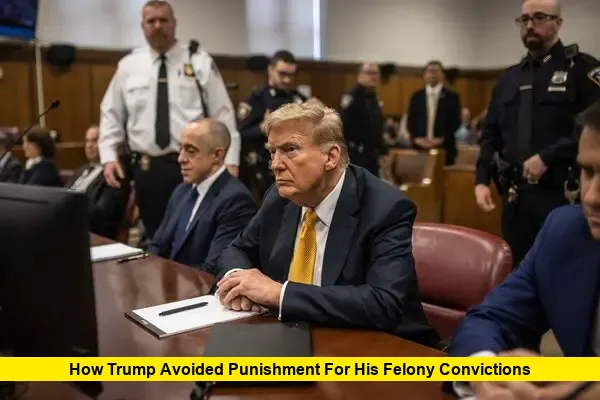

The question of How Trump avoided punishment for his felony convictions continues to attract attention long after one of the most historic criminal cases in U.S. political history reached its conclusion. Donald Trump became the first current or former American president to be convicted of felony crimes, yet the final outcome did not include jail time, probation, or other traditional criminal penalties. The result created a legal and political moment unlike any seen before in the United States.
As the nation continues to debate the significance of the case, legal analysts point to a combination of judicial discretion, constitutional considerations, and the unique status of the defendant as key reasons behind the sentencing outcome.
A Historic Criminal Verdict
The criminal proceedings centered on allegations that business records were improperly classified in connection with payments made during the 2016 presidential campaign. After weeks of testimony and deliberation, a jury found Trump guilty on 34 felony counts.
The verdict immediately became a landmark event. Never before had an American president faced and lost a criminal trial resulting in felony convictions.
The decision generated intense reactions across the political spectrum. Supporters argued that the case represented an unprecedented use of the justice system against a political figure, while opponents maintained that the verdict demonstrated accountability under the law.
What Happened After the Convictions
Convictions do not automatically determine punishment. Once the jury reached its verdict, attention shifted to sentencing, where a judge would decide what consequences, if any, should follow.
In many felony cases, courts consider a range of possible penalties, including incarceration, supervised release, fines, or community-based sanctions. Sentencing decisions are influenced by numerous factors, including criminal history, the seriousness of the offense, and the likelihood of future violations.
The unusual circumstances surrounding Trump’s case ensured that the sentencing phase would receive as much public attention as the trial itself.
The Factors That Shaped the Outcome
Several elements contributed to the court’s final decision.
Non-Violent Nature of the Case
One of the most significant considerations involved the nature of the offenses. The convictions were tied to business record violations rather than violent crimes or offenses involving direct physical harm.
Judges frequently distinguish between violent and non-violent conduct when determining punishment. In cases involving financial or administrative misconduct, incarceration is not always considered necessary.
Lack of Prior Criminal Record
Another important factor was Trump’s criminal history—or lack thereof. Before the New York case, he had never been convicted of a criminal offense.
First-time offenders often receive more favorable treatment during sentencing than defendants with lengthy criminal records. Courts commonly view repeat offenses as evidence of an ongoing pattern of unlawful behavior.
Age and Public Responsibilities
Trump’s age and national role also created unusual circumstances. As a major political figure who later returned to the presidency, his situation presented questions with little historical precedent.
Legal experts noted that imposing traditional criminal penalties on a president-elect and later a sitting president would create constitutional and practical challenges. The judiciary had no modern roadmap for handling such a scenario.
Judicial Authority and Discretion
Sentencing judges possess considerable authority to tailor penalties to individual circumstances.
In Trump’s case, the court balanced the seriousness of the convictions against broader legal considerations. The result reflected the judge’s assessment that the convictions themselves carried significant consequences without requiring additional punitive measures.
Understanding the Final Sentence
The court ultimately imposed what is known as an unconditional discharge.
This outcome allowed the convictions to remain in place while avoiding incarceration, probation, fines, or court supervision.
An unconditional discharge is a lawful sentencing option under New York law and is generally used when a judge concludes that additional punishment would not serve a meaningful purpose.
For Trump, the sentence meant that he remained a convicted felon, but faced none of the restrictions commonly associated with criminal convictions.
How Trump Avoided Punishment for His Felony Convictions Became a National Debate
The issue of How Trump avoided punishment for his felony convictions quickly evolved into a broader national discussion about fairness, equality before the law, and the role of politics in criminal justice.
Critics argued that ordinary defendants might not have received such a lenient outcome under similar circumstances. Some legal commentators questioned whether the unique status of the defendant influenced the result.
Supporters countered that the sentence reflected standard legal principles, including the treatment often given to first-time, non-violent offenders.
The debate remains active because the case sits at the intersection of law, politics, and public perception.
Political Consequences Beyond the Courtroom
Although Trump did not receive prison time, the convictions carried substantial political implications.
The case became a central topic during campaign events, television interviews, and voter discussions. Both supporters and opponents used the verdict to reinforce competing narratives about the state of American institutions.
For some voters, the convictions raised concerns about character and accountability. For others, the prosecution strengthened beliefs that political figures were being targeted through the legal system.
The long-term political impact continues to be studied by analysts and strategists.
What the Constitution Allows
One of the most misunderstood aspects of the case involves eligibility for public office.
The U.S. Constitution does not prohibit a convicted felon from serving as president. As a result, Trump’s convictions did not automatically prevent him from seeking or holding the nation’s highest office.
This reality surprised many Americans and sparked renewed discussion about whether constitutional requirements for federal office should be updated in the future.
At present, however, no constitutional provision disqualifies a candidate solely because of a felony conviction.
A Case That Will Be Studied for Years
Legal scholars are expected to analyze the Trump case for decades. It combined criminal law, election-year politics, constitutional questions, and presidential history in ways never before seen in a single proceeding.
Future courts may look to the case when confronting similar questions involving high-profile public officials. Law schools, historians, and political scientists are also likely to examine the case as a defining chapter in modern American governance.
Whether viewed as a victory for accountability or evidence of legal exceptionalism, the outcome remains one of the most consequential legal developments in contemporary U.S. history.
Looking Ahead
The convictions remain part of the public record, ensuring that the case will continue to shape political conversations and legal analysis. While the court chose not to impose traditional penalties, the broader consequences of the verdict continue to influence public opinion, electoral debates, and discussions about the limits of presidential power.
The lasting significance of the case may ultimately be measured not by the sentence itself, but by the questions it raised about law, politics, and leadership in the United States.