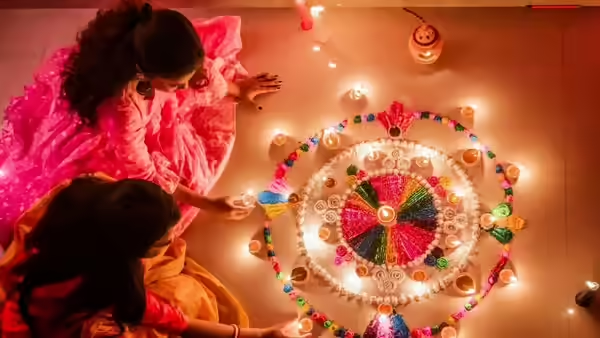

Learning how to pronounce Diwali correctly has become increasingly important as the Festival of Lights takes center stage in communities across the United States. With schools adding Diwali to their holiday calendars, cities hosting massive public celebrations, and workplaces recognizing the festival, this once niche question is now part of mainstream conversations.
Whether you’re greeting a friend, making an announcement at work, or simply wanting to show cultural respect, knowing how to say “Diwali” the right way matters. It’s a small gesture that carries a lot of meaning.
Why Pronouncing Diwali Correctly Matters
As Diwali’s visibility grows, correct pronunciation is more than just a linguistic detail — it’s an act of respect. For millions of Indian Americans and South Asians, hearing their cultural traditions pronounced properly signals inclusion and understanding.
Diwali is celebrated by Hindus, Jains, Sikhs, and some Buddhists. It’s one of the most significant festivals in the world, marking the victory of light over darkness and good over evil. In the U.S., the festival has grown beyond religious communities and become a public celebration in many states.
Yet, despite its popularity, many Americans still wonder how to pronounce the word “Diwali.” The answer is simple, but it helps to break it down clearly.
The Correct Pronunciation of “Diwali”
The correct pronunciation of “Diwali” is:
👉 Dee-VAH-lee
(IPA: /dɪˈvɑːli/)
Here’s a syllable-by-syllable breakdown:
- Di – pronounced like “dee” (rhymes with “see”)
- va – pronounced like “vah,” similar to the “a” in “father,” not “cat”
- li – pronounced “lee,” as in “family”
The emphasis is placed on the second syllable: Dee-VAH-lee.
This is the standard pronunciation in Hindi and Indian English and is widely accepted globally.
Common Mispronunciations in the U.S.
Because many Americans encounter the word “Diwali” through reading rather than hearing it, incorrect pronunciations are common. These usually stem from applying familiar English phonetics to an unfamiliar word.
Here are some of the most frequent errors:
- ❌ Die-WALL-ee
- ❌ Duh-WAH-lee
- ❌ DEE-wall-ee
- ❌ Di-vuh-LEE
These mistakes often involve either misreading “Di” as “Die,” putting the emphasis on the wrong syllable, or altering vowel sounds. While understandable, these mispronunciations can unintentionally distort the cultural meaning attached to the word.
✅ The correct version is always Dee-VAH-lee — smooth, rhythmic, and with the “vah” emphasized.
Why the Pronunciation Sounds the Way It Does
The word “Diwali” comes from the Sanskrit term Deepavali, which means “row of lights.” Over time, especially in North India, the pronunciation simplified to “Diwali,” dropping the middle syllable.
Sanskrit and Hindi have different phonetic systems than English. Words like “Diwali” are pronounced phonetically — every letter is sounded out consistently. In contrast, English has many irregular pronunciations, which is why English speakers often default to “Die-wall-ee” when first encountering the word.
By understanding its linguistic roots, it’s easier to remember why the “Dee-VAH-lee” pronunciation is correct.
Regional Variations Across India
India is incredibly linguistically diverse, and pronunciation can vary slightly depending on the region. Understanding these variations can help you appreciate the cultural richness behind the word:
- North India – The most common pronunciation is “Dee-VAH-lee,” which is also used widely in Indian English.
- South India – Many people use the original word “Deepavali” and pronounce it as Dee-PAH-va-lee. This version retains the Sanskrit structure and is especially common in Tamil, Telugu, Kannada, and Malayalam-speaking communities.
- Gujarati and Marathi speakers – Tend to use a pronunciation close to Dee-VAH-lee, with subtle accent differences.
For U.S. speakers, Dee-VAH-lee is universally understood and considered correct in both formal and informal contexts.
Deepavali vs. Diwali: Both Are Correct
Sometimes you might hear people say “Deepavali” instead of “Diwali.” This isn’t a mistake — both refer to the same festival.
- Deepavali is the original Sanskrit word: Dee-PAH-va-lee.
- Diwali is a shortened version, more commonly used in North India and globally.
Using either word, with the correct pronunciation, is perfectly respectful. Many South Indians prefer “Deepavali,” while North Indians and the diaspora typically say “Diwali.”
Tips to Master the Pronunciation
If “Diwali” feels unfamiliar, here are some simple, practical tips to help you pronounce it smoothly:
- ✅ Break it down: Say “Dee” – “Vah” – “Lee” slowly, then connect the syllables.
- ✅ Emphasize the second syllable: This is where most English speakers make mistakes.
- ✅ Practice aloud a few times to get comfortable with the rhythm.
- ✅ Avoid changing vowels: Keep “Dee” as “ee” and “Vah” as “ah,” not “ay” or “aw.”
- ✅ Listen to native speakers if possible and mirror their intonation.
With just a few tries, most people can master it quickly.
Why Pronunciation Shows Respect
Saying “Diwali” correctly isn’t about perfection — it’s about effort. For Indian Americans, hearing their festivals and traditions pronounced accurately can be deeply meaningful. It shows that others care to acknowledge their culture in a thoughtful way.
Correct pronunciation:
- ✔ Shows cultural respect and awareness
- ✔ Encourages inclusivity in schools, workplaces, and communities
- ✔ Helps avoid awkward missteps
- ✔ Builds stronger personal and professional relationships
Much like learning to pronounce “Hanukkah,” “Kwanzaa,” or “Ramadan” correctly, mastering “Diwali” is a simple but powerful act of respect.
Diwali’s Growing Presence in the U.S.
As Diwali becomes more visible in America, proper pronunciation is increasingly part of cultural literacy.
Public schools in several districts have started recognizing Diwali as an official holiday. Major cities like New York, Chicago, Houston, and San Francisco hold large-scale celebrations with lights, music, and food. Workplaces organize Diwali events, and communities come together to share traditions.
With this growing presence, pronouncing “Diwali” correctly is no longer niche — it’s part of being culturally aware in a diverse nation.
Quick Reference Table
| Word | Correct Pronunciation | Common Mistakes | Key Tip |
|---|---|---|---|
| Diwali | Dee-VAH-lee | Die-WALL-ee, Duh-WAH-lee | Emphasize “VAH,” not “WALL” |
| Deepavali | Dee-PAH-va-lee | Dee-PAW-vale, Dee-pal-ee | Four syllables, steady rhythm |
When in Doubt, Ask Politely
If you’re still unsure, the simplest and most respectful approach is to ask someone who celebrates:
“I want to make sure I’m saying it right — how do you pronounce Diwali?”
Most people will be happy to help and appreciate the effort far more than a perfect accent.
Closing Thoughts
Understanding how to pronounce Diwali correctly is a small step that carries real meaning. As the Festival of Lights becomes part of the American cultural landscape, saying “Dee-VAH-lee” with care is a way to honor its rich heritage and connect with those who celebrate it.
Whether you’re wishing a colleague, speaking at a public event, or joining a community festival, that single word — pronounced thoughtfully — shines almost as brightly as the lamps of Diwali itself