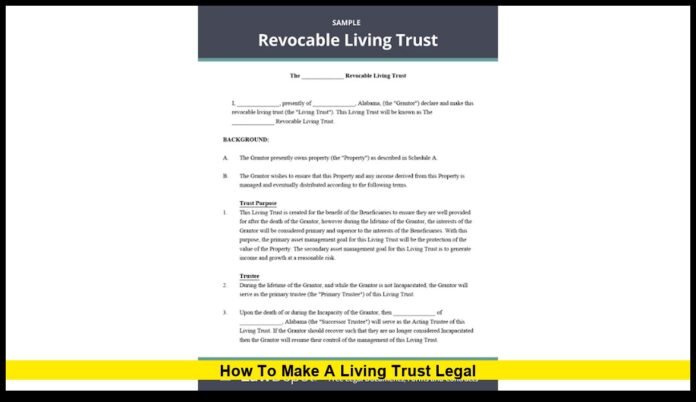

Understanding how to make a living trust legal is an important part of planning your estate in the United States. A properly established living trust can help you manage your property during your lifetime, prepare for possible incapacity, and provide instructions for distributing eligible assets to your beneficiaries after death. To establish an effective trust, you must prepare the appropriate legal document, follow your state’s requirements, appoint a trustee, identify beneficiaries, and transfer the intended assets into the trust.
A living trust can offer greater control over how property is managed and distributed. Many people choose a revocable living trust because they can generally change its provisions or revoke it while they have the necessary legal capacity. The arrangement can also help eligible trust-owned assets avoid the usual probate process after death.
However, creating a trust involves more than completing a form. The document must establish a valid arrangement, the signing process must satisfy applicable legal requirements, and the assets must be transferred correctly. Understanding these responsibilities can help you build a more reliable estate plan.
What Does It Mean to Make a Living Trust Legal?
A living trust is a legal arrangement established during a person’s lifetime. The creator places property under a trustee’s management for the benefit of designated beneficiaries. The trust document establishes the trustee’s authority and explains how the property should be managed and distributed.
Three main roles are involved in a typical living trust.
- Grantor: The person who establishes the trust and determines its terms.
- Trustee: The individual or institution responsible for managing the trust property.
- Beneficiary: The person or organization entitled to receive benefits from the trust.
In a revocable living trust, the grantor can often serve as the initial trustee and continue managing the assets. This arrangement allows the creator to retain substantial control while establishing instructions for future administration.
A successor trustee should also be named. This person takes responsibility if the original trustee becomes unable to serve, resigns, or dies.
For a trust to operate as intended, the document must establish the arrangement clearly, comply with applicable law, and identify the property it governs. Assets must also be transferred through the appropriate legal procedures.
Step 1: Determine Whether a Revocable or Irrevocable Trust Is Appropriate
Before preparing the paperwork, consider what you want the trust to accomplish.
Revocable living trust
A revocable living trust generally allows the grantor to change beneficiaries, revise instructions, transfer additional property, or revoke the arrangement while legally competent.
This flexibility makes it a common choice for people who want to organize their property and simplify the transfer of eligible assets after death.
You can generally continue using trust property during your lifetime, subject to the trust’s terms and applicable law.
Irrevocable living trust
An irrevocable trust generally places greater restrictions on the grantor’s ability to change or cancel the arrangement. The extent of those restrictions depends on the trust document and applicable law.
Some people consider irrevocable trusts for specialized estate-planning or tax objectives. However, transferring assets into such a trust can affect ownership rights, financial flexibility, and tax obligations.
Before choosing either structure, evaluate your objectives and the consequences of transferring property. A qualified estate-planning attorney can help determine which arrangement fits your circumstances.
Step 2: Check the Legal Requirements in Your State
Living trust laws differ among states. Requirements involving written documents, signatures, witnesses, notarization, and property transfers may depend on the jurisdiction and the type of trust.
Before signing, verify the rules that apply to your situation.
Important considerations include:
- Whether the trust must be written.
- How the document must express the grantor’s intention.
- Whether witnesses or notarization are necessary.
- How the trustee and beneficiaries must be identified.
- What rules apply to transferring real estate.
- Whether additional requirements apply to certain trust provisions.
Some states impose special execution rules on certain revocable trusts, especially when the trust contains provisions governing property distribution after death. Requirements can differ substantially, so a template designed for one state may not be appropriate for another.
Real estate transfers require particular care. A deed must satisfy applicable legal requirements, and the transfer may need to be recorded with the appropriate local authority.
Check current state law before executing the trust. If you own property in several states or have complicated family or financial circumstances, obtain legal advice before proceeding.
Step 3: Draft a Complete and Clear Trust Agreement
The trust agreement is the foundation of your living trust. It explains how the arrangement operates and establishes the instructions the trustee must follow.
A carefully prepared agreement generally addresses:
- The trust’s name and creation date.
- The grantor’s identity.
- The initial trustee and successor trustee.
- The beneficiaries and their interests.
- The assets covered by the trust.
- Rules for managing and investing trust property.
- Distribution instructions during the grantor’s lifetime.
- Procedures for incapacity and death.
- Conditions for amending or revoking the trust.
- Payment of authorized expenses and distribution of remaining assets.
Clarity is particularly important when several beneficiaries are involved.
For example, if you want your children to inherit equal shares, explain how those shares should be calculated and what should happen if one child dies before you.
You may also want the trustee to distribute funds over time instead of giving a beneficiary the entire inheritance immediately. If so, include clear conditions and instructions.
Avoid relying on vague language that leaves important decisions unresolved. The trustee should be able to understand your wishes without guessing what you intended.
Step 4: Decide Whether You Need an Attorney
You may be able to create a straightforward living trust using a reputable legal document service or an appropriate state-specific template. Whether this is sufficient depends on your estate and the legal issues involved.
A basic arrangement may be relatively simple, but more complicated estates often require individualized drafting.
Consider consulting an estate-planning attorney if you:
- Own real estate in multiple states.
- Have a blended family.
- Own a business or substantial investments.
- Want to provide for a beneficiary with a disability.
- Need specialized tax planning.
- Anticipate disagreements among family members.
- Want detailed restrictions on inheritance distributions.
An attorney can review your proposed terms, explain ownership restrictions, and help coordinate the trust with other estate-planning documents.
Professional assistance can also be valuable when you are uncertain whether particular assets can be transferred into the trust or how a transfer may affect taxes, mortgages, or other obligations.
Step 5: Select a Trustee and Successor Trustee
The trustee manages the property and follows the trust’s instructions. Your choice should reflect the responsibilities involved.
With a revocable living trust, you can generally serve as your own initial trustee. This allows you to retain day-to-day control over the trust assets.
You should also select a successor trustee who can take over when needed.
A suitable successor should be reliable, organized, financially responsible, and capable of handling administrative duties. The trustee may need to maintain records, communicate with beneficiaries, manage investments, pay appropriate expenses, and arrange distributions.
You can consider a trusted relative, a qualified professional fiduciary, or an eligible financial institution.
Discuss the appointment before naming someone. Managing a trust can require considerable time, particularly when it contains real estate, business interests, or multiple investments.
Naming an alternate successor can also help prevent administrative difficulties if your first choice cannot serve.
Trustees must follow the trust’s terms and applicable law. They generally have fiduciary duties and must manage trust property for the appropriate purposes rather than for personal benefit.
Step 6: Name Your Beneficiaries and Establish Distribution Rules
Beneficiaries receive the benefits provided by the trust. Depending on your objectives, they may include a spouse, children, other relatives, friends, or charitable organizations.
Identify each beneficiary clearly and explain how the trustee should distribute the assets.
Before finalizing the document, consider these questions:
- Who should inherit your property?
- What percentage or amount should each beneficiary receive?
- Should distributions occur immediately or over time?
- What happens if a beneficiary dies before you?
- Who receives a share if the original beneficiary cannot inherit?
- Should a minor’s inheritance remain under trustee management?
If you have minor children, the trust can establish instructions for managing their inheritance and making distributions for permitted purposes.
Married individuals should also consider applicable marital-property rules and their spouse’s legal rights. A trust cannot automatically override another person’s ownership interest or legally protected rights.
Review the beneficiary provisions carefully. Clear distribution instructions can reduce uncertainty and help the trustee administer the trust according to your intentions.
Step 7: Complete the Required Signing Formalities
Once the trust document is ready, complete the signing process required by applicable law and the document itself.
Begin by checking the names, trustee appointments, beneficiary details, and distribution provisions. Correct errors before executing the agreement.
The process may involve:
- Reviewing the final document.
- Confirming that you have the legal capacity to establish the trust.
- Signing and dating the agreement as required.
- Obtaining witnesses or notarization when applicable.
- Completing supporting documents where necessary.
- Keeping the executed document in a secure place.
Not every state applies identical requirements to living trusts. Some situations require additional formalities, particularly when the trust includes provisions governing the distribution of property after death.
Do not assume that the signing rules for a will automatically apply to a living trust. The documents serve different purposes and may be subject to different requirements.
Follow current, state-specific instructions and seek legal assistance if you are uncertain whether the document has been executed correctly.
Step 8: Fund the Trust by Transferring Your Assets
Funding is essential to making your trust useful in practice.
A trust document does not automatically transfer ownership of your existing property. You must complete the required steps for each asset you intend to place in the trust.
The appropriate procedure depends on the type of property.
| Asset | Important funding step |
|---|---|
| Real estate | Prepare and record an appropriate deed. |
| Bank accounts | Follow the financial institution’s procedures for retitling eligible accounts. |
| Brokerage accounts | Complete the required trust ownership paperwork. |
| Personal property | Prepare an assignment or other transfer document when appropriate. |
| Business interests | Review governing agreements and transfer restrictions. |
| Vehicles | Check state title rules, lender conditions, and related costs. |
Retirement accounts require special attention. An IRA or 401(k) generally should not be transferred directly into a living trust through an ordinary ownership change. Such a transfer can create significant tax consequences or conflict with account rules. Beneficiary designations typically require separate consideration.
Life insurance also requires careful planning. Naming a trust as the beneficiary is different from transferring ownership of the policy to the trust.
When transferring real estate, review mortgage obligations, insurance coverage, title requirements, and recording procedures. Do not assume that signing a trust agreement changes the name on a property deed.
Maintain records showing which transfers have been completed. This helps the successor trustee identify the property the trust actually owns.
Step 9: Coordinate the Trust With Other Estate Documents
A living trust often works alongside a will and other estate-planning documents.
A pour-over will directs certain assets remaining in the probate estate to the trust after death. It provides a backup for property that was not transferred into the trust during the grantor’s lifetime.
However, a pour-over will does not automatically eliminate probate. Assets passing under the will may still require probate administration before reaching the trust.
Other documents to consider include:
- A durable financial power of attorney.
- An advance health care directive.
- Medical decision-making documents.
- Updated retirement and insurance beneficiary designations.
- A will addressing guardianship nominations for minor children, where appropriate.
Each document has a distinct purpose. A living trust governs the property it covers, while a financial power of attorney can authorize an agent to manage certain financial matters outside the trust.
Coordinating these documents helps create a more complete estate plan and reduces the chance that important matters will remain unaddressed.
Step 10: Understand the Tax and Probate Effects
A properly funded revocable living trust can help eligible assets pass to beneficiaries without the usual probate process. It can also establish a management structure for trust property if the grantor becomes incapacitated.
However, a revocable living trust does not automatically eliminate taxes, personal debts, or every possible court proceeding.
For federal income-tax purposes, a typical revocable living trust is treated as a grantor trust while the grantor retains the relevant powers. The grantor generally continues reporting the trust’s income on their individual tax return.
A revocable trust also does not automatically provide protection from the grantor’s personal creditors or eliminate applicable estate taxes.
After the grantor’s death, the trustee may need to address expenses, complete required tax filings, obtain a taxpayer identification number when necessary, and distribute assets under the trust’s terms.
The applicable obligations depend on the trust, its assets, and the circumstances. Professional tax advice may be appropriate when substantial assets or complicated financial arrangements are involved.
Step 11: Review and Update Your Trust
An effective estate plan should reflect your current wishes and circumstances. Review your living trust periodically and after important life changes.
Events that may require a review include:
- Marriage or divorce.
- The birth or adoption of a child.
- The death of a beneficiary.
- Buying or selling real estate.
- Significant changes in your finances.
- Moving to another state.
- Changes in your preferred trustee or beneficiaries.
A revocable trust can generally be amended while the grantor has the necessary legal capacity. Follow the amendment procedures in the document and any applicable legal requirements.
Avoid informal changes that may not be legally effective. If you need extensive revisions, a restated trust may provide a clearer and more organized document.
Moving to another state is also a reason to review the trust. The document may remain valid, but state law can affect administration, property transfers, and other aspects of the arrangement.
Common Mistakes to Avoid
Several errors can prevent a living trust from achieving its intended purpose.
Not funding the trust: Property left outside the trust may still need to pass through probate.
Using an unsuitable template: A generic document may not address state-specific rules or your individual circumstances.
Choosing an unsuitable trustee: Poor administration can create delays, disputes, or financial difficulties.
Writing unclear beneficiary provisions: Ambiguous instructions can complicate distributions and increase the likelihood of disagreements.
Ignoring ownership restrictions: Joint property, business interests, and assets subject to contractual conditions may require additional steps.
Overlooking tax considerations: Improper transfers can create unnecessary tax complications.
Failing to prepare supporting documents: A living trust does not necessarily replace a will, power of attorney, or health care directive.
Avoid relying on promises that a living trust automatically eliminates all taxes, prevents every creditor claim, or guarantees that probate and court involvement will never occur.
Living Trust Legal Checklist
Before considering your living trust complete, make sure you have addressed the following:
- Selected the appropriate type of trust.
- Checked the legal requirements in your state.
- Identified the grantor, trustee, successor trustee, and beneficiaries.
- Prepared clear asset-management and distribution instructions.
- Signed the document according to applicable requirements.
- Transferred eligible assets into the trust.
- Reviewed ownership restrictions and beneficiary designations.
- Considered a pour-over will and other supporting documents.
- Stored the signed agreement and transfer records securely.
- Established a plan for reviewing and updating the trust.
Conclusion
Establishing a valid living trust requires more than signing a document. You need to follow state-specific legal requirements, choose appropriate trustees and beneficiaries, write clear instructions, and transfer the intended assets correctly. A revocable living trust can offer flexibility during your lifetime and simplify the distribution of eligible property after death, but its effectiveness depends on proper preparation and administration.
For complicated estates or significant financial assets, consulting an estate-planning attorney can help you address legal requirements and avoid preventable mistakes.
Are you planning to create a living trust or reviewing one you already have? Share your questions in the comments and stay informed about important estate-planning developments.