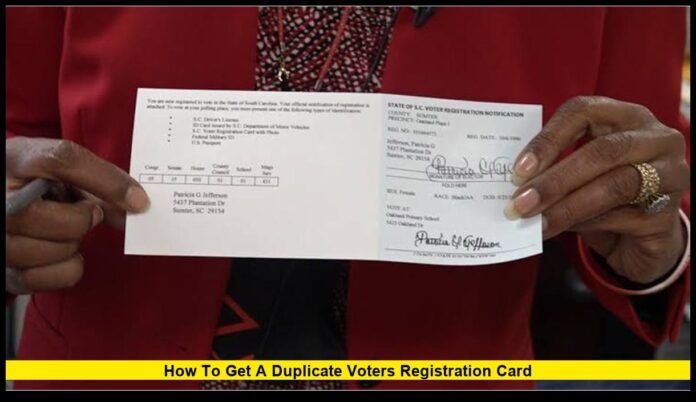

Losing an important election document can create confusion, especially when an election is approaching. Understanding how to get a duplicate voters registration card can help eligible voters confirm their registration information, correct outdated details, and determine whether they need a replacement document. In the United States, voter registration records are maintained under state and local election rules, so the process depends on where you live. Some jurisdictions offer online services, while others handle replacement requests through county election offices, registrars, or local clerks.
A missing voter registration card does not automatically mean your registration has been canceled or that you cannot vote. However, it is important to verify your registration status and understand your state’s voting requirements before Election Day. Knowing which office to contact, what information to prepare, and how to handle delays can make the process easier.
Key Points Summary
╔════════════════════════════════════════════════════════════════════╗
║ – Voters can contact their state or local election office to ask ║
║ about obtaining a duplicate voter registration card. ║
║ – Replacement procedures differ by state and may include online, ║
║ telephone, mail, or in-person services. ║
║ – Losing a registration card does not automatically cancel an ║
║ otherwise valid voter registration. ║
║ – Most voters do not need the registration card itself to vote, ║
║ although state identification requirements may apply. ║
║ – Voters who recently moved or changed their names may need to ║
║ update their registration before requesting a new card. ║
║ – Checking registration status early can help resolve errors ║
║ before an upcoming election. ║
╚════════════════════════════════════════════════════════════════════╝
What Is a Voter Registration Card?
A voter registration card is a document issued by an election authority to confirm or communicate information about a person’s voter registration. Depending on the state, it may be called a voter information card, registration certificate, or voter acknowledgment card.
The document may contain the voter’s name, residential address, assigned precinct, political party affiliation where applicable, and other information related to election administration.
Its primary purpose is to help voters review their registration details and understand where or how they may participate in elections. It can also serve as a useful reference when contacting election officials about an incorrect address, a registration question, or a missing document.
However, a voter registration card is not necessarily the same as an official photo identification card. A registration document may confirm that someone is registered without satisfying the identification requirements imposed by a particular state.
For this reason, voters should distinguish between replacing a missing registration document and resolving an issue with their actual voter registration record.
How to Get a Duplicate Voters Registration Card
The replacement process generally begins with the election office responsible for maintaining your registration. Follow these steps to identify the correct office, confirm your record, and request a new card if the service is available.
1. Identify the Correct Election Office
Start by determining which agency maintains your voter registration. Depending on your location, this may be a county elections department, county clerk, registrar of voters, or state election agency.
In many states, county offices handle registration records and provide direct assistance to voters. Other jurisdictions offer centralized state services that allow residents to review their registration information online.
If you recently moved, the office responsible for your previous address may not be the correct place to handle your current registration. Contact the election authority for your present residential address and explain your circumstances.
Use an official government election service or a verified telephone number to avoid submitting personal information to an unauthorized website.
2. Check Your Current Registration Status
Before requesting a replacement card, confirm that your registration record exists and that the information is accurate.
An online voter lookup service may allow you to check whether your registration is active, review your registered address, and locate other available details. Some systems also display precinct information or the status of a recent registration application.
If your record appears active and accurate, you can ask the election office whether it offers a duplicate card.
If your name does not appear in the lookup system, do not immediately assume that you are no longer registered. Your record may be listed under a different name, your application may still be processing, or you may be checking the wrong jurisdiction.
Contact the election office if you cannot locate your information or discover an error. Officials can explain whether you need to update an existing registration, correct a record, or take another step.
3. Ask Whether an Online Replacement Service Is Available
Some states and counties offer digital services that let voters review their registration information or request replacement documents.
Depending on the jurisdiction, you may be able to complete a request through an online voter registration portal. Other systems provide registration details without allowing users to order a replacement card.
These services are not uniform across the country. A voter in one state may be able to complete a request online, while another voter may need to contact a local office directly.
If you find your registration information online, check whether the system specifically offers a replacement-card service. Viewing your registration record does not necessarily mean you can download or print an official duplicate.
4. Submit a Request by Phone, Mail, or In Person
If an online replacement option is unavailable, contact your election office and ask which alternatives it accepts.
A telephone request may be sufficient in some jurisdictions, although staff may direct you to complete a form. Other offices accept written requests by mail or provide assistance at a public service counter.
When contacting the office, explain whether your original card was lost, damaged, never delivered, or contains outdated information. This helps staff determine the appropriate procedure.
If you visit in person, check the office’s opening hours and ask whether appointments or specific documents are required. Do not assume every location can print a replacement immediately.
5. Provide the Required Information
Election officials may need to verify your identity and locate your voter registration record before processing a replacement request.
Depending on state procedures, you may be asked for:
- Your full legal name.
- Your date of birth.
- Your current residential address.
- Your previous address if you recently moved.
- Your mailing address, if different from your residential address.
- A completed form, signature, or additional identifying information where required.
Not every office requests all these details, and some may require information specific to their procedures.
Provide information only through a verified election office or an authorized government service. Avoid sharing sensitive personal details through unsolicited messages or unfamiliar websites claiming to offer replacement cards.
6. Confirm the Request and Delivery Method
Once you submit your request, ask how the replacement will be provided and whether you should expect it by mail or collect it in person.
Find out whether the office has received your request, whether additional documentation is needed, and how to follow up if the card does not arrive.
Keep any confirmation number or written acknowledgment you receive. This may help when contacting the office again.
What Documents Are Needed to Replace a Voter Registration Card?
The documents required depend on the jurisdiction and the reason for the request.
If your registration is already active and you simply misplaced the card, the office may need only enough information to identify your record. If you recently changed your name or address, additional information may be necessary to update the registration.
Some election offices may request identification or a completed application before issuing another document. Others may handle replacement requests through existing registration records.
Before visiting an office, ask what you need to bring. Taking appropriate identification and any available registration correspondence can make the process more straightforward, but follow the specific instructions provided by the responsible authority.
Do not submit original identity documents by mail unless the official procedure specifically requires them. When copies are permitted, follow the office’s instructions for providing them securely.
How Long Does It Take to Receive a Replacement Card?
There is no single nationwide processing time for duplicate voter registration cards. The timeframe depends on local procedures, request volume, verification requirements, and the method used to deliver the document.
A replacement may be available quickly in jurisdictions that provide in-person service. Requests handled through mail or a central processing office may take longer.
If you recently submitted a voter registration application, changed your address, or corrected your name, the office may need to process that change before issuing an updated card.
Contact the election office if your replacement has not arrived within the timeframe provided. Verify that your mailing address is correct and ask whether the request is still being processed.
If Election Day is approaching, do not wait for the card before checking your voting eligibility and identification requirements.
Can You Vote Without Your Voter Registration Card?
In general, voters do not need to bring their voter registration card to the polling place simply to prove that they are registered. Losing the physical document does not automatically invalidate an otherwise valid registration.
Nevertheless, voters must satisfy applicable eligibility and voting procedures. Depending on the state and the voter’s circumstances, an accepted form of identification may be required.
Identification rules vary. Some states require government-issued photo identification, while others accept specified non-photo documents or use alternative verification procedures.
Certain voters may also face additional requirements, such as identification rules applicable to first-time voters who registered by mail. The exact requirements depend on state law and individual circumstances.
If you do not have the identification requested at the polling place, ask election officials whether another verification method or a provisional ballot is available. Do not assume that the same alternative applies in every state.
What Should You Do If Your Card Is Lost Before Election Day?
A missing registration card can be stressful when an election is close, but there are practical steps you can take.
First, check your voter registration status through the official state or local election service. Confirm that your name and address are correct and that your registration is active.
Next, review the identification requirements for your state. Determine which documents you may need to bring and verify your assigned polling location.
If you discover a problem with your registration record, contact your election office immediately. Ask what procedures are available to resolve the issue before the applicable deadline.
You should also verify polling hours and any relevant registration or voting deadlines. Rules for early voting, absentee voting, and same-day registration differ among states.
The key is to address the registration issue directly rather than assuming that a missing card prevents you from participating.
What If Your Voter Registration Card Never Arrived?
If you registered to vote or updated your information but never received a card, the first step is to check your registration record.
Possible explanations include a delayed application, an incorrect mailing address, a card lost during delivery, or a registration update that has not yet been processed.
Contact the election office responsible for your address and explain that you never received the original document. Staff can check the available record and tell you whether a replacement can be issued.
If your registration application is incomplete or your record cannot be located, ask what additional steps are necessary.
Avoid submitting duplicate applications without checking your existing record first. The election office can help determine whether you need to correct an application, update your information, or request another card.
How State Procedures Can Differ
Voter registration administration varies by state, so the name of the document and the replacement procedure may differ.
| State | Election office to contact |
|---|---|
| California | County elections office |
| Florida | County supervisor of elections |
| Texas | County voter registrar |
| New York | County board of elections |
| Pennsylvania | County election office |
| Washington | County elections office |
| Ohio | County board of elections |
| Georgia | County registrar or election office |
These offices are starting points for assistance, not a guarantee that every jurisdiction offers a dedicated replacement-card application. Some may provide registration certificates, while others use different terminology or procedures.
If you live in a state that delegates registration services to counties, make sure you contact the office responsible for your current residential address.
What If You Recently Moved or Changed Your Name?
A move or legal name change may require an update to your voter registration before an accurate replacement card can be issued.
If you moved within the same state, check the state’s process for updating your residential address. If you moved to another state, you will generally need to register under the new state’s rules.
A legal name change may also require updating the information associated with your voter registration. The election office can explain which forms or supporting documents, if any, are necessary.
Do not request a replacement that simply repeats outdated information without first asking whether your record should be corrected.
Pay attention to deadlines, especially during an election period. Registration deadlines and the availability of same-day registration differ among jurisdictions.
How to Avoid Problems With Your Registration Record
Keeping your registration information accurate can help reduce confusion when you need election services.
Review your registration after moving, changing your legal name, or making another change that could affect your record. Keep registration correspondence in a secure place and make a note of the election office responsible for your address.
If your card is lost, contact the office rather than relying on unofficial replacement services. Be cautious of websites that charge unnecessary fees or request personal information without clearly identifying the government agency responsible for the service.
You should also remember that a registration card is not a substitute for checking your registration status before an election.
Frequently Asked Questions
Can I get a duplicate voter registration card online?
Some states and local election offices provide online replacement services. Others offer only registration lookups or require voters to contact the office directly.
Is there a fee for a replacement voter registration card?
Fees and procedures vary by jurisdiction. Ask your election office whether the replacement is free or whether any authorized charge applies.
Can I request a duplicate card by phone?
Some offices accept telephone requests or provide instructions over the phone. Others require a form, a mailed request, or an in-person visit.
What if my replacement card arrives after Election Day?
A delayed card does not automatically prevent you from voting. Confirm your registration status and follow your state’s identification and voting procedures.
Can I use a printed registration lookup as my replacement card?
Not necessarily. An online registration record or printed screenshot may not be considered an official replacement document. Check with your election office.
Does a lost card mean someone else can vote in my name?
Losing the physical card does not itself authorize another person to vote. If you suspect identity theft or attempted voter fraud, contact the appropriate election authority and follow its reporting instructions.
Final Thoughts
Replacing a missing voter registration card starts with identifying the correct election office and confirming that your registration information is accurate. Depending on where you live, you may be able to request another card online, by phone, by mail, or in person. The most important step is to follow the procedure established by your state or local election authority.
If an election is approaching, confirm your registration status and identification requirements as early as possible. You generally do not need the physical registration card to vote, but you should resolve any uncertainty about your registration before Election Day.
Have you experienced a delay or problem with a voter registration card? Share your experience in the comments and stay informed about important voting updates.