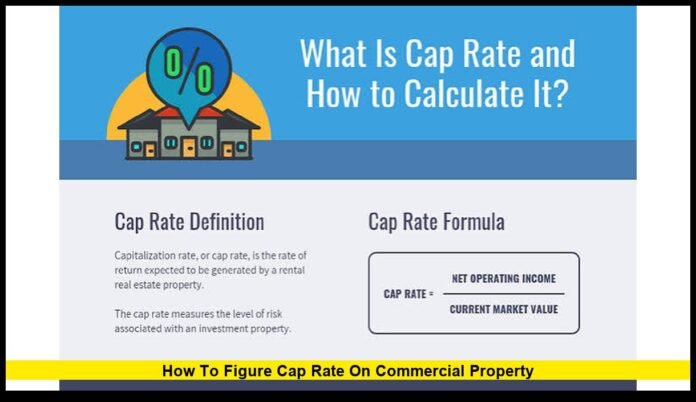

Knowing how to figure cap rate on commercial property helps real estate investors determine how much operating income a building generates compared with its value. The capitalization rate, commonly called the cap rate, is an important metric for evaluating office buildings, retail spaces, warehouses, industrial facilities, and multifamily properties. It helps buyers compare investment opportunities, estimate property values, and assess whether an asking price aligns with a property’s income potential.
The calculation begins with net operating income (NOI), which represents the income remaining after ordinary property operating expenses. Investors divide this amount by the property’s purchase price or current market value to determine the cap rate as a percentage.
However, a reliable calculation requires accurate rental figures, realistic vacancy allowances, and a complete understanding of operating costs. Property location, tenant quality, lease agreements, and building condition also influence how investors interpret the result. Understanding these factors helps buyers make better-informed commercial real estate decisions in the United States.
What Is the Capitalization Rate on Commercial Real Estate?
A capitalization rate measures the relationship between a property’s annual net operating income and its market value or purchase price. Investors use this percentage to evaluate the income-producing potential of commercial real estate.
For example, a commercial building generating $100,000 in annual NOI and valued at $1 million has a 10% cap rate. Its annual operating income equals 10% of its stated value before financing costs.
Investors frequently use this measurement to compare buildings with different prices and income levels. However, the cap rate does not represent the property’s guaranteed profit or complete investment return.
A higher cap rate may indicate a stronger operating yield relative to the purchase price, but it can also reflect greater investment risk. A building with vacancies, aging equipment, or unreliable tenants may offer a higher cap rate because buyers expect additional challenges.
Conversely, a property with dependable tenants and stable leases may command a lower cap rate. Investors must evaluate the underlying financial performance before deciding whether a particular rate is attractive.
The Formula for Figuring Cap Rate on Commercial Property
The standard capitalization rate formula is:
Cap Rate = (Annual Net Operating Income ÷ Property Value) × 100
The formula requires two primary figures: annual NOI and property value.
Net operating income measures the property’s operating performance after normal expenses. Property value represents the amount paid for the building or its estimated current market value.
Consider a commercial property with annual NOI of $150,000 and a purchase price of $2 million.
The calculation is:
$150,000 ÷ $2,000,000 = 0.075
0.075 × 100 = 7.5%
The commercial property’s cap rate is 7.5%.
This result provides a straightforward way to compare property-level income with the amount invested in acquiring the asset. However, investors must calculate NOI consistently and use a reasonable property value to make meaningful comparisons.
Step 1: Determine the Property’s Annual Rental Income
Start by calculating the income the commercial property can generate over 12 months. Review existing leases, rental schedules, and financial records to establish the property’s potential gross income.
Include rental payments and other legitimate operating revenue, such as parking fees, storage income, and tenant reimbursements where applicable.
For example, a commercial building might generate the following annual revenue:
| Income source | Annual amount |
|---|---|
| Base rental income | $220,000 |
| Parking revenue | $10,000 |
| Storage rental income | $5,000 |
| Total potential gross income | $235,000 |
The property has potential annual income of $235,000 before accounting for vacancies and collection losses.
Investors should verify rental amounts against actual lease agreements. Advertised rental rates alone may not reflect the income the property can collect.
Lease expiration dates, rent concessions, contractual increases, and tenant payment histories can also affect the reliability of projected revenue.
Step 2: Account for Vacancies and Uncollected Rent
A commercial property rarely collects every dollar of potential income throughout its operating life. Tenants may leave spaces vacant, delay payments, or fail to meet their lease obligations.
Subtract realistic vacancy and collection losses from potential gross income to determine effective gross income.
Suppose the building in the previous example experiences $15,000 in annual vacancy and collection losses.
The calculation becomes:
$235,000 − $15,000 = $220,000
The property’s effective gross income is $220,000.
When estimating these losses, examine the property’s historical occupancy, current tenant mix, lease expirations, and local leasing conditions. A building with several vacant units may require a different allowance from one with long-term tenants and consistently high occupancy.
Investors should avoid assuming that every vacant space will immediately attract a new tenant. Leasing delays and tenant turnover can affect the property’s income.
Step 3: Calculate Total Operating Expenses
Operating expenses include the ordinary costs required to maintain and manage a commercial building. These expenses reduce the income available from the property.
Common operating expenses include:
- Property taxes.
- Building and liability insurance.
- Routine repairs and maintenance.
- Property management fees.
- Owner-paid electricity, water, and other utilities.
- Landscaping and cleaning.
- Security and building services.
- Common-area maintenance.
- Administrative expenses.
The owner’s responsibilities depend partly on the lease structure. Some leases require tenants to reimburse the landlord for certain property expenses, while other arrangements leave more costs with the owner.
Investors should review lease agreements and operating statements to determine which expenses the property actually bears. They should also avoid counting tenant reimbursements twice.
Consider this example of annual operating expenses:
| Expense category | Annual amount |
|---|---|
| Property taxes | $30,000 |
| Insurance | $8,000 |
| Repairs and maintenance | $12,000 |
| Property management | $11,000 |
| Owner-paid utilities | $7,000 |
| Landscaping and cleaning | $5,000 |
| Administrative costs | $3,000 |
| Total operating expenses | $76,000 |
These figures illustrate the calculation and do not describe an actual commercial property.
Step 4: Calculate Net Operating Income
Net operating income is the foundation of the cap rate calculation. It represents the income remaining after ordinary operating expenses are deducted from effective gross income.
Use this formula:
Net Operating Income = Effective Gross Income − Operating Expenses
Using the example above:
- Effective gross income: $220,000.
- Annual operating expenses: $76,000.
- Net operating income: $144,000.
The property generates $144,000 in annual NOI under these assumptions.
Do not subtract mortgage principal or interest from NOI. These costs depend on the investor’s financing arrangements rather than the property’s underlying operating performance.
Income taxes and depreciation also fall outside the standard NOI calculation. Major capital improvements should receive separate consideration because they can create substantial additional cash requirements.
Step 5: Divide NOI by the Purchase Price
After calculating annual NOI, divide it by the property’s purchase price to determine the acquisition cap rate.
Assume the building has annual NOI of $144,000 and costs $1.8 million.
The formula is:
$144,000 ÷ $1,800,000 = 0.08
0.08 × 100 = 8%
The commercial property has an 8% cap rate.
This result means the property’s annual NOI equals 8% of its purchase price under the stated assumptions.
The purchase price has a direct effect on the calculation. If the same property sells for $1.6 million, its cap rate increases to 9%. If the purchase price rises to $2 million, its cap rate falls to 7.2%.
These differences show why buyers should evaluate both the property’s income and the price they are being asked to pay.
Complete Example: Calculating a Commercial Property’s Cap Rate
The following table summarizes the calculation from potential rental income to the final capitalization rate.
| Financial item | Annual amount |
|---|---|
| Potential gross income | $235,000 |
| Vacancy and collection losses | −$15,000 |
| Effective gross income | $220,000 |
| Operating expenses | −$76,000 |
| Net operating income | $144,000 |
| Purchase price | $1,800,000 |
The final calculation is:
Cap Rate = ($144,000 ÷ $1,800,000) × 100 = 8%
This example demonstrates how rental income, vacancy losses, operating expenses, and purchase price determine the property’s cap rate.
For an actual investment, replace these illustrative figures with verified operating statements, current lease information, and a realistic assessment of ongoing costs.
How to Calculate Cap Rate Using Current Property Value
Commercial property owners can calculate a cap rate using current market value rather than the original purchase price.
Suppose an office building generates $180,000 in annual NOI and has an estimated current market value of $2.4 million.
The calculation is:
$180,000 ÷ $2,400,000 × 100 = 7.5%
The property’s cap rate based on its estimated current value is 7.5%.
Current market value can be assessed using comparable sales, professional appraisals, and other relevant market evidence. The valuation should reflect current conditions rather than rely entirely on a historical purchase price.
Changes in occupancy, rental income, tenant demand, and operating expenses can influence property value. Therefore, owners should update their assumptions when market conditions or building performance change materially.
How to Estimate Commercial Property Value Using Cap Rate
Investors can reverse the cap rate formula to estimate a property’s value when they know its NOI and an appropriate market capitalization rate.
The formula is:
Estimated Property Value = Annual Net Operating Income ÷ Cap Rate
Suppose a commercial property generates $160,000 in annual NOI. Comparable properties support a market cap rate of 8%.
Convert the cap rate to decimal form: 0.08.
Then calculate:
$160,000 ÷ 0.08 = $2,000,000
The estimated property value is $2 million.
This approach is called direct capitalization. It can be useful when a property produces relatively stable income and the selected market cap rate reflects comparable buildings.
However, the result is an estimate rather than a guaranteed selling price. The appropriate cap rate depends on property type, location, condition, lease terms, tenant quality, and prevailing buyer demand.
Different assumptions can produce substantially different valuations.
| Annual NOI | Assumed cap rate | Estimated property value |
|---|---|---|
| $160,000 | 7% | $2,285,714 |
| $160,000 | 8% | $2,000,000 |
| $160,000 | 9% | $1,777,778 |
When NOI stays constant, lower cap rates produce higher estimated values. Higher cap rates produce lower estimated values.
What Is a Good Cap Rate for Commercial Property?
There is no single cap rate that makes every commercial property a good investment. An appropriate rate depends on the asset’s location, building condition, tenant quality, lease structure, and income stability.
Investors should compare properties with similar characteristics instead of relying on a universal benchmark.
A well-maintained building with dependable tenants and long-term leases may command a lower cap rate than a property with significant vacancies or extensive repair requirements. The difference may reflect greater confidence in future operating income.
A higher cap rate can indicate a stronger initial income yield relative to price. However, it can also signal greater uncertainty, weaker demand, or higher operating risks.
Before judging a cap rate, investors should examine:
- Recent sales of comparable properties.
- Local rental demand and vacancy rates.
- Tenant financial strength and lease expiration dates.
- Expected maintenance and capital improvement costs.
- Property taxes, insurance, and management expenses.
- The reliability of current and projected NOI.
A suitable cap rate should reflect the property’s risks and income potential rather than simply appear higher than another investment’s rate.
How Market Conditions Affect Commercial Property Cap Rates
Commercial real estate cap rates respond to changes in property values, income expectations, investor demand, and financing conditions.
Interest rates can influence the prices buyers are willing to pay. Higher borrowing costs may reduce purchasing power and put downward pressure on property valuations. If NOI remains unchanged while the price falls, the cap rate rises.
When buyer demand strengthens and property values increase, cap rates may decline if income does not rise at the same pace.
However, cap rates do not move automatically with interest rates. Local rental demand, property quality, leasing prospects, and market liquidity also affect valuation.
Different commercial property categories can experience different market conditions. An industrial building with stable tenants may attract a different cap rate from an office property facing high vacancy or costly renovations.
Investors should use current market evidence and property-specific financial information instead of assuming that one national trend applies to every commercial building.
Common Mistakes When Figuring Cap Rate on Commercial Property
A straightforward formula can still produce misleading results when investors use incorrect assumptions.
Using gross rent instead of NOI: Gross rent excludes vacancies and operating expenses. Using it directly overstates the property’s operating yield.
Including mortgage payments in NOI: Mortgage principal and interest are financing costs. Subtracting them from NOI creates an inconsistent cap rate calculation.
Ignoring vacancy losses: Empty spaces and unpaid rent reduce income. Investors should account for realistic collection and occupancy assumptions.
Underestimating operating expenses: Taxes, insurance, management, maintenance, and utilities can significantly affect NOI. Review actual financial records whenever possible.
Using inappropriate comparable properties: A cap rate from a different market or property type may not provide a reliable valuation benchmark.
Confusing cap rate with total investment return: Cap rate excludes financing effects, appreciation, and certain capital expenditures. Additional calculations are necessary to evaluate the complete investment.
Mixing actual income with projections: Current NOI may differ from expected income after renovations or new leasing. Clearly distinguish actual financial performance from projected results.
Cap Rate vs. Cash-on-Cash Return
Cap rate and cash-on-cash return measure different aspects of commercial real estate performance.
The cap rate compares annual NOI with the property’s purchase price or market value. It measures operating income without considering the buyer’s mortgage structure.
Cash-on-cash return compares annual pre-tax cash flow after debt service with the actual cash invested in the property.
For example, a commercial property may have an 8% cap rate but a different cash-on-cash return when the buyer uses financing. The down payment, mortgage interest rate, loan repayment schedule, and other borrowing terms affect the amount of cash the investor receives.
Investors can use cap rate to compare properties on a property-level basis and cash-on-cash return to assess the effect of financing on their invested capital.
Other measures, including internal rate of return and long-term cash flow projections, can provide additional insight into the investment’s potential performance.
Final Thoughts on Commercial Property Cap Rates
Figuring out a cap rate on commercial property requires accurate rental income, realistic vacancy allowances, complete operating expenses, and a reliable property value. Once you determine annual NOI, divide it by the purchase price or current market value and multiply the result by 100.
Although the calculation is simple, interpreting the result requires careful analysis. Property type, tenant stability, location, maintenance requirements, and current market conditions all influence whether a cap rate represents an attractive opportunity.
Investors should use cap rates alongside other financial measures rather than treating them as a guarantee of profitability. A thorough review of the property’s income and expenses can help buyers compare opportunities and make better-informed decisions.
Have you used the cap rate formula to evaluate a commercial property? Share your questions and experiences in the comments, and stay informed about the factors shaping commercial real estate investment decisions.