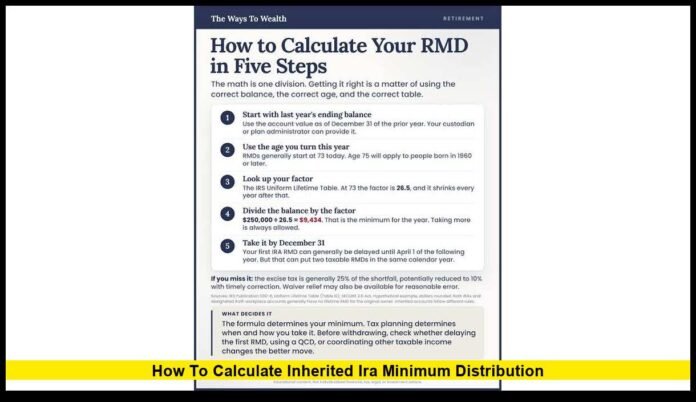

Knowing how to calculate inherited ira minimum distribution amounts can help beneficiaries follow federal retirement account rules, manage potential tax liabilities, and avoid penalties for missed withdrawals. The calculation depends on several factors, including the original account owner’s date of death, the beneficiary’s relationship to the deceased, the type of IRA, and the distribution method that applies to the inheritance.
An inherited individual retirement account (IRA) does not follow exactly the same rules as an account owned by a living retiree. Some beneficiaries must withdraw a minimum amount annually, while others must distribute the entire account within a specified period. Certain surviving spouses and eligible designated beneficiaries may qualify for different distribution options.
For the 2026 tax year, beneficiaries should pay particular attention to the distinction between annual required minimum distributions (RMDs) and the deadline for emptying an inherited account. These requirements can overlap, meaning that taking the correct annual withdrawal does not necessarily satisfy the final distribution obligation.
If you have inherited retirement savings, start by identifying your beneficiary status and reviewing the account’s distribution history. These details can help you determine the correct withdrawal method before making financial decisions.
What Is an Inherited IRA Minimum Distribution?
An inherited IRA minimum distribution is a withdrawal that a beneficiary is required to take from an inherited retirement account under applicable federal tax rules.
When an IRA owner dies, the remaining assets generally pass to the designated beneficiaries or other eligible recipients. The beneficiary receives the account subject to distribution requirements that depend on the circumstances of the inheritance.
A required minimum distribution establishes the minimum amount that must be withdrawn during a particular year when annual RMD rules apply. It does not necessarily represent the entire amount that must eventually be removed from the account.
For example, an adult child who inherits a traditional IRA from a parent may need to take annual distributions and empty the remaining balance within 10 years. A surviving spouse may have additional choices that change the applicable withdrawal schedule.
The account type also matters. Traditional IRA withdrawals are generally taxable to the extent they consist of untaxed funds. Inherited Roth IRAs have different tax characteristics, but beneficiaries must still follow applicable distribution deadlines.
Understanding these differences helps beneficiaries avoid treating every inherited retirement account as if it followed one universal withdrawal rule.
How to Calculate an Inherited IRA Minimum Distribution
When an annual RMD must be calculated using a life expectancy factor, the basic formula is:
Annual minimum distribution = Applicable December 31 account balance ÷ Applicable life expectancy factor
The account balance generally comes from December 31 of the previous year. The appropriate factor depends on the beneficiary’s classification and the distribution rules governing the inherited IRA.
Consider an inherited IRA with a December 31, 2025, balance of $150,000. If the beneficiary’s applicable life expectancy factor for 2026 is 25, the calculation would be:
$150,000 ÷ 25 = $6,000
Under these assumptions, the annual minimum distribution would be $6,000.
This example illustrates the calculation rather than establishing the correct factor for a particular person. The beneficiary must determine the appropriate IRS table and distribution method before calculating the actual amount.
Not every inherited IRA uses this formula. Some beneficiaries follow a 10-year distribution rule, while others qualify for different treatment based on their relationship to the deceased account owner.
Step 1: Determine Your Beneficiary Classification
Your first task is to establish which beneficiary category applies to you.
Federal rules distinguish among surviving spouses, eligible designated beneficiaries, other designated beneficiaries, and certain non-individual beneficiaries. These categories can determine whether annual life expectancy-based withdrawals apply or whether a different distribution schedule governs the account.
Surviving spouses
A surviving spouse may have options that include treating the inherited IRA as their own or retaining it as a beneficiary account. The available choices can affect the timing of withdrawals and the applicable RMD calculations.
Eligible designated beneficiaries
This category generally includes a surviving spouse, the deceased owner’s minor child until the applicable age limit, certain individuals who meet statutory disability or chronic illness requirements, and individuals who are not more than 10 years younger than the original owner.
Eligible designated beneficiaries may qualify for life expectancy-based distributions, subject to the applicable rules and any subsequent transition requirements.
Other designated beneficiaries
Many adult children, siblings, and other individual beneficiaries fall into this category when they do not qualify for an exception. For many accounts covered by the post-2019 rules, these beneficiaries must follow the 10-year rule.
Estates, charities, and certain trusts
When the beneficiary is not an individual, different distribution rules may apply. The terms of a trust, the identity of the beneficiary, and other legal circumstances can affect the applicable schedule.
Do not choose a distribution method solely because it appears simpler. Establishing the correct beneficiary classification is essential to calculating the required amount accurately.
Step 2: Review the Original Owner’s Date of Death
The date of death can determine which set of inherited IRA distribution rules applies.
The SECURE Act changed the rules for many beneficiaries of account owners who died after 2019. As a result, the distribution requirements for a recently inherited IRA may differ from those governing an account inherited under earlier rules.
Many designated beneficiaries who are subject to the 10-year rule must empty the account by December 31 of the 10th calendar year following the original owner’s death.
For example, if the original owner died in 2026 and the beneficiary is subject to the standard 10-year rule, the general deadline would be December 31, 2036.
However, the final deadline does not determine every annual withdrawal requirement. The original owner’s required beginning date and the beneficiary’s classification can influence whether annual distributions must also be taken during the 10-year period.
Step 3: Obtain the Previous Year’s Closing Balance
For a 2026 annual RMD calculation, beneficiaries generally need the inherited IRA’s account balance as of December 31, 2025.
Suppose the account held $225,000 at the end of 2025. If the applicable distribution method requires a life expectancy calculation, that balance generally provides the starting point for determining the 2026 minimum withdrawal, subject to any applicable adjustments.
The current account value is not automatically the correct figure. Investment gains, market losses, and withdrawals during 2026 may change the balance, but the standard annual RMD calculation generally uses the preceding December 31 balance.
Your account statement or IRA custodian can help establish the relevant figure. Keep the year-end statement with your tax records so that you can review the calculation later if necessary.
Step 4: Identify the Correct Life Expectancy Factor
The applicable life expectancy factor is another essential part of the calculation.
The IRS Single Life Expectancy Table is used for many inherited IRA distributions. However, the factor is not automatically determined by looking up the beneficiary’s current age each year.
Under many life expectancy-based beneficiary methods, the initial factor is established using the beneficiary’s age in the relevant starting year. The factor is then reduced by one for each subsequent year.
Additional requirements may apply when the original owner died on or after their required beginning date. Depending on the beneficiary category and circumstances, the calculation may need to account for the applicable life expectancy of the original owner as well.
A surviving spouse who elects to treat the account as their own generally follows the rules for an owner-held IRA instead of automatically continuing under the same beneficiary calculation.
Before using a factor, verify the applicable IRS table and the method required for your particular inheritance.
Step 5: Divide the Account Balance by the Factor
After establishing the correct account balance and life expectancy factor, complete the calculation.
For example, suppose an inherited IRA had a December 31, 2025, balance of $180,000, and the applicable factor for 2026 was 30.
The calculation would be:
$180,000 ÷ 30 = $6,000
Under those assumed circumstances, the beneficiary’s annual minimum distribution would be $6,000.
The factor is illustrative and should not be used as a personal RMD figure without confirming the applicable rules.
If your inheritance is governed by a different distribution method, the calculation may be different. This is why determining your beneficiary category should always come before performing the arithmetic.
Step 6: Verify the Withdrawal Deadline
Once the amount has been calculated, confirm the deadline for completing the distribution.
Annual RMDs generally must be withdrawn by December 31 of the applicable year. A separate obligation may exist if the original owner died during the preceding year and did not complete the RMD required for that year.
The beneficiary may need to ensure that any outstanding year-of-death RMD is distributed. The original owner’s death does not automatically eliminate a withdrawal obligation that already applied.
Beneficiaries subject to the 10-year rule must also track the final account-emptying deadline. Meeting the annual RMD requirement does not remove the obligation to distribute the remaining balance by the end of the applicable period.
Understanding the 10-Year Rule for Inherited IRAs
The 10-year rule is particularly relevant to adult children and other beneficiaries who do not qualify for an exception to the standard distribution requirements.
Under the rule, many designated beneficiaries must withdraw the entire inherited account balance by December 31 of the 10th year following the original owner’s death.
The timing of withdrawals within that period depends on whether annual RMDs also apply.
When the original owner died on or after the required beginning date, annual distributions generally remain necessary during the 10-year period under the applicable rules. The beneficiary must satisfy those annual requirements and empty the account by the final deadline.
When the original owner died before the required beginning date, an ordinary designated beneficiary subject to the 10-year rule generally must empty the account within the 10-year period, but annual life expectancy-based RMDs generally are not required during that period.
Consider an adult child who inherits a traditional IRA from a parent. If annual RMDs apply, the child cannot simply postpone every withdrawal until the final year. The required annual amounts must be distributed along the way.
If annual RMDs do not apply, the beneficiary may have more flexibility over the timing of withdrawals, but the account must still be emptied by the deadline.
The tax implications can also influence withdrawal planning. Distributing a large traditional IRA balance in one year can increase taxable income. Spreading withdrawals across several years may produce a different tax outcome, provided all required distributions and deadlines are satisfied.
How Surviving Spouses Should Approach Inherited IRA Calculations
Surviving spouses generally have more flexibility than other beneficiaries.
Depending on the circumstances, a surviving spouse may be able to treat the inherited IRA as their own, remain a beneficiary, or use another permitted distribution option.
Each choice has different implications for required withdrawals.
When a spouse treats the inherited IRA as their own, the account generally follows the RMD rules applicable to an IRA owner. The spouse’s age and other relevant circumstances help determine the distribution requirements.
When the spouse retains beneficiary status, the inherited IRA rules apply. This option may be worth evaluating when the surviving spouse is younger than the original owner or needs to consider access to retirement funds under the rules applicable to inherited accounts.
There is no single choice that is best for every surviving spouse. The decision should account for age, anticipated income needs, tax consequences, and the applicable withdrawal requirements.
Before making an election, review the available options and confirm how each choice affects the account’s distribution schedule.
Inherited Roth IRA Distribution Rules in 2026
Roth IRAs generally do not require the original owner to take lifetime RMDs. Inherited Roth IRAs, however, remain subject to beneficiary distribution rules.
Many non-spouse beneficiaries must distribute the entire inherited Roth IRA by the end of the 10th year following the original owner’s death.
In many cases, annual RMDs are not required during that period for inherited Roth IRAs, although the final distribution deadline remains important. Special beneficiary categories and older inheritance arrangements can follow different rules.
The tax treatment also requires attention. Qualified Roth IRA distributions can generally be tax-free, but the beneficiary must meet the applicable requirements for qualified treatment.
Consequently, an inherited Roth IRA should not be treated as an account with no withdrawal obligations simply because the original owner was not required to take lifetime RMDs.
Beneficiaries should confirm the applicable deadline and understand the account’s tax status before deciding when to withdraw funds.
Are Inherited IRA Minimum Distributions Taxable?
The tax treatment depends on the account type and the portion of the withdrawal that represents untaxed retirement funds.
Traditional inherited IRA distributions are generally included in the beneficiary’s taxable income to the extent the funds have not already been taxed. The distribution may affect the beneficiary’s federal income tax liability and, where applicable, state income taxes.
Inherited Roth IRA distributions may qualify for tax-free treatment if the relevant requirements are satisfied.
An RMD is a required withdrawal, not an additional tax on the account balance. The taxable portion of the distribution is what generally matters for income tax purposes.
For example, a beneficiary who withdraws $15,000 from a traditional inherited IRA may need to include that amount in taxable income if the entire distribution consists of untaxed funds. The actual tax impact depends on the beneficiary’s overall financial circumstances.
Planning withdrawals in advance can help beneficiaries understand how distributions interact with wages, Social Security benefits, investment income, and other financial considerations.
However, tax planning should never replace compliance with the applicable RMD rules. A beneficiary must still meet required withdrawal amounts and account-emptying deadlines.
What Happens When an Inherited IRA RMD Is Missed?
Missing a required distribution can trigger a federal excise tax on the amount that should have been withdrawn but was not distributed on time.
The general excise tax rate is 25% of the shortfall. The rate may be reduced to 10% when the shortfall is corrected within the applicable correction period.
The IRS may waive the excise tax if the missed distribution resulted from reasonable error and the beneficiary takes reasonable steps to correct the problem. A waiver is not automatic, and applicable filing requirements may still need to be completed.
If you discover a missed distribution, first determine the amount that should have been withdrawn. Then arrange the corrective distribution promptly and review the relevant tax reporting requirements.
Keep records of the original calculation, the amount distributed, and any corrective action. These documents can help explain what happened if questions arise later.
Beneficiaries should also remember that financial institutions may provide RMD calculations without assuming full responsibility for the beneficiary’s compliance. Reviewing the calculation and deadline remains important.
Common Errors to Avoid When Calculating an Inherited IRA RMD
Several mistakes can create unnecessary financial and administrative problems.
Using the current account value instead of the applicable year-end balance: The standard annual calculation generally begins with the previous December 31 balance.
Applying the wrong life expectancy factor: The correct factor depends on the applicable beneficiary rules and distribution method.
Ignoring the original owner’s final-year RMD: An outstanding distribution for the year of death may still need to be withdrawn.
Assuming the 10-year rule eliminates all annual withdrawals: Some beneficiaries must take annual RMDs and empty the account within the same 10-year period.
Treating a Roth IRA as exempt from distribution deadlines: Inherited Roth IRAs still have beneficiary withdrawal requirements.
Waiting until the end of December: Delaying the calculation may leave insufficient time to resolve errors or process a withdrawal.
Overlooking the tax consequences: A large taxable distribution may affect the beneficiary’s overall income tax situation.
A careful review of the account’s status, balance, distribution method, and deadlines can help prevent these problems.
A Practical Checklist for Calculating Your 2026 Distribution
Before making a withdrawal, gather the information needed to establish your distribution requirements.
- Confirm the original owner’s date of death.
- Identify your beneficiary classification.
- Determine whether the original owner had reached the required beginning date.
- Obtain the applicable December 31, 2025, account balance.
- Find the correct life expectancy factor if an annual life expectancy calculation applies.
- Check whether an RMD remains unpaid for the year of death.
- Determine the final deadline for emptying the account.
- Establish whether the inherited account is a traditional IRA or Roth IRA.
- Consider the potential federal and state tax implications.
- Keep records of the calculation and completed distributions.
This checklist provides a practical starting point for understanding the rules that apply to your inheritance.
Frequently Asked Questions
1. What is the formula for an inherited IRA minimum distribution?
When an annual RMD uses a life expectancy factor, divide the applicable December 31 balance from the preceding year by the correct factor. Confirm the beneficiary category and distribution method before using this formula.
2. Does every inherited IRA require annual RMDs?
No. Some beneficiaries must take annual minimum distributions, while others are primarily subject to a deadline for emptying the account. The applicable rules depend on the original owner’s circumstances and the beneficiary’s status.
3. When must an inherited IRA be emptied?
Many designated beneficiaries subject to the 10-year rule must distribute the remaining account balance by December 31 of the 10th year following the original owner’s death. Exceptions and older distribution rules may produce different deadlines.
4. Are inherited IRA withdrawals taxable?
Traditional inherited IRA withdrawals are generally taxable to the extent they consist of untaxed funds. Inherited Roth IRA withdrawals may qualify for tax-free treatment when the applicable requirements are met.
5. Can a surviving spouse use a different withdrawal method?
Yes. A surviving spouse may have options that include treating the inherited IRA as their own or retaining beneficiary status. The choice can affect the applicable RMD requirements.
6. What should I do if I miss an RMD?
Determine the shortfall, correct it as promptly as possible, and review the applicable excise tax and filing requirements. A waiver may be available when the relevant conditions are satisfied.
7. Can my IRA custodian calculate the distribution for me?
Many custodians provide RMD calculation services or withdrawal assistance. However, beneficiaries should confirm that the amount and deadline reflect the specific rules governing their inherited account.
Final Takeaway
Calculating an inherited IRA minimum distribution starts with identifying the beneficiary category, reviewing the original owner’s circumstances, and determining the applicable withdrawal method. The account balance and life expectancy factor are important, but they are only part of the process.
For 2026, beneficiaries should review annual RMD requirements, the 10-year rule where applicable, and the potential tax impact of their withdrawals before making distribution decisions. Keeping accurate records and confirming the relevant rules can help protect inherited retirement savings from avoidable penalties.
Have you inherited an IRA or are you planning withdrawals from a retirement account? Share your questions in the comments and stay informed about important retirement distribution rules.