
Understanding how to apply for Medicare in California is essential in 2026, as enrollment continues through streamlined federal systems with faster online processing and expanded support options for new beneficiaries.
Medicare remains a federal health insurance program, which means California residents follow the same application process used nationwide. However, California also offers additional assistance programs that can help reduce costs and guide applicants through enrollment.
Who Qualifies for Medicare in California?
Before you begin the process, confirm your eligibility. As of 2026, the requirements are:
- You are 65 years or older
- You are under 65 with a qualifying disability
- You have End-Stage Renal Disease (ESRD) or ALS
Most applicants receive premium-free Part A if they or their spouse paid Medicare taxes for at least 10 years.
Best Time to Enroll in Medicare
Knowing when to apply can help you avoid penalties and coverage delays.
Initial Enrollment Period (IEP)
This is your main enrollment window:
- Begins 3 months before your 65th birthday
- Includes your birthday month
- Ends 3 months after your birthday month
You get a total of 7 months to enroll without penalties.
General Enrollment Period (GEP)
If you miss your first window:
- Runs from January 1 to March 31
- Coverage starts the month after enrollment
Late enrollment may increase your monthly costs.
Special Enrollment Period (SEP)
If you have employer-based coverage, you may qualify for a Special Enrollment Period. This allows you to sign up later without penalties.
How to Apply for Medicare in California
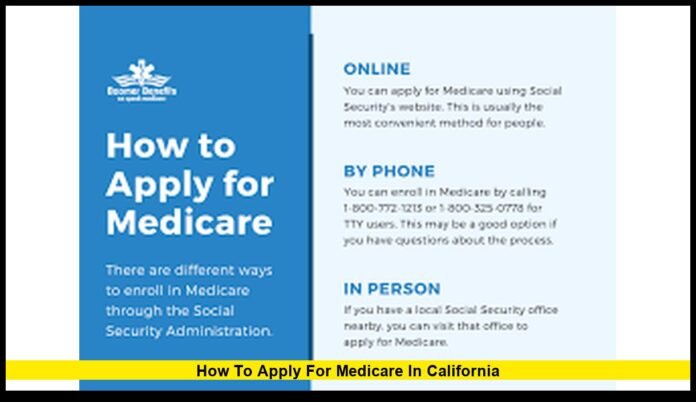
There are three official ways to apply, and each is widely used across the U.S.
Apply Online (Fastest Option)
The easiest method is applying online through Social Security:
- Takes about 10–30 minutes
- Available 24/7
- No paperwork required
You can also check your application status online after submitting it.
Apply by Phone
You can apply by calling Social Security:
- Phone: 1-800-772-1213
- TTY: 1-800-325-0778
This option is helpful if you want step-by-step assistance from a representative.
Apply In Person
You can visit a Social Security office in California:
- Ideal for complex situations
- Helpful if you need document verification
- Appointments are recommended
Documents You May Need
Most applications are simple, but you should have:
- Social Security number
- Proof of age (birth certificate)
- Proof of U.S. citizenship or legal residency
- Work history details (if required)
If you already receive Social Security benefits, you may be automatically enrolled in Medicare Parts A and B.
Understanding Medicare Coverage Options
Medicare includes several parts, each covering different services.
Part A (Hospital Insurance)
- Covers hospital stays
- Includes skilled nursing and hospice care
Part B (Medical Insurance)
- Covers doctor visits and outpatient services
- Requires a monthly premium
Part C (Medicare Advantage)
- Offered by private insurers
- Combines Parts A and B
- May include extra benefits like dental or vision
Part D (Prescription Drug Coverage)
- Helps cover medication costs
- Requires separate enrollment
California Programs That Can Help You Save
California offers additional programs that can lower your healthcare costs.
Medi-Cal
- Supports low-income individuals
- May help pay premiums and out-of-pocket costs
Medicare Savings Programs
- Help cover Part B premiums
- Eligibility depends on income
HICAP
- Provides free Medicare counseling
- Offers unbiased guidance to help you choose plans
Common Mistakes to Avoid
Many applicants face issues due to avoidable errors.
- Missing your enrollment window
- Assuming automatic enrollment when you are not eligible
- Skipping Part D when you need drug coverage
- Entering incorrect personal information
Avoiding these mistakes ensures smooth enrollment and continuous coverage.
How Long the Process Takes
In most cases, the process is quick:
- Online applications: instant submission confirmation
- Approval: usually within 2 to 4 weeks
- Medicare card: mailed shortly after approval
Applying early helps prevent delays in coverage.
What Happens After Enrollment?
After your application is approved:
- You receive your Medicare card
- Your coverage start date is confirmed
- You can choose additional plans like Part C or Part D
Review your options carefully to make sure your coverage meets your needs.
Medicare Costs in 2026
While some coverage is free, certain costs apply:
- Part A: Usually free if you qualify
- Part B: Monthly premium (adjusted annually)
- Out-of-pocket costs: Deductibles and coinsurance
- Part C and D: Vary by plan
Financial assistance programs in California can help reduce these expenses.
Why You Should Apply Early
Applying early offers several benefits:
- Avoid late penalties
- Start coverage on time
- Access full benefits without delays
Waiting too long can lead to gaps in coverage and higher long-term costs.
Final Thoughts
Learning how to apply for Medicare in California can make the enrollment process simple and stress-free. With clear timelines, multiple application options, and helpful state programs, getting covered is easier than ever in 2026.
Got questions or experiences to share about Medicare enrollment? Drop your thoughts below and stay updated for more helpful guides.