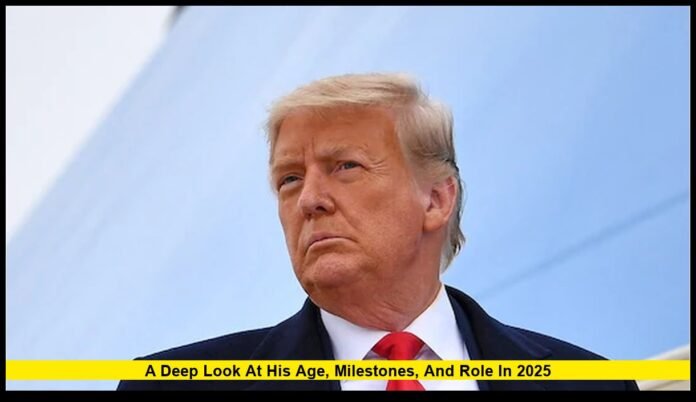

The question how old is Trump continues to be a major point of discussion in 2025 as Donald J. Trump remains at the center of America’s political and cultural conversation. Born on June 14, 1946, Trump is 79 years old as of October 2025. His age places him among the oldest figures in modern U.S. politics, yet his influence and activity show no signs of slowing down.
Trump’s age is more than a number — it reflects a lifetime that spans eras of transformation in business, media, and politics. Understanding his age in the broader context helps explain why he continues to play such a significant role today.
Trump’s Age: Key Facts at a Glance
| Name | Donald John Trump |
|---|---|
| Date of Birth | June 14, 1946 |
| Current Age | 79 years old |
| Birthplace | Queens, New York |
| Zodiac Sign | Gemini |
| Occupation | Businessman, Television Personality, 45th U.S. President |
Trump turned 79 earlier this year. His age puts him in a unique position in American history — as both a past president and a continuing political force nearly eight decades into his life.
A Lifetime That Mirrors Modern America
Donald Trump’s 79 years trace a journey that runs parallel to the story of modern America itself. His personal milestones, public controversies, and political triumphs form a living timeline that mirrors the nation’s cultural and economic evolution.
1946–1960s: Born in Queens during the postwar boom, Trump grew up amid America’s rising optimism. He attended New York Military Academy and later the Wharton School at the University of Pennsylvania, institutions that shaped his disciplined yet ambitious outlook.
1970s–1980s: As the nation’s cities transformed, Trump stepped boldly into the real estate world. His high-profile developments in New York City — from luxury towers to casinos — made him both a symbol of American ambition and excess.
1990s: During a decade of economic turbulence, Trump faced major financial setbacks but leveraged his brand to stay visible. His name became less about buildings and more about image — a precursor to the celebrity-driven business culture that would later dominate.
2000s: Reinventing himself for a new era, Trump became a household name through “The Apprentice.” His catchphrase, “You’re fired,” entered popular culture, solidifying his image as a decisive businessman and television icon.
2016: In a stunning turn, Trump transformed from media mogul to political powerhouse. Elected the 45th President of the United States at age 70 — then the oldest person ever elected to the office — he redefined American politics with a populist message and unconventional style.
2021–2025: Even after leaving the White House, Trump remains a dominant presence in public life. As he nears 80, he continues to shape national debates, headline rallies, and drive political movements, underscoring his enduring influence on the American narrative.
Trump’s age is more than a chronological marker — it’s a reflection of endurance and continuity. His life spans postwar prosperity, Cold War anxiety, the digital revolution, and deep political division. Through every era, he has not only witnessed America’s transformation but has, time and again, positioned himself at its very center.
How Trump’s Age Compares to Other Presidents
When Donald J. Trump took the oath of office in January 2017, he made history in a way that few presidents before him had. At 70 years old, Trump became the oldest person ever inaugurated as President of the United States at that time. His age was a symbol of both experience and resilience, marking a significant moment in the evolution of American political leadership. Although Joe Biden would later surpass that record, Trump’s age continues to carry historical and cultural weight within the broader story of modern America.
A Historical Shift in Presidential Age
For much of U.S. history, the presidency was seen as a position best suited for men in their fifties or early sixties. Age was often associated with wisdom, but also with declining energy in an era that demanded constant travel and public engagement. Presidents like John F. Kennedy, who took office at just 43, represented a younger generation’s rise to power during the Cold War. However, the modern political landscape has shifted dramatically since then.
By the time Trump entered the Oval Office, voters had already shown an increased comfort with older leaders who carried decades of experience in business, politics, or public service. Trump’s election signaled that age was no longer viewed as an obstacle — it could even be a strength. His reputation as a seasoned businessman and media figure gave him credibility among those who valued experience over traditional political careers.
Trump’s Place in the Presidential Age Timeline
To understand Trump’s historical position, it helps to look at how his age compares with other American presidents who shaped the modern era.
- Ronald Reagan – Reagan was 69 when first elected and 77 when he left office in 1989. At the time, many viewed him as the oldest president to ever serve. Despite initial concerns about his age, Reagan’s two-term presidency was marked by confidence, optimism, and strong communication — qualities that helped redefine perceptions of older leadership.
- Donald Trump – In 2017, Trump surpassed Reagan’s record when he took office at 70. Now 79, Trump remains an active and visible figure in national politics. Whether through campaign rallies, interviews, or social media, he continues to shape public discourse with the same vigor that defined his presidency.
- Joe Biden – Biden became president in 2021 at age 78, overtaking Trump as the oldest president ever inaugurated. His election further confirmed a generational shift — one where advanced age no longer deters political ambition but instead emphasizes endurance and experience.
- Dwight D. Eisenhower – Eisenhower, who left office in 1961 at age 70, was once considered unusually old for a sitting president. In his time, reaching that milestone in public service was seen as remarkable. Today, that age is viewed as relatively common among modern leaders.
This comparison underscores how the expectations of presidential age have evolved. In earlier decades, entering the presidency past the age of 65 was rare. Now, it has become almost typical for America’s top leaders to be in their seventies.
Age, Experience, and Public Perception
Trump’s age has played a complex role in shaping public perception. Supporters often describe his energy as “unmatched,” emphasizing his relentless schedule of rallies, speeches, and media appearances. They argue that his stamina challenges stereotypes about aging and demonstrates a level of engagement uncommon even among younger politicians.
Critics, on the other hand, have questioned whether advanced age could hinder judgment or adaptability in a rapidly changing world. Yet, Trump’s ability to dominate political conversations well into his late seventies shows that age has done little to slow his influence.
This generational reality is mirrored by other global leaders as well. Figures such as Joe Biden, Pope Francis, and Britain’s late Queen Elizabeth II all represented extended leadership well beyond traditional retirement years. Trump’s continuing political presence places him within that global trend — one where longevity and leadership increasingly go hand in hand.
Why Age Matters in Modern Politics
The rising age of U.S. presidents reflects deeper societal trends. Americans are living longer, working later, and staying engaged in civic life well into their senior years. In politics, this shift has blurred the lines between generations. Experience, rather than youth, has become a prized attribute among large segments of the electorate.
Trump’s journey embodies that transformation. Having built a career that spans real estate, television, and politics, he stands as a figure of both continuity and change. His presidency and continued influence at 79 show how longevity can reinforce authority in the public eye. Voters often interpret long careers as proof of resilience — and Trump’s ability to remain at the center of national discussion proves that point.
A New Era of Older Leadership
The past decade has reshaped how Americans think about leadership and age. Both Trump and Biden have challenged the notion that political energy declines with time. Instead, they represent a new standard where leadership often draws strength from lived experience rather than youthful idealism.
Ronald Reagan once joked that he would not exploit his opponent’s “youth and inexperience” during the 1984 presidential debates. Decades later, that sentiment resonates even more strongly. The nation now seems comfortable with leaders who bring not just energy, but long-term perspective — an understanding of history that comes only with age.
Trump’s Ongoing Influence at 79
As Donald Trump approaches 80, his visibility remains as sharp as ever. He continues to host campaign rallies that attract thousands, command massive media attention, and drive public debates on key national issues. Unlike many former presidents who step back into quiet retirement, Trump has maintained a front-line presence in politics. His speeches, policy endorsements, and digital engagement keep him relevant in ways few post-presidency figures have achieved.
For many Americans, his age is seen as part of his identity — a symbol of persistence and determination. Trump himself often frames his longevity as proof of strength, declaring that his endurance reflects the same energy that fueled his rise in business and politics decades earlier.
A Reflection of Changing Times
The story of Trump’s age isn’t just about numbers — it’s about the broader evolution of American leadership. From Eisenhower’s 70 to Biden’s 81, the United States has seen its definition of “presidential age” expand dramatically. Trump’s 79 years serve as a mirror of that transformation, bridging multiple eras of American life — from the postwar boom to the digital revolution.
As society continues to age, it’s likely that more leaders will follow this path, extending their influence well beyond traditional expectations. Trump’s continued prominence in the political arena demonstrates that vitality and vision are no longer confined to youth. Instead, they can thrive at any stage of life, as long as the will to lead remains strong.
In conclusion, Donald Trump’s age is more than a statistic — it’s a symbol of endurance, adaptability, and the changing face of American politics. His journey from business icon to president and now elder statesman reflects the evolving standards of leadership in a nation where age has become both a measure of experience and a testament to staying power.
Stay tuned for more updates and share your thoughts below — do you believe age strengthens or limits a leader’s ability to connect with today’s America?
Trump at 79: Public Activity and Energy
At an age when most public figures retire from the spotlight, Donald J. Trump continues to stand apart. Now 79, the former president remains one of the most active and visible personalities in American life. His schedule is filled with rallies, interviews, and public appearances that often resemble full-scale campaign events. Even as he approaches 80, Trump shows no signs of slowing down. His energy level, stage presence, and determination continue to surprise many who expected a quieter post-presidency.
Trump’s calendar today rivals that of many younger political figures. He travels frequently across the country, speaking before large crowds of supporters in arenas and outdoor venues. These rallies are not short affairs. They often run for more than an hour, with Trump speaking off the cuff, weaving between policy commentary, personal anecdotes, and sharp political critiques. His trademark off-script style keeps audiences engaged and adds an unpredictable edge to each appearance. The crowds he draws—sometimes in the tens of thousands—illustrate that his influence within American politics remains powerful, even years after leaving office.
Supporters often point to his stamina as proof that age has not diminished his effectiveness. They describe him as tireless, citing his ability to deliver long speeches, travel between states, and maintain a relentless pace of engagement. Many note that Trump’s presence on stage feels as energetic as it did during his first campaign nearly a decade ago. For them, his activity level demonstrates that leadership and influence can thrive at any age, as long as passion and conviction remain intact.
Beyond rallies, Trump maintains a strong presence across the media landscape. He frequently appears on television, gives interviews to radio hosts, and stays active through digital platforms. His social media posts continue to shape national conversations, often sparking intense debate across the political spectrum. By directly addressing his audience online, Trump bypasses traditional media filters and keeps a direct connection with millions of followers. This approach allows him to dominate headlines and maintain constant visibility, something few former presidents have achieved at this stage in life.
Trump’s continued political involvement extends beyond communication. He remains deeply engaged in shaping the direction of his party and the candidates who represent it. His endorsements often carry significant influence in primary races, with many contenders seeking his approval as a key factor in their campaigns. Through strategic appearances, fundraising efforts, and policy advocacy, Trump continues to exert control over the broader conservative movement. Even when he is not physically present, his influence is unmistakable. Many candidates still align themselves with his message and brand, keeping his vision alive in the national dialogue.
Observers note that Trump’s ability to sustain such a demanding schedule at 79 challenges traditional expectations of aging in public life. In earlier generations, political figures often stepped away from the spotlight in their seventies, focusing on legacy rather than ongoing engagement. Trump, however, has redefined what it means to remain relevant. His routine of traveling, speaking, and campaigning shows that he thrives on public interaction. Rather than viewing age as a limitation, he has turned it into part of his identity—proof, he often says, of his strength and resilience.
His long speeches have become a defining feature of his public appearances. Without relying heavily on teleprompters, he delivers extended remarks filled with humor, criticism, and policy discussion. Even critics admit that his ability to speak for long stretches without notes reflects remarkable stamina. His stage presence, commanding and animated, continues to draw attention from both supporters and detractors. For his followers, it reinforces their belief that Trump embodies endurance and determination. For his opponents, it highlights the extraordinary persistence of a political figure who refuses to fade from public view.
The symbolism of Trump’s activity at 79 reaches beyond his individual career. It mirrors a broader societal change in how Americans view age and leadership. In the past, age was often associated with decline or retirement. Today, with longer life expectancies and a culture that values experience, older leaders are increasingly prominent. Figures like Trump and President Joe Biden represent a new political era in which energy and engagement are not defined by youth alone. Both have demonstrated that public leadership can continue well into one’s late seventies or even eighties, provided there is focus, health, and a loyal following.
Trump’s ongoing activity also underscores his understanding of media and performance. Few political figures have mastered public visibility like he has. Every rally, every interview, and every statement seems designed to generate headlines and reinforce his presence in the national consciousness. Even when controversies arise, they often serve to keep him at the center of discussion, ensuring that his name remains synonymous with American politics. His ability to shape the narrative, intentionally or not, remains one of his most defining traits.
For many Americans, Trump’s continued visibility offers a familiar sense of continuity in an era of rapid change. His supporters view him as a fighter who refuses to back down, while others see him as a symbol of persistence in a constantly shifting political landscape. His rallies, often filled with chants, energy, and patriotic imagery, serve as a reminder that his influence extends far beyond the conventional boundaries of a former president. He operates as both a political leader and a cultural phenomenon—one whose voice continues to resonate with millions.
Even as Trump nears 80, he shows little sign of slowing his pace. His travel schedule remains busy, his media presence steady, and his political involvement deep. While many of his peers have chosen quieter lives, he continues to operate at full speed. His ability to sustain such intensity after decades in the public eye speaks to his unique position in American culture. Whether admired or criticized, Trump’s continued activity is impossible to ignore. It reflects not only his personal endurance but also the evolving expectations of leadership in a nation that prizes determination and visibility.
In many ways, Donald Trump’s life at 79 encapsulates the story of modern political engagement. His energy challenges traditional assumptions about aging, while his persistence underscores a deep desire to remain influential. He has turned longevity into a statement—one that suggests leadership does not end with age but instead transforms through experience and willpower. His journey continues to prove that influence in America’s public life depends less on years lived and more on the determination to stay relevant.
Donald Trump at 79 remains a symbol of endurance, energy, and relentless presence. His ability to command attention, fill stadiums, and shape national conversation demonstrates that, in modern America, age may mark experience—but it does not define limits.
Why Trump’s Age Is a Key Talking Point
Trump’s age isn’t just a statistic — it’s a factor that shapes perceptions, discussions, and strategies in the political arena. Several key reasons explain why his age remains at the forefront:
- Historical Uniqueness
At 79, Trump represents a rare case of a former president who maintains significant national influence decades after his first public rise. - Leadership Expectations
Age affects how voters view leadership ability. Some value his experience and see it as proof of resilience; others question whether older leadership can fully adapt to future challenges. - Comparison with Political Rivals
His age invites direct comparisons with other prominent political figures, some of whom are younger and represent different generational perspectives. - Legacy and Continuity
At this stage, Trump’s age naturally brings legacy into focus. His actions now shape how future generations will view his impact.
Public Perception and Voter Opinions
Voters are divided in their views on Trump’s age. Supporters often argue that his energy at 79 surpasses that of many younger politicians, pointing to his active travel schedule and rallies. They see his long experience as an asset.
Critics, on the other hand, raise concerns about generational leadership and the physical demands of political office at such an advanced age. This division reflects broader conversations in American politics about age, leadership, and the future direction of both major parties.
Polls and public forums frequently reveal that age plays a role in shaping voter confidence, but it’s often intertwined with broader questions about personality, policy, and vision rather than age alone.
Read Also-Trump MRI Scan Declared “Perfect” Amid Health Spotlight
Historical Context: Age and Leadership
Throughout U.S. history, most presidents have been in their 50s or 60s. The prominence of leaders in their late seventies and eighties is a new phenomenon. Advances in healthcare, media presence, and political communication have allowed figures like Trump to remain in the public arena far longer than their predecessors.
This shift has created a new political dynamic in which older leaders command both historical authority and modern media influence. Trump’s age positions him as a bridge between eras — someone who remembers mid-century America firsthand while also shaping 21st-century political discourse.
The Role of Age in Trump’s Legacy
As Trump approaches 80, discussions about his legacy intensify. His age places him in a category of historical figures whose influence spans multiple generations. Whether one supports or opposes him, his continued relevance at 79 underscores his unique role in shaping American political identity.
His legacy will likely be evaluated through both his presidency and his post-presidential activity, which has extended longer and more actively than many of his predecessors.
Key Takeaways
- Donald Trump’s Age: 79 years old, born June 14, 1946.
- Historical Standing: Among the oldest political figures to remain active in U.S. politics.
- Public Life: Maintains a busy schedule of rallies and media appearances.
- Political Relevance: Age shapes how voters, media, and historians frame his role in 2025.
- Legacy: His age connects his early business and media rise with his lasting political impact.
Conclusion
Answering the question how old is Trump provides more than just a number. At 79 years old, Trump stands at the intersection of past and present, blending decades of personal milestones with an ongoing role in modern political life.
His age is a lens through which Americans view leadership, experience, and change. Whether admired for his endurance or scrutinized for generational leadership questions, Donald Trump’s age ensures he remains a defining figure in American history and politics.
What do you think about Trump’s age and its impact on U.S. politics today? Share your thoughts below.