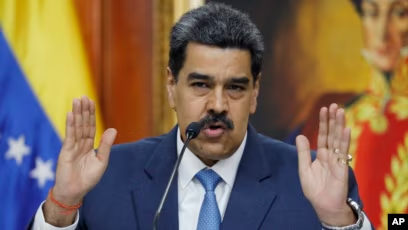

How old is Nicolas Maduro? In 2026, the Venezuelan leader is 63 years old, having been born on November 23, 1962, in Caracas. While the number itself is easy to state, Maduro’s age represents far more than a biographical detail. It places him at the center of a political generation forged by Cold War tensions, socialist ideology, and decades of confrontation between Latin America and Western powers.
Maduro’s life story is unusual among heads of state. He did not emerge from elite academic institutions or military command. Instead, his path to power began in the working class and unfolded through labor activism, political loyalty, and gradual ascent within Venezuela’s socialist movement.
Growing Up in Caracas
Nicolás Maduro Moros was raised in a modest household in Venezuela’s capital. His family environment exposed him early to union activity and political debate, particularly around workers’ rights and social inequality. These influences played a decisive role in shaping his worldview.
Unlike many politicians who follow conventional educational paths, Maduro did not earn a university degree. His political education came through experience—reading political theory, engaging in activism, and organizing at the grassroots level. This nontraditional background would later become both a defining feature of his public identity and a frequent point of criticism.
During his youth, Venezuela was experiencing growing economic disparities and declining trust in traditional political parties. These conditions reinforced Maduro’s belief that the system favored elites over ordinary citizens.
Life Before Politics: A Working-Class Start
Before entering public office, Maduro worked as a bus driver in Caracas, a job that would later become central to his political narrative. While employed in public transportation, he became active in labor unions, eventually taking on organizing roles.
Union work gave Maduro direct exposure to collective action, negotiation, and political mobilization. It also helped him build connections among working-class Venezuelans and sharpen his skills as a speaker and organizer.
To supporters, this background symbolizes authenticity and connection to everyday life. To critics, it highlights a lack of formal administrative training. Regardless of interpretation, this period laid the groundwork for his future political career.
Ideological Development and Leftist Politics
Maduro’s union involvement led him deeper into left-wing political movements that opposed market-driven reforms and U.S. influence in the region. Over time, he embraced socialist ideology and revolutionary rhetoric as tools for social change.
He spent time in Cuba, where he received political and organizational training. Cuban revolutionary thought had a lasting influence on him, reinforcing ideas of centralized authority, state-led economic control, and resistance to foreign intervention.
These beliefs aligned closely with the political vision of Hugo Chávez, who was reshaping Venezuela’s political system at the end of the 20th century.
Joining Hugo Chávez’s Movement
When Hugo Chávez rose to power in 1998, Maduro became one of his most dependable allies. His reputation for loyalty and discipline helped him gain trust within the ruling movement.
Maduro won election to the National Assembly, where he steadily expanded his influence. He later became President of the National Assembly, a role that increased his visibility and strengthened his understanding of Venezuela’s political institutions.
Rather than positioning himself as a rival within the movement, Maduro consistently framed himself as an executor of Chávez’s vision—a strategy that ultimately worked in his favor.
Years as Foreign Minister
In 2006, Maduro was appointed Minister of Foreign Affairs, a position he held for seven years. This role transformed him into one of Venezuela’s most recognizable international representatives.
As foreign minister, Maduro cultivated close relationships with governments that opposed U.S. dominance, including Cuba, Russia, China, and Iran. He frequently defended Venezuela’s sovereignty and criticized Western intervention on the global stage.
These years provided him with extensive experience dealing with sanctions, diplomatic pressure, and geopolitical conflict—challenges that would later define his presidency.
Timeline: Key Moments in Nicolás Maduro’s Life
- 1962 – Born in Caracas, Venezuela
- 1980s–1990s – Works as a bus driver and union organizer
- Late 1990s – Joins Hugo Chávez’s political movement
- 2000 – Elected to the National Assembly
- 2005 – Becomes President of the National Assembly
- 2006–2013 – Serves as Minister of Foreign Affairs
- 2012 – Appointed Vice President
- 2013 – Assumes the presidency
- 2026 – Reaches age 63
Becoming Vice President and Successor
In 2012, Chávez named Maduro as Vice President, a move widely interpreted as preparation for succession. Chávez publicly emphasized Maduro’s loyalty and commitment to the revolutionary project.
As Chávez’s health deteriorated, Maduro increasingly managed government operations. This period allowed him to gain executive experience and consolidate relationships with military and political institutions.
Following Chávez’s death in 2013, Maduro assumed the presidency and later secured electoral victory in a closely contested race.
Leading During Economic Turmoil
Maduro’s time in office has coincided with one of the most challenging periods in Venezuela’s modern history. Declining oil revenues, inflation, shortages, and widespread emigration reshaped the country’s social and economic landscape.
Maduro consistently attributed these problems to foreign pressure and domestic opposition. His government expanded state control over institutions and relied heavily on security forces and loyal political structures to maintain authority.
Rather than pursuing broad reform, his leadership focused on survival, continuity, and ideological resistance.
Global Pressure and Political Disputes
Subsequent elections under Maduro were met with international skepticism. Some governments questioned their legitimacy, while others continued diplomatic engagement.
Economic sanctions became a defining factor of his presidency, affecting trade, finance, and daily life. Maduro used these pressures to reinforce nationalist messaging and portray his government as defending sovereignty against external threats.
Despite international isolation, he retained support from key allies and domestic power centers.
Leadership Style and Public Persona
At 63, Maduro presents himself as a veteran revolutionary shaped by decades of struggle. His speeches frequently reference socialism, resistance, and the legacy of Hugo Chávez.
Unlike Chávez’s charismatic populism, Maduro’s leadership style relies more on institutional control and ideological consistency. His public image continues to emphasize his working-class origins and commitment to the Bolivarian project.
Family and Political Partnership
Maduro is married to Cilia Flores, a senior political figure who has held influential government roles. Together, they form one of Venezuela’s most powerful political partnerships.
Their relationship reinforces the image of unity and continuity within the ruling movement and plays a significant role in Maduro’s political narrative.
How Old Is Nicolas Maduro in Broader Context
Asking how old is Nicolas Maduro also raises questions about political generation and longevity. At 63, he belongs to a cohort shaped by late-20th-century ideological struggles rather than modern digital-era politics.
His age suggests experience and institutional memory, but it also highlights ongoing debates about succession, renewal, and Venezuela’s future beyond its founding revolutionary leadership.
Frequently Asked Questions
How old is Nicolas Maduro in 2026?
He is 63 years old.
What was Maduro’s job before politics?
He worked as a bus driver and later became a union organizer.
When did Maduro become president?
He assumed the presidency in 2013.
Is Nicolás Maduro a socialist?
Yes, he identifies strongly with socialist ideology and the Bolivarian Revolution.
Does Maduro have a college degree?
No, he did not complete a university degree.
Conclusion
Understanding how old is Nicolas Maduro provides insight into more than his birth date. It helps explain the political era he represents, the ideology he upholds, and the leadership style he employs.
From a working-class background to the presidency, Maduro’s rise reflects both individual determination and the broader trajectory of modern Venezuela. As the country continues to confront political and economic challenges, his age and experience remain central to discussions about its direction and future.