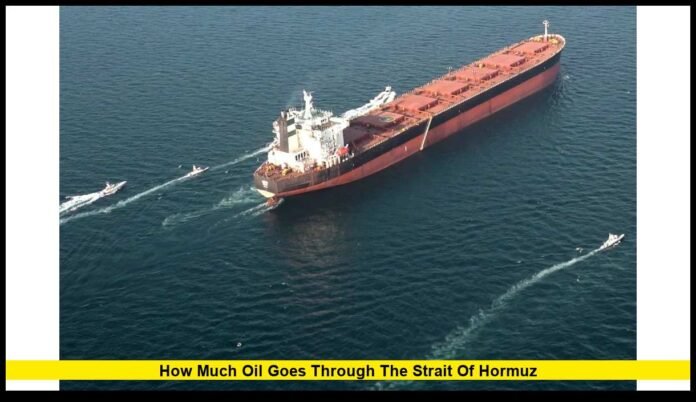

If you are wondering how much oil goes through the Strait of Hormuz, current verified energy data shows that about 20 million barrels of crude oil and petroleum liquids move through the strait each day. That equals roughly 20% of the world’s total petroleum consumption and about one-third of all oil transported by sea as of early 2026.
Those numbers confirm the Strait of Hormuz remains the most critical oil transit chokepoint on the planet. For U.S. readers, the volume moving through this narrow waterway has direct consequences for gasoline prices, inflation, and global energy stability.
Below is a comprehensive look at the daily flow, the countries involved, shipping logistics, and why this single passage continues to influence the global economy.
Where the Strait of Hormuz Is Located
The Strait of Hormuz connects the Persian Gulf with the Gulf of Oman and the Arabian Sea. It sits between:
- Iran to the north
- Oman and the United Arab Emirates to the south
At its narrowest point, the strait measures about 21 miles wide. However, the designated shipping lanes in each direction are only about two miles wide. That tight corridor forces massive oil tankers into confined routes, increasing its strategic importance.
Nearly all maritime oil exports from the Persian Gulf must pass through this passage.
Daily Oil Volume Moving Through the Strait
The answer to how much oil goes through the Strait of Hormuz centers on one critical figure: approximately 20 million barrels per day.
That volume includes:
- Crude oil
- Condensate
- Refined petroleum products
This daily total has remained near 20 million barrels throughout 2024 and 2025. Production decisions by OPEC+ influence total export levels, but the strait consistently handles close to one-fifth of global petroleum demand.
To put the number in perspective:
| Metric | Approximate Share |
|---|---|
| Global petroleum consumption | ~20% passes through Hormuz |
| Global seaborne oil trade | ~33% passes through Hormuz |
| Global LNG trade | ~20% passes through Hormuz |
No other chokepoint carries this concentration of energy supply.
Which Countries Export Oil Through the Strait?
Several of the world’s largest oil producers depend heavily on this route.
Major exporters using the Strait of Hormuz:
- Saudi Arabia
- Iraq
- United Arab Emirates
- Kuwait
- Iran
- Qatar (primarily LNG and condensate)
Saudi Arabia and Iraq account for a substantial portion of daily crude shipments. Kuwait and the UAE also move most of their seaborne exports through this corridor.
Iran exports oil through the same route as well. Meanwhile, Qatar relies on the strait for liquefied natural gas shipments, making it essential for global gas markets too.
How the Strait Affects the United States
The United States produces significant amounts of oil domestically. Still, American consumers remain exposed to global supply conditions.
Oil prices operate in an interconnected global market. When supply disruptions threaten the Strait of Hormuz, benchmark crude prices often rise quickly. That increase can translate into higher gasoline prices across the U.S.
Even if the U.S. imports less oil directly from the Persian Gulf than in past decades, global price shifts still impact American drivers, airlines, and businesses.
Energy traders watch tanker traffic through the strait in real time because it can influence pricing expectations within hours.
Liquefied Natural Gas Also Moves Through the Strait
Oil is only part of the story.
Qatar ranks among the world’s largest liquefied natural gas exporters. Nearly all of its LNG shipments pass through the Strait of Hormuz.
About 20% of global LNG trade transits this waterway. That adds another layer of strategic importance, particularly for energy-hungry economies in Asia and Europe.
Natural gas markets can also react sharply to disruptions in this region.
Why the Strait of Hormuz Is Considered a Chokepoint
Energy analysts label the Strait of Hormuz as the world’s most important oil chokepoint for three main reasons:
- Volume Concentration – Roughly 20 million barrels per day pass through a narrow corridor.
- Limited Alternatives – Few routes exist to bypass it at full capacity.
- Global Dependence – Major economies rely on Gulf oil exports.
Because the Persian Gulf holds some of the largest proven oil reserves in the world, exports naturally funnel through this single outlet.
Any disruption could reduce available supply on global markets.
Alternative Export Routes
Some Gulf countries have invested in pipelines that bypass the strait.
Saudi Arabia’s East-West Pipeline
This pipeline transports crude from oil fields in the eastern part of the kingdom to the Red Sea port of Yanbu. It allows shipments to avoid the Strait of Hormuz.
UAE’s Abu Dhabi Crude Oil Pipeline
The UAE operates a pipeline from inland oil fields to the port of Fujairah on the Gulf of Oman. Oil shipped from Fujairah does not pass through the strait.
Despite these alternatives, they cannot fully replace the 20 million barrels per day typically transported via Hormuz.
Most exports still depend on the strait.
Shipping Traffic and Tanker Types
Massive oil tankers travel through the strait every day. These include:
- Very Large Crude Carriers (VLCCs)
- Suezmax tankers
- Product tankers
Each VLCC can carry up to 2 million barrels of crude oil.
Commercial vessels move in designated traffic separation schemes. International naval forces maintain a presence in the region to protect shipping lanes.
The U.S. Navy’s Fifth Fleet, headquartered in Bahrain, operates patrols to help ensure safe passage for commercial tankers.
Oil Flow Stability in Recent Years
Despite periodic regional tensions, oil shipments have continued moving through the strait without sustained shutdowns.
Historical conflicts, including the Iran-Iraq War in the 1980s, disrupted shipping temporarily. However, global energy flows resumed quickly each time.
Throughout 2024 and 2025, daily volumes remained near 20 million barrels. Shipping activity has continued under international monitoring.
Energy markets remain sensitive to headlines related to the region, but physical oil flows have stayed consistent.
Economic Impact of a Potential Disruption
Because such a large portion of global oil passes through this corridor, even minor interruptions could tighten supply.
If daily shipments decline significantly:
- Global crude prices may spike
- U.S. gasoline prices could rise
- Shipping insurance costs may increase
- Market volatility could intensify
Brent crude, a key global benchmark, reflects expectations about supply conditions in regions like the Persian Gulf.
For American households, that translates into real-world fuel costs.
How Much Oil Goes Through the Strait of Hormuz Compared to Other Chokepoints?
The Strait of Hormuz handles more oil than other major transit points, including:
- The Suez Canal
- The Bab el-Mandeb Strait
- The Panama Canal
While those routes play important roles, none match the scale of Hormuz’s daily volume.
Its geographic position makes it unavoidable for most Persian Gulf exports.
Key Facts at a Glance
- Approximately 20 million barrels per day pass through the strait
- Represents about 20% of global petroleum consumption
- Accounts for roughly one-third of seaborne oil trade
- Carries about 20% of global LNG trade
- Connects the Persian Gulf to the Arabian Sea
These figures remain consistent as of early 2026.
Why Energy Markets Monitor the Strait Closely
Financial markets respond quickly to risk in major energy corridors.
Oil futures often move within minutes of reports involving the region. Traders evaluate:
- Tanker traffic patterns
- Production levels from Gulf states
- Regional security developments
Because of the strait’s importance, energy analysts treat it as a critical indicator of global supply stability.
The steady movement of 20 million barrels per day supports market balance.
The Bottom Line
So, how much oil goes through the Strait of Hormuz today? About 20 million barrels each day, representing roughly one-fifth of global petroleum use and one-third of worldwide seaborne oil trade.
That volume underscores why this narrow waterway remains central to global energy security and why American consumers feel its impact at the pump.
What are your thoughts on the Strait of Hormuz and its role in global energy markets? Share your perspective and stay informed on the latest developments.