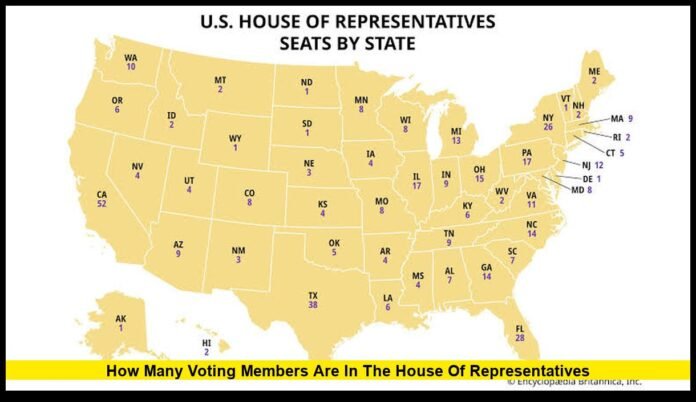

The question of how many voting members are in the house of representatives has a simple standard answer, but the current 2026 membership adds an important detail: the chamber is designed for 435 voting Representatives, while four seats are currently vacant.
As of August 21, 2026, the U.S. House has 431 voting Representatives serving, with four voting seats vacant. The House remains a 435-seat chamber under federal law. The current vacancies do not reduce the permanent size of the House.
That distinction matters because people often use the terms “House membership,” “voting members,” and “House seats” interchangeably. They are related, but they do not always describe the same number.
For anyone looking for the standard civics answer, the figure is 435 voting Representatives. For anyone checking the current composition of the chamber, the number of Representatives actually serving is 431.
The House Has 435 Voting Seats
Federal law fixes the House at no more than 435 voting Representatives. Those seats are distributed among the 50 states according to population.
Each voting Representative serves a specific congressional district. The number of districts assigned to each state depends on its population after the decennial census.
The House’s official directory describes the number of voting Representatives as fixed by law at no more than 435. It also distinguishes those Representatives from the non-voting delegates representing U.S. territories and the District of Columbia.
The 435-seat structure has remained the central figure used for House membership for many decades.
It does not mean that every one of those seats must be occupied every day. A resignation, death or other departure can leave a congressional district without a Representative until the vacancy is filled.
That is exactly what has happened in several districts during the current Congress.
How Many Are Serving Right Now?
As of August 21, 2026, the House has 431 voting Representatives.
Four voting seats are vacant.
The current House party breakdown lists:
- 218 Republicans
- 212 Democrats
- 1 Independent
- 4 vacancies
That produces 431 Representatives currently serving. The House Press Gallery’s current membership information lists the same breakdown and identifies the four vacancies.
This means the chamber is four members short of its full 435 voting membership.
The difference is temporary. Once the vacant districts elect successors and those Representatives take office, the number of serving voting members can return to 435.
Where Are the Four Vacant Seats?
The four current vacancies are spread across California, Florida, Georgia and Texas.
They are:
| State | District | Current status |
|---|---|---|
| California | 14th | Vacant |
| Florida | 20th | Vacant |
| Georgia | 13th | Vacant |
| Texas | 23rd | Vacant |
These vacancies occurred during 2026 as Representatives left office or died.
California’s 14th District became vacant after Eric Swalwell resigned on April 14. A special election was held on August 18, but the House’s current records still list the seat as vacant.
Texas’ 23rd District became vacant after Tony Gonzales resigned on April 14. Florida’s 20th District became vacant following Sheila Cherfilus-McCormick’s resignation on April 21.
Georgia’s 13th District became vacant following the death of David Scott on April 22.
The timing of special elections differs by state, so vacancies can remain open for weeks or months.
Why 435 Is Still the Correct Standard Answer
The current vacancies can make the answer appear confusing.
Someone asking how many voting members the House has may expect the number currently holding office. Someone studying U.S. government or preparing for a civics examination is generally looking for the permanent number established for the House.
That standard figure is 435.
The House has not been reduced to 431 seats.
Instead, four of its 435 seats are temporarily vacant.
Think of it as a building with 435 designated offices. If four offices are empty, the building still has 435 offices. The number of people currently occupying them is simply lower.
The same principle applies to House membership.
Why the Number of House Seats Is Fixed
The size of the House changed considerably during the early history of the United States.
As the nation expanded and its population increased, Congress added Representatives. The chamber eventually became increasingly crowded.
Congress later adopted a system designed to keep the House from growing indefinitely.
The Permanent Apportionment Act of 1929 fixed the number of Representatives at 435 and created a framework for reapportioning those seats after each decennial census.
The law did not permanently assign the same number of Representatives to each state.
Instead, the 435 seats are divided among states based on population.
That approach allows representation to change after each census while keeping the overall size of the chamber under control.
How Population Determines House Representation
The House is based on population representation.
States with larger populations receive more congressional districts. States with smaller populations receive fewer.
Every state receives at least one Representative.
After each census, the federal government calculates how the 435 seats should be distributed among the states.
That process is known as apportionment.
Once the seats are apportioned, states determine the boundaries of their congressional districts under applicable federal and state requirements.
The result is a House in which the total number of voting seats remains 435 even though the distribution among states can change.
This is one reason the answer remains stable nationally while individual states can gain or lose congressional representation.
Read More – 2026 House Incumbent Primary Losses Reach Nine as Anti-Incumbent Wave Grows
What About the Non-Voting Members?
The House also includes members who do not have the same voting authority as Representatives from the states.
The House currently has five delegates and one Resident Commissioner.
These positions represent:
- District of Columbia
- Puerto Rico
- Guam
- American Samoa
- U.S. Virgin Islands
- Northern Mariana Islands
The House directory distinguishes these members from the 435 voting Representatives.
The distinction is important because the phrase “House members” can refer to everyone serving in the chamber, while “voting Representatives” refers specifically to members representing the states.
The non-voting members can participate in congressional work under House rules. They can introduce legislation and take part in committee proceedings, but they do not have a final floor vote in the House in the same way voting Representatives do.
Therefore, the presence of these additional members does not change the standard answer of 435 voting Representatives.
Why Vacancies Happen
House seats can become vacant for several reasons.
A Representative may resign before the end of a term. A Representative may die while serving. Other circumstances can also create a vacancy.
When that happens, the congressional district does not permanently lose representation.
Instead, the vacancy remains until the seat is filled through the required election process.
The Constitution provides for House vacancies to be filled by election. The exact process and timing can differ from state to state.
This is why the number of active Representatives can temporarily fall below 435.
The House does not appoint a permanent replacement simply because a seat becomes empty. The appropriate electoral process must take place before the successor can take office.
What Happens After a Special Election?
Winning an election does not by itself mean the person immediately becomes a voting Representative on the House floor.
The elected successor must complete the required process and take the oath of office.
After that occurs, the House membership records are updated.
The number of filled voting seats then increases by one.
For example, if one of the four current vacancies is filled and the successor is sworn in, the number of serving voting Representatives would rise from 431 to 432.
If all four vacancies are filled, the House would again have 435 seated voting Representatives.
The permanent number of seats does not change during this process.
Does a Vacancy Change the House Majority?
Vacancies can affect the practical balance of power in the House.
The House’s full voting membership is 435. A majority of that full number is 218.
The current House has 431 seated voting Representatives because four seats are vacant.
The current party breakdown gives Republicans 218 seats, Democrats 212 seats and one Independent.
That makes the current political arithmetic especially important.
Republicans hold 218 seats, which is exactly half of the full 435-seat House plus one.
The number of occupied seats can affect how closely party totals are compared, especially when discussing narrow margins.
However, vacancies do not permanently alter the size of the chamber.
They simply reduce the number of members actually serving until elections fill the open districts.
How Long Do House Representatives Serve?
Each voting Representative serves a two-year term.
House elections occur every two years, making the entire chamber subject to regular election cycles.
This differs from the Senate, where senators serve six-year terms and only about one-third of the seats are normally up for election at one time.
The two-year House term is one reason the chamber can experience frequent changes in membership.
Members can leave office before their terms expire, and special elections can bring new Representatives into the chamber.
The overall structure remains the same even as individual membership changes.
How the House Differs From the Senate
The House and Senate form the two chambers of Congress, but their membership systems are different.
The House has 435 voting seats.
The Senate has 100 senators, with two representing every state.
House representation is based primarily on population. Senate representation gives every state equal representation.
That means California has far more voting Representatives than a smaller state, while both states have two senators.
For the House, population changes can affect the distribution of congressional districts after a census.
The national House total, however, remains capped at 435 under the current system.
Why the 435 Figure Matters
The 435 figure affects far more than a basic civics question.
It determines the overall size of the House and provides the foundation for calculating congressional representation across the country.
It also helps voters understand why congressional districts exist and why states have different numbers of Representatives.
A state with a large population may have many congressional districts.
A state with a smaller population may have only one.
Every district is still one of the 435 voting seats assigned to the states.
This structure creates a direct connection between population, congressional districts and representation in the House.
Can Congress Increase the Number of Voting Members?
The current number is not permanently protected from change.
Congress has the authority to change the statutory size of the House.
However, under the current law, the chamber is limited to 435 voting Representatives.
Changing that number would require Congress to change the governing federal law.
Until such a change occurs, 435 remains the established national total.
The four current vacancies therefore do not represent a reduction in the legal size of the House.
They are temporary openings within the existing 435-seat structure.
The Difference Between Seats and Members
One of the easiest ways to understand the current situation is to separate three terms: seats, members and vacancies.
A seat is a congressional position assigned to a district.
A member is the person currently serving in that position.
A vacancy means the seat exists but currently has no serving Representative.
Under the current situation:
- 435 voting seats exist.
- 431 voting Representatives are serving.
- 4 voting seats are vacant.
That is why two different numbers can both appear in discussions about House membership.
The answer depends on whether the question is asking about the House’s full authorized size or its current active membership.
What Is the Answer for U.S. Civics Questions?
For a standard U.S. government or civics question, the expected answer is 435 voting Representatives.
That number is the established size of the House’s voting membership under current federal law.
The current vacancies do not change that standard answer.
However, if someone asks specifically how many voting Representatives are serving at this moment, the current figure is 431.
This distinction is particularly useful in 2026 because four seats are vacant.
It also explains why different House-related figures may appear in current reports.
A historical or educational source may state 435, while a current membership page may show 431 active Representatives.
Both figures can be correct when used in the proper context.
Current Numbers at a Glance
| House category | Current figure |
| Voting seats authorized | 435 |
| Voting Representatives serving | 431 |
| Vacant voting seats | 4 |
| Republicans | 218 |
| Democrats | 212 |
| Independent | 1 |
| Delegates | 5 |
| Resident Commissioner | 1 |
The current House membership data confirms that four voting seats remain vacant while the chamber’s full structure remains based on 435 voting Representatives.
Bottom Line
The clearest answer is 435 voting Representatives when referring to the established size of the U.S. House.
As of August 21, 2026, however, only 431 voting Representatives are serving because four congressional districts currently have vacant seats.
Those vacancies are temporary and do not reduce the House’s legal size.
The four open seats are in California’s 14th District, Florida’s 20th District, Georgia’s 13th District and Texas’ 23rd District.
The distinction between the full 435-seat structure and the current 431-member active voting membership is the key point for understanding the latest House numbers.
Have thoughts on the current House membership or the four open seats? Share your view and stay updated as congressional membership changes.