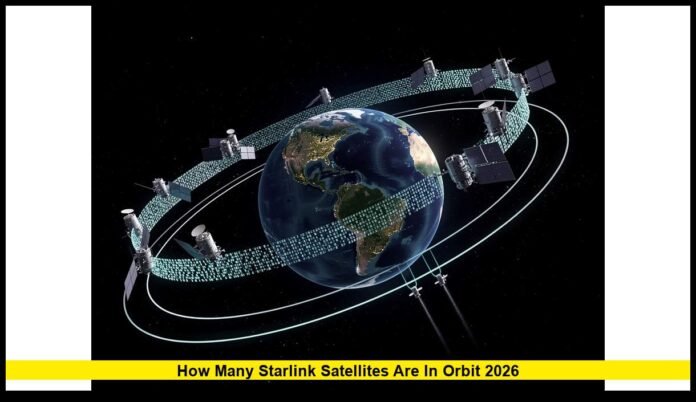

The global fascination with SpaceX’s Starlink network continues to grow, and one question dominates space and tech discussions: how many Starlink satellites are in orbit? As of January 2026, verified satellite-tracking data confirms that more than 5,630 Starlink satellites are active around Earth, forming the world’s largest orbital communication system. The ever-expanding constellation has transformed how people access the internet and how humanity interacts with space.
Starlink’s Current Orbital Footprint
Starlink began in 2019 as a bold project within SpaceX, aiming to build a low-Earth-orbit (LEO) network capable of delivering broadband to virtually every corner of the globe. In just seven years, it has grown into a complex infrastructure of thousands of satellites, ground stations, and user terminals operating across dozens of nations.
As of the first week of January 2026:
- Satellites launched since 2019: approximately 6,320
- Operational and transmitting satellites: about 5,630
- Inactive or deorbited satellites: near 690
That number changes monthly, as Falcon 9 rockets continue to launch new units while older ones retire. At least one Starlink mission lifts off every week, keeping the network in a constant state of renewal and expansion.
How Starlink Reached This Scale
The project’s incredible speed of growth is tied directly to SpaceX’s advances in reusable launch technology. The company’s Falcon 9 rocket has become the workhorse of modern spaceflight, completing more than 300 launches since its introduction. Its first-stage boosters can fly repeatedly—some over 20 times—slashing launch costs and enabling mass deployment.
When Starlink started, skeptics doubted the feasibility of managing thousands of satellites simultaneously. By 2026, that skepticism has evaporated. SpaceX now operates nearly half of all active satellites in orbit, a feat unmatched in aerospace history.
Annual Progress: From Dozens to Thousands
| Year | Total Launched | Operational by Year-End | Milestone |
|---|---|---|---|
| 2019 | 60 | 60 | First Starlink batch deployed |
| 2020 | ~900 | ~850 | Beta internet service introduced |
| 2021 | ~1,900 | ~1,700 | Coverage reaches North America and Europe |
| 2022 | ~3,300 | ~3,000 | Service expands to maritime markets |
| 2023 | ~4,800 | ~4,400 | Launch rate exceeds 60 missions per year |
| 2024 | ~5,500 | ~5,100 | Direct-to-device tests begin |
| 2025 | ~6,100 | ~5,600 | Laser-linked mesh network operational |
| 2026 | ~6,320 | ~5,630 | Active constellation across 70+ nations |
This steady, predictable rhythm has allowed SpaceX to perfect every part of the system—from orbital deployment to end-user performance.
The Architecture of the Constellation
Starlink’s structure differs from traditional communications satellites. Instead of a few large spacecraft in high orbits, the network uses thousands of small satellites flying much closer to Earth.
Altitudes and Orbits
Most Starlink units operate between 340 km and 550 km above Earth’s surface. These low altitudes provide:
- Low latency: typically 20–30 milliseconds.
- Faster data transfer: shorter distances mean less signal loss.
- Natural deorbiting: atmospheric drag ensures retired satellites burn up within a few years.
The constellation is divided into multiple “shells,” or layers, at varying altitudes and inclinations. Together, these shells ensure seamless coverage from the equator to the poles.
| Shell | Altitude (km) | Inclination | Coverage Focus |
|---|---|---|---|
| 1 | 550 | 53° | North America, Europe, Asia |
| 2 | 540 | 70° | Northern latitudes |
| 3 | 560 | 97.6° | Polar regions |
| 4 | 350 | 53° | Low-latency global routes |
| 5 | 340 | 43° | Equatorial regions |
Each satellite communicates with several others through laser interlinks, creating a space-based data web that minimizes dependence on ground stations.
Inside a Starlink Satellite
Starlink satellites are compact marvels of engineering. Each weighs roughly 573 pounds (260 kilograms) and unfolds a single solar array once in orbit. Despite their size, they pack advanced features that rival far larger spacecraft.
Key systems include:
- Phased-array antennas capable of steering signals electronically without physical movement.
- Krypton-powered ion thrusters for orbital adjustments and collision avoidance.
- Laser communication terminals linking satellites directly to one another.
- High-efficiency solar cells supplying continuous power.
- Autonomous navigation software that allows self-positioning within orbital shells.
Since 2023, SpaceX has introduced the Starlink V2 Mini, an upgraded design with stronger antennas, higher data throughput, and built-in support for direct-to-cellular connectivity.
Direct-to-Cell and Next-Generation Service
One of Starlink’s most revolutionary steps came in late 2025, when it began limited direct-to-cell service in partnership with U.S. carriers. The technology enables ordinary smartphones to send text messages via satellite—no ground towers required.
The 2026 roadmap extends that capability to voice and data. Once complete, it will allow mobile coverage literally everywhere on Earth, including oceans, mountains, and deserts.
This innovation depends heavily on Starlink’s satellite density. A single satellite only covers a small footprint; thousands are needed to guarantee uninterrupted service. That reality underscores why the answer to how many Starlink satellites are in orbit continues to climb.
Launch Operations in the United States
Nearly all Starlink launches originate from U.S. soil, highlighting the country’s growing leadership in commercial spaceflight. SpaceX routinely flies from:
- Kennedy Space Center (LC-39A) – Florida’s Atlantic coast.
- Cape Canaveral Space Force Station (SLC-40) – nearby facility for frequent missions.
- Vandenberg Space Force Base (SLC-4E) – California site serving polar orbits.
Each Falcon 9 carries 20 to 23 satellites per flight, releasing them into an initial parking orbit. After deployment, satellites use onboard propulsion to climb to their final positions over several weeks.
SpaceX’s booster reusability allows incredible efficiency. A single rocket first stage can support dozens of Starlink missions, making rapid expansion economically sustainable.
Safety and Debris Management
With thousands of objects in orbit, responsible operations are essential. SpaceX has developed one of the most advanced orbital safety programs in the industry.
Debris Mitigation Practices
- Automatic avoidance: satellites maneuver autonomously when collision risk is detected.
- End-of-life deorbiting: inactive units lower their altitude and disintegrate within 5 years.
- Brightness reduction: coatings and visors minimize reflectivity to protect astronomical research.
- Continuous tracking: onboard GPS and global radar networks monitor every unit’s location.
As a result, Starlink satellites account for a large portion of objects in low Earth orbit but maintain a strong record of safe operations.
Starlink’s Reach in 2026
Starlink’s service footprint now spans more than 70 countries and all seven continents. The system provides broadband to homes, businesses, emergency responders, ships, aircraft, and military operations.
Key Market Segments
- Residential users: millions of customers in the U.S., Canada, Europe, and Australia.
- Commercial and enterprise: mining sites, offshore rigs, remote construction projects.
- Government and defense: field communications and emergency response.
- Maritime and aviation: global in-motion connectivity.
Typical Performance
- Download speeds: 50 – 250 Mbps
- Upload speeds: 10 – 40 Mbps
- Latency: 20 – 40 ms
Continuous satellite additions help maintain consistent performance as subscriber numbers rise.
Economic Impact
Starlink has evolved into one of SpaceX’s largest revenue streams, with annual income estimated in the billions. These funds directly support broader company goals, including Starship development and interplanetary exploration initiatives.
For the United States, Starlink represents a major success story in commercial space enterprise. It has:
- Created thousands of manufacturing and engineering jobs.
- Strengthened domestic launch infrastructure.
- Advanced the nation’s leadership in satellite networking technologies.
The U.S. now dominates the global small-satellite sector, largely because of SpaceX’s scalable model.
Competitors in the Orbital Internet Race
Other companies are building their own constellations, but none yet match Starlink’s size or operational maturity.
Key Challengers
- Project Kuiper (Amazon): preparing to launch over 3,000 satellites by 2029.
- OneWeb: roughly 630 satellites in medium-Earth orbit targeting enterprise users.
- Telesat Lightspeed: focusing on government and industrial broadband.
Starlink’s head start, frequent launches, and direct consumer sales have made it the most visible and widely used system in the LEO internet sector.
Environmental and Astronomical Cooperation
The astronomical community initially raised concerns about satellite brightness affecting night-sky observations. In response, SpaceX collaborated with observatories to develop mitigation techniques.
Key improvements include:
- DarkSat coatings and VisorSat shades reducing reflected sunlight.
- Attitude adjustments to minimize glare during twilight passes.
- Coordination protocols with observatories for predictive tracking.
By 2026, these measures have substantially reduced Starlink’s brightness profile, earning cautious praise from astronomers who once criticized the constellation.
The Transition to Starlink Gen 2
The next chapter in Starlink’s evolution is well underway. The Gen 2 constellation features larger satellites with more power and bandwidth. In late 2024, U.S. regulators cleared SpaceX to deploy 7,500 Gen 2 satellites, supplementing and gradually replacing earlier models.
Gen 2 Enhancements
- Higher throughput per satellite.
- Greater interference resistance.
- Expanded inter-satellite laser network for faster global routing.
- Improved resilience through AI-driven network management.
Hundreds of Gen 2 units are already operational as of early 2026, enhancing connectivity in the Northern Hemisphere and enabling new service tiers for enterprise users.
Monitoring the Fleet
Tracking thousands of active spacecraft requires transparency. Independent databases—such as Celestrak and open-source satellite trackers—monitor Starlink’s positions, ensuring that every object’s orbit is publicly logged.
Amateur observers also play a role, providing visual sightings that help verify maneuvers and deorbit events. The cooperative nature of this monitoring system sets a new standard for accountability in commercial space operations.
The Role of Artificial Intelligence
Starlink’s scale would be impossible to manage manually. Machine-learning algorithms handle orbit maintenance, signal routing, and network optimization. These systems analyze millions of data points daily, predicting potential collisions and adjusting satellite paths automatically.
AI also helps allocate bandwidth dynamically, prioritizing regions experiencing high demand. This automation ensures that users worldwide receive consistent, high-quality service even as the constellation grows.
Social and Humanitarian Benefits
Starlink has delivered tangible benefits beyond convenience. Its global reach has made it a lifeline in emergencies and underserved areas.
Notable Achievements
- Disaster zones: temporary internet for hurricane- and wildfire-affected communities.
- Rural education: reliable online learning in regions lacking infrastructure.
- Medical outreach: telemedicine support in remote hospitals.
- Conflict areas: rapid deployment of communication networks where traditional systems fail.
These contributions underscore Starlink’s dual role as both a commercial enterprise and a humanitarian resource.
Public Reception
Public perception of Starlink has shifted from curiosity to appreciation. Early adopters praised the simple setup—a small terminal and Wi-Fi router—but recent hardware improvements have made the system even more user-friendly.
Businesses in rural America have especially embraced it, citing reliable speeds and minimal downtime. Critics remain cautious about space-traffic congestion, yet most acknowledge SpaceX’s transparency and proactive safety policies.
Looking Ahead
By mid-decade, Starlink aims to maintain a constellation of up to 12,000 satellites, with long-term authorization for as many as 30,000 if needed. Whether that full number materializes depends on demand and regulatory approval, but the momentum is undeniable.
SpaceX plans to transition bulk deployment to its Starship rocket, which can carry hundreds of satellites per launch—dramatically increasing efficiency. If achieved, this next phase will move the network from thousands to tens of thousands of satellites in just a few years.
The Present Answer
So, how many Starlink satellites are in orbit right now? As of January 2026, approximately 5,630 active satellites form the operational constellation, orbiting between 340 km and 550 km above Earth. Including retired and deorbited units, SpaceX has launched over 6,300 Starlink satellites since 2019.
This vast fleet delivers high-speed, low-latency internet across land, sea, and air—an achievement once thought impossible. Each new launch adds resilience, redundancy, and reach to a system that already spans the planet.
The Starlink story is still being written. With each new launch, the night sky grows busier—and humanity grows more connected. Keep an eye on the stars; the next breakthrough may already be on its way into orbit.