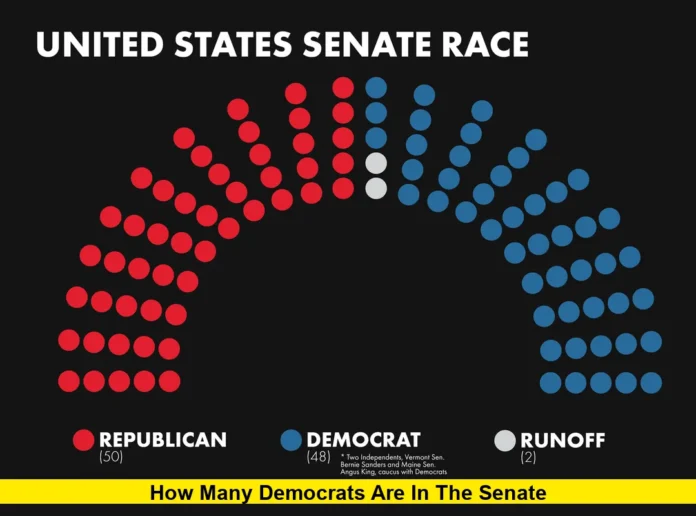

How Many Democrats Are in the Senate is a common question as Americans follow congressional power dynamics. As of the latest verified updates, the U.S. Senate has 45 Democratic senators, while two independent senators — Bernie Sanders of Vermont and Angus King of Maine — caucus with Democrats, giving the Democratic caucus an effective working total of 47 members.
The Senate currently has 100 members, with Republicans holding the majority at 53 seats. Democrats hold 45 seats, and the two independent senators who align with Democrats play an important role in Senate organization and voting strategies.
The party balance in the Senate affects which party controls committees, sets the legislative agenda, and determines how easily major bills move through the chamber.
Current Democratic Strength in the U.S. Senate
The current Senate breakdown is:
| Party | Number of Senators |
|---|---|
| Republicans | 53 |
| Democrats | 45 |
| Independents who caucus with Democrats | 2 |
| Total Senate Seats | 100 |
Although Democrats are not the majority party, their caucus includes the two independent senators who participate with them in organizational matters. This means the Democratic side generally operates with 47 members when counting caucus alignment.
How the Democratic Senate Caucus Works
The Senate Democratic Caucus is the formal group representing Democratic senators and the two independent senators who choose to caucus with Democrats. The caucus helps coordinate legislative priorities, committee assignments, leadership decisions, and voting strategies.
The Democratic leadership team includes:
- Chuck Schumer of New York — Senate Democratic leader
- Dick Durbin of Illinois — Democratic whip
- Mark Warner of Virginia — Democratic caucus leadership role
Leadership positions help organize the party’s approach to legislation, negotiations, and Senate debates.
Why the Number of Democratic Senators Matters
The number of Democratic senators directly affects the party’s influence in Washington. The Senate operates differently from the House of Representatives because each state receives two senators regardless of population.
With 53 Republicans and 47 members in the Democratic caucus, Republicans control the chamber. The majority party typically has greater influence over committee leadership, scheduling decisions, and which legislation receives consideration.
However, Senate rules often require cooperation between both parties for major legislation. Because many bills need more than a simple majority to overcome procedural hurdles, the minority party can still play a significant role.
States Represented by Democratic Senators
Democratic senators currently represent states across different regions of the country, including large states such as California and New York, as well as smaller states such as Delaware and Vermont.
Some states have two Democratic senators, while others have one Democratic senator paired with a Republican senator.
Examples of states with Democratic Senate representation include:
- California
- New York
- Illinois
- Massachusetts
- Washington
- Maryland
- Michigan
- Minnesota
- Pennsylvania
- Colorado
The Senate’s structure means Democrats must maintain support across many different types of states to increase their number of seats.
Independent Senators Who Caucus With Democrats
Two independent senators are counted separately from the Democratic Party but work with the Democratic caucus:
- Bernie Sanders of Vermont
- Angus King of Maine
Both senators have historically aligned with Senate Democrats for organizational purposes, including committee assignments and caucus meetings.
Their participation means the Democratic side has more voting strength than the official party number alone suggests.
Democrats’ Position in the Current Senate
The Democratic Party entered the 119th Congress as the Senate minority after Republicans gained control of the chamber. Republicans hold 53 seats, compared with 45 Democratic senators and two Democratic-aligned independents.
As the minority party, Senate Democrats focus on influencing legislation through negotiations, amendments, procedural votes, and coalition-building.
The party’s ability to block or shape legislation depends on Senate rules and whether Republicans can secure enough votes within their own caucus.
Upcoming Senate Elections and Potential Changes
The Senate lineup can change after elections, retirements, resignations, or special elections. The next major opportunity for voters to reshape the chamber comes during the 2026 Senate elections, when multiple seats will be contested.
Democrats will attempt to gain seats to challenge Republican control, while Republicans will work to defend their majority.
The final balance after future elections will determine which party controls Senate leadership, committees, and legislative priorities.
Democratic Senators and Their Role in National Politics
Democratic senators influence national policy debates involving areas such as healthcare, the economy, environmental policy, judicial nominations, national security, and federal spending.
Even without a Senate majority, Democratic senators can affect outcomes through negotiations and bipartisan agreements. The Senate’s requirement for cooperation often makes individual senators influential during closely divided votes.
The current Democratic caucus remains a major force in the chamber because of its size, leadership structure, and alliance with independent senators.
How Senate Numbers Can Change
The number of Democratic senators can change through several events:
- General Senate elections held every two years
- Special elections after vacancies
- Senators changing party affiliation
- Retirements or resignations
Because only about one-third of Senate seats are normally contested at a time, control of the chamber often changes gradually rather than all at once.
Current Answer: How Many Democrats Are in the Senate?
The direct answer is that there are 45 Democratic senators in the U.S. Senate today. When the two independent senators who caucus with Democrats are included, the Democratic caucus has 47 members.
The Senate remains controlled by Republicans with a 53-seat majority, making the current Democratic delegation the minority party in the chamber.
The Senate balance of power continues to shape decisions in Washington, and future elections could change the numbers. Share your thoughts on the current Senate makeup and stay updated as new developments emerge.