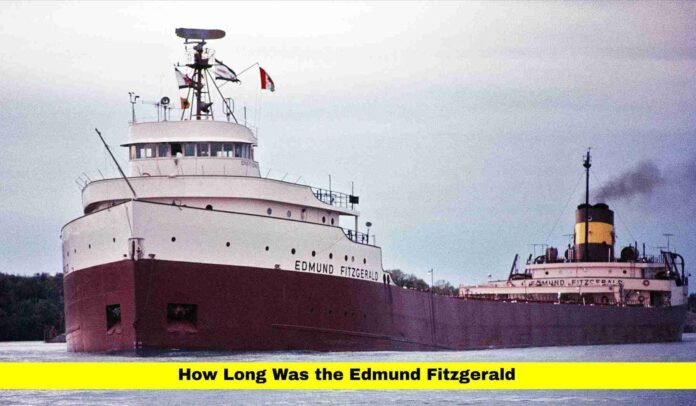

When people ask how long was the Edmund Fitzgerald, the answer reveals more than a number—it uncovers a story of engineering, history, and tragedy. The Great Lakes freighter measured 729 feet (222 meters) in length, making it the largest ship on the Great Lakes when it was launched in 1958. Its sheer size contributed to its fame, its operational success, and the legend that still surrounds it today.
Key Points Summary
- The Edmund Fitzgerald was 729 feet long, 75 feet wide, and 39 feet deep.
- Built in 1958, it was the largest ship on the Great Lakes at the time.
- The vessel sank in November 1975, taking all 29 crew members with it.
- Her massive length allowed her to carry record cargoes of iron ore.
- Even today, her length and story remain symbols of Great Lakes maritime history.
The Design and Dimensions of the Edmund Fitzgerald
The Edmund Fitzgerald was a marvel of mid-20th-century engineering. Constructed by the Great Lakes Engineering Works in River Rouge, Michigan, she was launched on June 7, 1958, to great fanfare. Her owner, the Northwestern Mutual Life Insurance Company, commissioned the ship to transport taconite iron ore from the mines near Duluth, Minnesota, to steel mills in the Great Lakes region.
At 729 feet in length, the Fitzgerald was the longest vessel on the Great Lakes at her debut. The ship’s beam (width) measured 75 feet, while her depth was 39 feet. Her enormous hull could hold over 26,000 tons of taconite pellets—an impressive capacity that made her both economically and industrially vital.
Her massive size wasn’t just for show—it reflected the era’s push for more efficient bulk transport. The Fitzgerald’s size allowed her to move more material in fewer trips, reshaping Great Lakes shipping standards.
Why Her Length Was So Significant
The Edmund Fitzgerald’s 729-foot length wasn’t just a statistic—it defined her role and her fame.
At the time of her launch, the Great Lakes shipping industry was undergoing a transformation. Companies were racing to build “maximum-size freighters”—ships as large as the Great Lakes locks and channels would allow. The Fitzgerald reached those limits, which made her the pride of the fleet.
Her extraordinary size had multiple implications:
- Record-breaking cargo capacity: She could haul over 26,000 long tons of iron ore in one trip.
- Efficiency: Fewer voyages meant lower costs and faster deliveries for steel mills.
- Visibility: Her size made her instantly recognizable to maritime watchers and photographers across the Lakes.
Because of her remarkable dimensions, the Fitzgerald became known as the “Queen of the Great Lakes.”
The Role of Her Size in Day-to-Day Operations
The Fitzgerald’s length also defined how she was operated. Her 21 cargo hatches lined the deck, covering enormous holds that could be filled in a matter of hours at ore docks in Superior, Wisconsin. Her powerful engines could push the 13,600-ton empty ship and its 26,000-ton cargo across the sometimes unpredictable Great Lakes.
Despite her size, she was gracefully designed and handled well under most conditions. Her captain and crew often spoke proudly of her performance, noting that she moved through the water with surprising stability.
However, her enormous length also presented challenges. Maneuvering through tight ports and locks required precision and experience. During storms, her long frame could flex and twist, creating dangerous stresses on the hull.
The Edmund Fitzgerald’s Final Voyage
On November 9, 1975, the Edmund Fitzgerald left Superior, Wisconsin, fully loaded with 26,116 tons of taconite pellets, bound for Detroit. Another freighter, the Arthur M. Anderson, followed close behind.
As a severe storm developed over Lake Superior, waves reached heights of 25 feet, with winds over 60 miles per hour. The Fitzgerald’s last known position was near Whitefish Bay, Michigan. On the evening of November 10, 1975, radio contact was lost. The ship disappeared beneath the surface, taking all 29 crew members with it.
Her length of 729 feet played a factor in later analyses of the disaster. Some experts suggested that the ship’s long, narrow hull might have flexed under stress, contributing to the rapid breakup of the vessel in the massive waves.
Technical Specifications of the Edmund Fitzgerald
| Specification | Detail |
|---|---|
| Length Overall | 729 feet (222 meters) |
| Beam (Width) | 75 feet (23 meters) |
| Depth | 39 feet (12 meters) |
| Gross Tonnage | 13,632 tons |
| Cargo Capacity | Over 26,000 long tons |
| Year Launched | 1958 |
| Year Sank | 1975 |
| Builder | Great Lakes Engineering Works, Michigan |
These figures underline why she was considered the largest and most powerful ship on the Great Lakes during her service.
Impact of Her Length on Great Lakes Shipping
The Edmund Fitzgerald’s design influenced shipbuilding for years. Her 729-foot length set the upper limit for vessels using the St. Lawrence Seaway and the Soo Locks at the time.
Her success encouraged the construction of more long freighters, some even larger in the decades that followed. However, her tragic end also led to new safety regulations:
- Stronger hull construction requirements
- Improved weather forecasting for Lake Superior
- Mandatory use of depth finders and survival suits on large freighters
Thus, her length became both a symbol of innovation and a reminder of vulnerability.
Cultural Legacy and Modern Recognition
Even after half a century, the Edmund Fitzgerald remains one of the most recognized names in maritime history. Her immense size and mysterious loss have been immortalized through songs, documentaries, and annual memorials.
The Great Lakes Shipwreck Museum in Whitefish Point, Michigan, continues to display artifacts from the Fitzgerald. Divers who have visited the wreck, which lies about 530 feet beneath Lake Superior, describe the hull as largely intact but split near the bow—again emphasizing how her length may have contributed to the ship’s final moments.
The ship’s story is also told in Gordon Lightfoot’s 1976 song “The Wreck of the Edmund Fitzgerald,” which poetically recounts the tragedy. The song’s enduring popularity keeps public attention on the ship’s length, power, and mystery.
Modern Perspective: The Meaning of 729 Feet
Today, ships longer than the Fitzgerald operate on the Great Lakes, but her 729-foot length remains iconic. It represents a turning point in maritime design—when shipbuilders pushed the boundaries of what the inland seas could handle.
For historians and ship enthusiasts, her dimensions are more than technical specifications—they’re part of her identity. Her scale makes it easier to imagine the magnitude of the storm that claimed her and the strength required to navigate such vast inland waters.
Even 50 years later, those numbers—729 feet long, 75 feet wide, 39 feet deep—still resonate with anyone who studies or remembers the Great Lakes shipping industry.
Final Thoughts
For anyone wondering how long was the Edmund Fitzgerald, the answer is 729 feet—but that number represents much more than a measurement. It stands as a symbol of human ingenuity, industrial ambition, and the unpredictable power of nature.
The Fitzgerald’s immense size was both her strength and, perhaps, her downfall. Her story remains a cornerstone of maritime history, forever tied to the waters of Lake Superior and the memories of the crew who sailed her last voyage.
What do you think—should her massive design have been celebrated or reconsidered? Share your thoughts and reflections below.