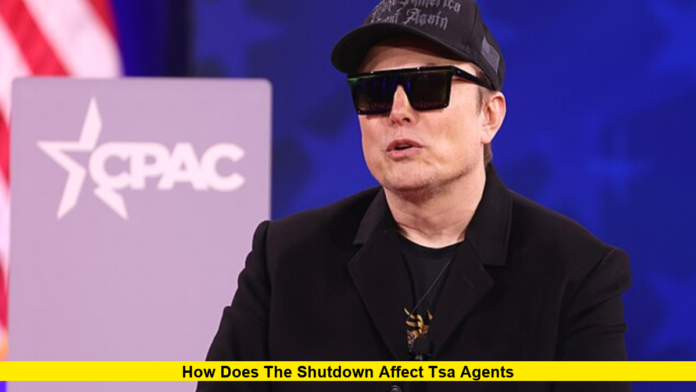

The partial government shutdown has now dragged into its fifth week, and the question millions of Americans are asking is: how does the shutdown affect TSA agents, and what happens to airport safety when the people guarding America’s skies stop getting paid? This week, Elon Musk’s shocking offer to personally cover TSA salaries put the crisis squarely in the national spotlight — and the fallout has been fast, fierce, and deeply political.
If you’re flying anywhere in the United States right now, this story affects you directly. Keep reading.
The Shutdown That Won’t End
The Department of Homeland Security funding lapse began on February 14, 2026, when Congress failed to pass a new appropriations bill before the deadline. That single failure in Washington set off a chain reaction that is now being felt at every major airport in the country.
More than 50,000 Transportation Security Administration officers have been reporting to work every day since then — without a single paycheck. These are the agents running the body scanners, checking your carry-on bags, and making sure dangerous items never make it onto a plane. They are doing one of the most critical security jobs in the country, and right now, many of them cannot afford groceries.
TSA agents across the country have turned to food pantries and community donation drives just to cover basic needs. Senator John Fetterman of Pennsylvania, a Democrat, went public with that reality this week, calling the situation something that should never have been allowed to happen. He remains, by his own account, the only Democrat in the Senate who has voted alongside Republicans to fully fund the Department of Homeland Security and end the standoff.
Airport Lines Are Already Breaking Down
The staffing pressure is no longer invisible. At major hubs including George Bush Intercontinental Airport in Houston, travelers faced two-hour wait times at TSA security checkpoints on Friday alone — and that was the day before spring break travel surged even higher.
A top TSA union leader issued a warning this week that the situation is only going to get worse. The agency has been under a hiring freeze since last year, meaning there is no pipeline of new workers ready to fill gaps as current agents call out, resign, or simply become too financially strained to continue showing up.
Transportation Secretary Sean Duffy went even further, warning publicly that smaller regional airports could be forced to shut down entirely if Congress does not act soon. That is not a scenario anyone in the aviation industry is treating lightly.
Elon Musk Steps In
On Saturday morning, Elon Musk posted on X — the social media platform he owns — a direct offer to personally fund TSA worker salaries for the duration of the shutdown. The post was brief and blunt: he wanted to cover the pay of TSA personnel whose lives were being negatively affected by the ongoing funding dispute.
The math behind that offer is staggering. With an annual workforce cost of roughly $8.6 billion, keeping TSA officers paid would run approximately $23.6 million per day out of Musk’s own pocket.
Whether the offer could ever become reality is a different question entirely. Federal law generally prohibits government workers from receiving outside compensation tied to their official duties, meaning the legal path forward is murky at best. No government agency has responded with a formal plan to accept or process the offer, and no timeline has been discussed publicly.
Still, the gesture landed like a thunderclap across Washington.
Political Reactions Come Fast From Both Sides
Senator Fetterman was quick to praise the offer, calling it incredibly generous and using the moment to sharpen his criticism of fellow Democrats who he says are prolonging the shutdown over immigration-related demands.
Republican Senator Mike Lee also responded positively, adding to what became a rare and brief moment of cross-party agreement around the human cost of the standoff.
President Trump, however, escalated rather than negotiated. About five hours after Musk’s post went live, Trump took to Truth Social and threatened to deploy ICE agents to airports as a substitute security force if Democrats did not immediately agree to a funding deal. The shutdown has not affected ICE, which secured $75 billion in dedicated funding through the One Big Beautiful Bill Act of 2025, covering its operations through 2029.
Congress Remains Gridlocked
A Senate vote on a bill to fund the Department of Homeland Security failed to advance on Friday. Senate Majority Leader John Thune acknowledged that negotiators have narrowed the gaps between the two sides but said no final agreement is in place.
Democrats have made sweeping changes to immigration enforcement operations a condition of any deal. Republicans have pushed back against efforts to fund TSA and other DHS agencies separately from the rest of the department, insisting on a comprehensive solution rather than a piecemeal approach.
The White House did make some movement this week, agreeing in principle to expand the use of body-worn cameras on immigration enforcement agents and to limit enforcement operations near sensitive locations like schools and hospitals. It was not enough to unlock a deal.
What This Means for Travelers
For anyone stepping into an airport right now, the message is simple: build extra time into your travel plans, expect long security lines, and understand that the agents on the other side of those checkpoints are doing their jobs under enormous personal financial strain.
The broader question — whether Musk’s offer signals a new role for private wealth in filling federal government gaps — is one Washington is not ready to answer yet. But with no resolution in sight and spring break travel in full swing, the pressure on Congress is about to get a great deal louder.
Are you feeling the effects of the TSA shutdown at your local airport? Drop your experience in the comments and keep following this story — it is far from over.