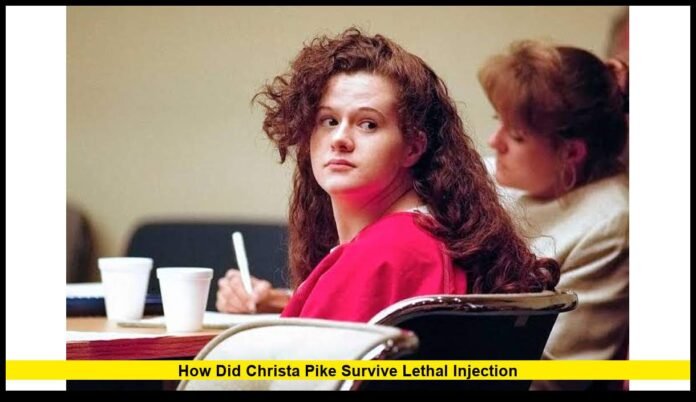

How did Christa Pike survive lethal injection? The latest confirmed information shows that Tennessee administered two doses of pentobarbital during the September 30, 2026, execution attempt, but Christa Pike remained alive. Witnesses reported that she continued breathing and was audibly snoring, while state officials later transported her from Riverbend Maximum Security Institution to an off-site medical facility.
The failed execution has created major questions about what happened inside Tennessee’s execution chamber. However, the exact reason Pike survived has not been officially established.
Tennessee officials said the state’s established execution protocol was followed. Gov. Bill Lee then ordered an independent third-party review and halted the remaining scheduled execution in Tennessee for 2026.
Pike’s case therefore remains active on both medical and legal fronts. The available evidence confirms that the execution attempt did not result in her death, but it does not yet establish why the lethal-injection procedure failed.
What Happened to Christa Pike During the Execution Attempt?
Christa Pike was scheduled to be executed at Riverbend Maximum Security Institution in Nashville on September 30, 2026.
The execution faced legal challenges throughout the day. A federal appeals court temporarily stopped the execution shortly before it was scheduled to begin. The U.S. Supreme Court later cleared the way for Tennessee to proceed.
After the legal barriers were removed, prison officials resumed preparations.
The execution eventually began that evening. According to court filings and media witnesses, officials administered two doses of pentobarbital.
The procedure did not produce the intended result.
Pike remained alive after the second dose. Witnesses reported hearing her breathing and snoring. Reports also described moments when she appeared to remain responsive during the procedure.
Officials eventually ended the execution attempt.
Pike was then transported by ambulance to an outside medical facility.
The Tennessee Department of Correction confirmed that she had been taken to an off-site medical facility. The department also stated that officials had followed the state’s established execution protocol.
Those two facts are central to understanding what happened.
Tennessee confirms that its protocol was carried out. Pike survived despite the attempt.
Why Did the Lethal Injection Fail?
There is currently no official finding that identifies one specific reason.
That distinction is important because several explanations have appeared in public discussion. Pike’s attorneys had previously raised concerns about medical issues and the execution process. However, those concerns have not been officially established as the cause of the failed procedure.
The state has not announced that the wrong drug was used.
It has not announced that the pentobarbital was ineffective.
It has not officially determined that an intravenous-access problem caused the failure.
It has also not released a final medical explanation for why Pike survived the two injections.
Instead, Tennessee has ordered an independent review.
That investigation is expected to examine the circumstances surrounding the procedure and determine what went wrong.
Until investigators release verified findings, the safest factual conclusion is that the execution failed despite the administration of two doses of the state’s lethal-injection drug.
What Drug Was Used in Christa Pike’s Execution Attempt?
Pentobarbital was used during the execution attempt.
Court filings and reporting following the incident identified two doses of pentobarbital as having been administered.
Tennessee’s Department of Correction has said that the lethal-injection chemical in its protocol has consistently been effective in previous executions.
The department also stated that the protocol did not authorize officials to continue with additional procedures after the steps carried out that night.
This helps explain why the process did not simply continue indefinitely after the second dose failed to produce death.
The state now has to determine why the approved process did not achieve its intended outcome.
That determination could require examination of the medication, its administration, intravenous access, equipment, timing, personnel actions and other elements of the procedure.
At present, however, no single factor has been officially identified as the cause.
What Did Witnesses Report During the Procedure?
Media witnesses provided some of the clearest public information about the execution attempt.
Their accounts indicated that Pike remained alive after both doses of pentobarbital.
Witnesses reported hearing breathing and loud snoring. They also described unusual activity inside the execution chamber as officials continued the procedure.
Reports said Pike appeared to raise her head during the process.
She was also reported to have complained about discomfort in her arm.
Those observations became especially significant after the state failed to complete the execution.
The witnesses were eventually removed from the viewing area.
The precise sequence inside the chamber remains subject to further investigation because outside witnesses did not have uninterrupted visibility of every action.
That means witness accounts can establish important facts about what they saw and heard, but they cannot independently determine the medical cause of Pike’s survival.
Was Christa Pike Conscious After the Injections?
Witness accounts indicate that Pike showed signs of consciousness during at least part of the procedure.
Reports described her speaking and reacting while officials were attempting to carry out the execution.
After the second dose, witnesses continued to hear sounds indicating that she was alive.
The reports of breathing and snoring are particularly significant because they occurred after the lethal-injection drugs had been administered.
However, the publicly available information does not establish a complete medical assessment of Pike’s consciousness throughout the entire procedure.
There is also no final medical report publicly confirming exactly what Pike experienced physiologically.
For that reason, descriptions of her condition should remain limited to what witnesses and court documents have actually established.
The independent review may provide a clearer timeline.
Why Were Two Doses of Pentobarbital Administered?
Two doses were administered during the attempted execution.
The second dose became particularly important because Pike remained alive after the first administration.
Her attorneys subsequently described the second administration in emergency court filings.
Despite the second dose, Pike continued to show signs of life.
Tennessee’s execution protocol did not allow officials to keep adding procedures indefinitely. The Department of Correction said the protocol had been followed and that it did not authorize additional procedures beyond those performed.
This is one reason the execution eventually stopped.
The state was left with a failed execution rather than a completed one.
The independent review will now have to examine the circumstances surrounding both administrations.
Did Pike’s Medical History Play a Role?
Pike’s attorneys had raised medical concerns before the execution.
Her legal team challenged Tennessee’s lethal-injection method and argued that her medical circumstances could create problems during the procedure.
Among the issues raised before the execution were concerns involving intravenous access and the possibility of severe complications.
Those arguments were part of Pike’s broader legal effort to stop the execution.
However, it is important not to turn those previous claims into established facts about the failed procedure.
The state has not officially concluded that Pike’s medical history caused her survival.
Likewise, investigators have not publicly established that an intravenous-access problem explains what happened.
Those questions remain unresolved.
The upcoming independent review is therefore important because it can distinguish documented facts from allegations and possible explanations.
What Did Tennessee Say About the Failed Execution?
The Tennessee Department of Correction issued a statement after the failed execution.
The department said officials followed every step of the state’s lawful and established execution protocol.
It also said that the lethal-injection chemical used in the protocol had consistently been effective.
The department confirmed that Pike had been transported to an off-site medical facility.
The statement did not provide a detailed explanation for why the procedure failed.
That explanation is now expected to come through the independent review ordered by the governor.
The state’s position is therefore clear on one point: officials say they followed the established procedure.
The reason that procedure failed remains unresolved.
What Did Governor Bill Lee Do After Pike Survived?
Gov. Bill Lee responded by halting Tennessee’s remaining executions for 2026.
He also ordered a comprehensive third-party review of the Pike execution attempt.
The decision means Tennessee will not proceed with the other execution that had remained on the state’s 2026 schedule while the review is underway.
The governor’s action reflects the seriousness of the failure.
A state execution is supposed to follow an established legal and operational process. In Pike’s case, officials administered the designated drug but did not complete the execution.
The review will therefore have to determine exactly what occurred.
It may also help establish whether Tennessee’s existing procedures require changes before executions resume.
No final conclusions from that review had been released as of October 1, 2026.
Where Is Christa Pike Now?
Pike was taken from Riverbend Maximum Security Institution to an off-site medical facility after the failed execution.
Her attorneys said they were not immediately given detailed information about her condition.
The state has confirmed the transfer, but detailed information about her medical status has not been publicly released.
That means reports about specific injuries or long-term medical effects should not be treated as confirmed unless officials or reliable medical documentation establish them.
The confirmed information is narrower.
Pike survived the execution attempt.
She was transported to an outside medical facility.
Her condition became part of the continuing legal and medical questions surrounding the failed procedure.
Was Christa Pike’s Death Sentence Carried Out?
No.
Pike’s death sentence was not carried out on September 30.
The state attempted to execute her through lethal injection, but the procedure ended without her death.
She was subsequently transported for medical treatment.
A failed execution attempt is therefore different from a completed execution.
Her underlying sentence remains a separate legal matter.
The failure of the procedure does not by itself establish that the sentence has been overturned.
Any future action involving Pike’s sentence would have to proceed through the applicable legal system.
As of October 1, 2026, no new execution date had been publicly established.
Could Tennessee Attempt Another Execution?
The legal consequences of Pike’s survival remain unresolved.
Her attorneys are expected to continue challenging the state’s ability to make another attempt.
At the same time, the failed procedure does not automatically erase a death sentence.
There is a longstanding U.S. Supreme Court precedent involving a person who survived an earlier execution attempt. That precedent may become relevant to future legal arguments, although Pike’s case involves its own specific facts and constitutional claims.
The immediate focus is the investigation.
Tennessee must first establish what happened during the September 30 procedure.
Courts could then have to consider the consequences of the failed execution and any future attempt.
Because those proceedings have not been completed, it would be inaccurate to state that another execution will definitely occur or that Pike’s sentence has definitely been permanently blocked.
Why Has the Pike Case Attracted So Much Attention?
The failed procedure is unusual because Pike survived after officials administered two doses of the lethal-injection drug.
The incident also followed another failed execution attempt in Tennessee earlier in 2026.
That combination has placed renewed attention on the state’s execution procedures.
Pike’s case was already receiving national attention before the execution because she was scheduled to become the first woman executed by Tennessee in more than two centuries.
The execution also involved several last-minute court developments.
The federal appeals court had temporarily stopped the execution before the U.S. Supreme Court allowed Tennessee to proceed.
The eventual failure then created another legal and administrative crisis.
For now, however, the central factual question remains narrower: why did the lethal-injection procedure fail?
The state has not answered that question conclusively.
What Happens Next in the Investigation?
The independent third-party review is the next major development.
Investigators will need to establish a factual timeline of the procedure.
That process can include reviewing records from the execution chamber, medication information, equipment records, medical documentation and statements from personnel and witnesses.
The investigation may also examine whether every step occurred according to Tennessee’s written protocol.
Another important question will be whether the two doses were administered as intended.
The review could also determine whether any equipment or procedural issue affected the outcome.
Until that work is complete, claims about the exact cause remain unconfirmed.
The investigation therefore matters not only to Pike’s case but also to Tennessee’s future execution procedures.
What Is Confirmed About Pike’s Survival?
Several facts are now firmly established.
First, Tennessee attempted to execute Pike on September 30, 2026.
Second, officials administered two doses of pentobarbital.
Third, Pike remained alive after the doses.
Fourth, witnesses reported continued breathing and snoring.
Fifth, prison officials transported Pike to an outside medical facility.
Sixth, Tennessee’s Department of Correction said the approved execution protocol had been followed.
Seventh, Gov. Bill Lee halted the state’s remaining executions for 2026.
Finally, the governor ordered an independent third-party investigation into what happened.
What remains unknown is the precise reason the drugs failed to result in Pike’s death.
That distinction should remain at the center of any factual reporting about the case.
Latest Update on Christa Pike
As of October 1, 2026, Christa Pike remains alive after Tennessee’s failed lethal-injection attempt.
The state has not released a final explanation for the failure.
Pike was taken to an off-site medical facility after receiving two doses of pentobarbital.
Tennessee has paused its remaining executions for the year while an independent review examines the procedure.
The investigation is expected to provide more information about the sequence of events and the reason the execution did not succeed.
Until those findings are released, the available evidence does not support a definitive explanation beyond the confirmed fact that the lethal-injection procedure failed.
The answer to the question How did Christa Pike survive lethal injection? therefore remains incomplete. Tennessee successfully administered the scheduled drug doses, according to officials and court filings, but the procedure did not cause Pike’s death. The state is now investigating why.
What do you think about the latest developments in Christa Pike’s case? Share your thoughts and stay tuned for confirmed updates as officials continue reviewing what happened.
Frequently Asked Questions
Q: How did Christa Pike survive lethal injection?
A: The exact reason has not been officially determined. Tennessee administered two doses of pentobarbital, but Pike remained alive and was taken to an outside medical facility.
Q: Did Christa Pike receive two doses of pentobarbital?
A: Yes. Court filings and reports from the execution indicate that two doses of pentobarbital were administered.
Q: Is Christa Pike still alive?
A: Yes. The latest confirmed information as of October 1, 2026, states that Pike survived the execution attempt.
Q: Was Christa Pike taken to a hospital?
A: Yes. Tennessee officials confirmed that she was transported from the prison to an off-site medical facility after the failed execution.
Q: Why did the lethal injection fail?
A: Officials have not yet established the precise reason. Tennessee has ordered an independent third-party review to determine what happened.
Q: Was the wrong drug used?
A: There is no confirmed evidence that the wrong drug was used. Tennessee identified pentobarbital as the lethal-injection chemical used during the procedure.
Q: Did witnesses hear Christa Pike breathing after the injections?
A: Yes. Media witnesses reported hearing breathing and snoring after the lethal-injection drugs had been administered.
Q: Did Tennessee continue the execution after the second dose?
A: No additional lethal-injection procedure was carried out after the second dose. Tennessee’s Department of Correction said its protocol did not allow additional procedures beyond those already performed.
Q: Has Tennessee announced another execution date for Pike?
A: No new execution date had been publicly established as of October 1, 2026.
Q: Did Tennessee stop other executions after Pike survived?
A: Yes. Gov. Bill Lee halted the remaining scheduled executions for 2026 and ordered an independent review.
Q: Has the state explained what caused Pike to survive?
A: Not yet. The investigation is intended to determine why the procedure failed.
Q: Does Pike’s survival mean her death sentence was overturned?
A: No. The failed execution and the underlying death sentence are separate legal matters. The failed procedure does not automatically overturn the sentence.
Q: What is the latest confirmed information about Christa Pike?
A: Pike survived the September 30 execution attempt, was transported to an off-site medical facility, and remains subject to ongoing legal proceedings while Tennessee investigates the failed procedure.