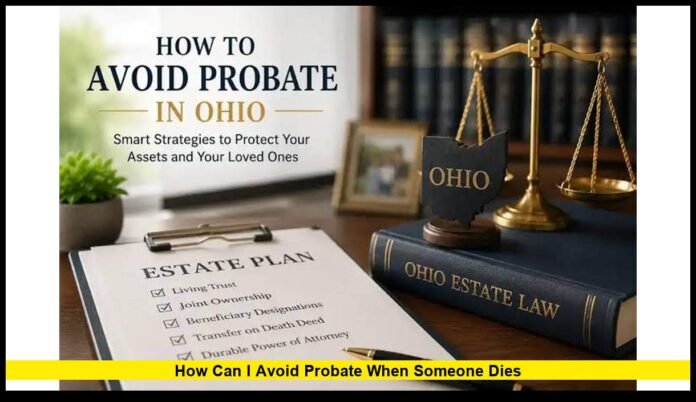

How Can I Avoid Probate When Someone Dies is a question many families face when planning how property, money, and other assets should pass to loved ones. In the United States, probate is not automatically required for everything a person owns. The way an asset is titled, whether a beneficiary has been named, and whether the property is held through a trust can determine whether it must go through court administration.
Probate can involve filing documents with a court, identifying property, paying valid debts and expenses, and distributing assets to the appropriate beneficiaries. The process varies from state to state. Some estates move through probate relatively quickly, while others require more administration.
For people planning ahead, several established legal arrangements can allow qualifying assets to pass directly to beneficiaries. The most important step is making sure those arrangements are properly created and kept current while the owner is alive.
What Probate Means for a Deceased Person’s Estate
Probate is the legal process used to settle certain assets after a person dies. It is generally associated with property that belonged solely to the deceased and does not have another legally recognized method of transferring ownership.
The process can involve several stages. A court may recognize the person’s will, appoint a personal representative, identify assets, address debts and taxes, and authorize distribution of remaining property.
Not every asset enters probate.
Property held in a properly established living trust can generally pass under the trust’s terms. Certain retirement accounts and insurance policies can pass through beneficiary designations. Some bank and investment accounts can use payable-on-death or transfer-on-death arrangements.
Jointly owned property may also transfer automatically when the ownership arrangement includes a valid right of survivorship.
This makes the ownership structure of each asset extremely important.
Why Avoiding Probate Starts Before Death
The opportunity to avoid probate generally comes during the owner’s lifetime.
After death, family members usually cannot create a new trust, add a new beneficiary, or change the deceased person’s ownership arrangement simply because they want to avoid probate.
That does not mean every post-death estate requires a lengthy court proceeding. State laws may provide simplified procedures for qualifying estates. The availability of those procedures depends on the location, size, and nature of the estate.
For people planning in advance, however, the strongest approach is to review assets before death and determine how each one should transfer.
A person may have a house, checking account, savings account, retirement account, investment portfolio, life insurance policy, and personal property. Each asset can follow a different transfer path.
A Revocable Living Trust Can Keep Assets Out of Probate
A revocable living trust is one of the most widely used estate-planning tools for avoiding probate.
The person who creates the trust can generally retain control of the assets during life. The trust document identifies how property should be managed and distributed.
A successor trustee can take over after the person’s death and administer trust property according to the instructions in the trust.
However, creating the trust is only part of the process.
Assets generally need to be transferred into the trust or otherwise properly connected to it. A trust document sitting in a filing cabinet does not automatically move every asset into the trust.
This is commonly referred to as funding the trust.
For example, if a home is properly transferred into a living trust, the trust can generally control what happens to that property after death. If a separate bank account remains solely in the person’s name with no beneficiary designation, that account may still become a probate asset.
A complete review of trust funding is therefore essential.
Beneficiary Designations Can Transfer Assets Without Probate
Many financial products allow an owner to name a person who will receive the asset after death.
These arrangements are especially important for retirement accounts and life insurance policies.
The beneficiary listed with the financial institution or insurance company can generally receive the qualifying asset according to the governing contract and applicable law.
This can allow the asset to bypass the probate process.
Beneficiary designations also require regular attention. A person may have created a retirement account decades ago and named someone who is no longer intended to receive the money.
Marriage, divorce, death, remarriage, births, adoptions, and other major family changes can make an old designation inappropriate.
A current estate plan can therefore become ineffective if beneficiary records are ignored.
Payable-on-Death Accounts Can Help With Bank Accounts
A payable-on-death arrangement is another way certain bank accounts can pass directly to a beneficiary.
The account owner normally retains control of the money during life. The named beneficiary generally receives the account after the owner’s death under the applicable account agreement and state law.
This arrangement can be straightforward for qualifying bank accounts.
It can also reduce the number of assets that need to be administered through probate.
However, account owners should verify the designation directly with their financial institution. The rules governing primary and contingent beneficiaries can vary.
If a named beneficiary dies before the account owner and no effective replacement is listed, the account may not transfer as originally intended.
Keeping beneficiary information current is therefore just as important as creating the designation in the first place.
Transfer-on-Death Registrations Can Apply to Investments
Certain investment and brokerage accounts can use transfer-on-death registrations.
A transfer-on-death arrangement generally allows the account owner to name a person or people who will receive qualifying assets after death.
The owner retains control during life and can generally change the designation while alive, subject to the terms of the account and applicable law.
When properly established, the arrangement can allow the qualifying account to pass outside probate.
Investment accounts should be reviewed separately from bank accounts because financial institutions may use different forms and procedures.
Owners should also consider contingent beneficiaries. A carefully prepared designation can provide a clearer transfer path if the primary beneficiary dies first.
Joint Ownership Can Avoid Probate in Certain Situations
Joint ownership is another potential probate-avoidance method.
When property is jointly owned with a valid right of survivorship, the deceased owner’s interest generally passes to the surviving owner rather than through the deceased person’s probate estate.
This structure can apply to certain bank accounts, real estate, and other property depending on state law and the title used.
The exact language on ownership documents matters.
Simply adding another person’s name to an asset does not guarantee that the asset will avoid probate. Different forms of joint ownership carry different legal consequences.
There can also be financial and family consequences when another person becomes a joint owner during the original owner’s lifetime.
For that reason, joint ownership should be selected because it reflects the owner’s actual intentions, not merely because it appears to provide a convenient shortcut.
Transfer-on-Death Deeds May Help With Real Estate
Real estate is one of the most important assets to address in a probate-avoidance plan.
Some states allow a transfer-on-death deed or similar instrument. These arrangements can allow qualifying real estate to transfer to a named beneficiary after the owner’s death without becoming part of the traditional probate estate.
State law controls whether such an arrangement is available and what requirements must be satisfied.
A transfer-on-death deed may need to be properly prepared, signed, notarized, and recorded. The specific requirements depend on the jurisdiction.
Homeowners should also understand that a transfer-on-death deed is not the same as immediately giving the property to the beneficiary.
The owner generally retains ownership during life under the applicable statutory framework.
Because real estate law is highly state-specific, using a form designed for another state can create serious problems.
Keep a Will as a Backup
Avoiding probate does not mean a person should avoid having a will.
A will remains an important part of an estate plan because not every asset will necessarily transfer through a trust, beneficiary designation, or survivorship arrangement.
A person may acquire property after creating an estate plan. An account may be opened without a beneficiary. A beneficiary may die first. A transfer may fail because a required formal step was missed.
A will can provide instructions for property that remains subject to probate.
It can also identify an executor and address other matters that cannot necessarily be handled through account beneficiary forms.
The most effective approach is usually coordination rather than relying on one document.
Review Every Account and Property Record
A major reason probate-avoidance plans fail is that people focus on the estate documents while overlooking individual asset records.
An estate plan should be compared with actual ownership records.
A useful review includes:
- Bank accounts
- Brokerage accounts
- Retirement accounts
- Life insurance policies
- Real estate
- Business interests
- Trust accounts
- Vehicles
- Valuable personal property
- Other significant financial assets
For each item, determine who owns it and what happens when the owner dies.
A bank account may have a payable-on-death beneficiary. A retirement account may have a separate beneficiary. A home may be held in a trust. An investment account may have a transfer-on-death registration.
These arrangements can operate independently.
That means an estate plan can contain conflicting instructions unless the records are reviewed together.
Do Not Assume a Will Controls Everything
A common misunderstanding is that a will automatically determine who receives all of a person’s property.
That is not necessarily the case.
Assets with valid beneficiary designations can generally transfer according to those designations. Property held through a trust can pass under the trust’s terms. Joint property with survivorship rights can pass to the surviving owner.
The will may therefore control only the property that remains subject to probate.
This makes beneficiary designations particularly important.
A person could leave a will directing an investment account to one child while the account’s beneficiary form names another person. The beneficiary arrangement may determine who receives that account.
Regular coordination is essential.
Check for State-Specific Small-Estate Rules
Not every estate needs the same type of probate administration.
Many states provide simplified procedures for smaller estates. These rules can allow qualifying property to be transferred through an affidavit or another streamlined process.
The requirements differ significantly.
One state may use a particular dollar threshold. Another may have different limits, waiting periods, or requirements involving debts and property.
Some states also have special procedures for certain assets.
These options can be especially useful after someone dies because they may reduce the administrative burden when the estate qualifies.
However, families should not assume that a small-estate procedure is automatically available. The applicable state law must be checked before using it.
Avoiding Probate Does Not Mean Avoiding All Estate Responsibilities
Keeping an asset outside probate does not necessarily eliminate every legal or financial obligation associated with that property.
Debts, taxes, creditor claims, and other estate responsibilities can still matter.
An asset that passes directly to a beneficiary may not need to go through the same probate administration, but that does not automatically place it beyond every legal claim.
Estate tax is also a separate issue from probate.
An asset can avoid probate and still have tax consequences under federal or state law.
For that reason, probate planning should not be treated as a substitute for broader estate planning.
What Families Should Do Immediately After a Death
When a death has already occurred, the first step is to identify the deceased person’s assets.
Families should locate:
- The will
- Any trust documents
- Bank statements
- Brokerage records
- Retirement account information
- Life insurance policies
- Real estate deeds
- Business ownership documents
- Beneficiary records
- Other significant financial documents
The next step is to determine how each asset is titled.
An individually owned bank account with no beneficiary may need probate. A retirement account with a valid beneficiary may transfer directly. Property held by a trust may be handled by the successor trustee.
The distinction can save considerable confusion.
Families should also avoid moving or distributing property before determining who legally controls it. The executor, administrator, trustee, or beneficiary may have different responsibilities depending on the asset.
How to Build a Probate-Avoidance Plan
A practical plan can be organized around five steps.
1. Make a complete asset inventory
List everything of meaningful value and identify the current owner.
2. Identify the transfer method
Determine whether each asset passes through a trust, beneficiary designation, survivorship arrangement, transfer-on-death registration, or probate.
3. Correct outdated information
Update beneficiaries and ownership records when circumstances have changed.
4. Coordinate the documents
Make sure the will, trust, deeds, account records, and beneficiary forms do not conflict unnecessarily.
5. Review the plan regularly
Estate plans should be revisited after major family, financial, or legal changes.
This process can help reveal gaps before they become problems.
Why Professional Estate Planning Can Matter
Probate rules are state-specific, and mistakes involving ownership or beneficiary designations can have significant consequences.
An estate-planning attorney can review the person’s assets and determine which probate-avoidance tools are legally available.
Professional guidance can be particularly important when someone owns real estate in multiple states, operates a business, has a complex family structure, owns substantial assets, or needs specialized trust planning.
The objective is not simply to create documents. It is to ensure that the documents actually correspond with the property and the owner’s intentions.
Final Takeaway
Avoiding probate is primarily a matter of planning how assets will transfer before death. Revocable living trusts, beneficiary designations, payable-on-death accounts, transfer-on-death registrations, survivorship ownership, and qualifying transfer-on-death deeds can all play a role when they are properly established under applicable law.
There is no single method that works for every American family or every type of property. State law, ownership records, account agreements, and individual circumstances all matter.
The strongest plans begin with a complete inventory of assets and then match each asset with an appropriate transfer method. Regular reviews are equally important because a beneficiary designation or ownership arrangement that was appropriate years ago may no longer reflect the owner’s wishes.
What has your experience been with probate or estate planning? Share your thoughts below and stay informed about important changes affecting families and inherited property.