
For anyone studying textiles, shopping for clothing, or working in fabric production, understanding how are fibers classified provides a useful way to distinguish materials by their origin, composition, manufacturing process, and performance. From cotton and wool to polyester and rayon, each fiber belongs to a broader category that helps explain how it behaves in a finished textile.
Fiber classification is more than an academic concept. It affects fabric selection, garment manufacturing, labeling, care requirements, durability, comfort, and many industrial applications.
The Two Major Fiber Categories
The most basic division separates textile fibers into two groups: natural fibers and manufactured fibers.
Natural fibers occur in nature and can come from plants, animals, or mineral sources. Manufactured fibers are produced through industrial processes and can be created from natural polymers or chemically synthesized materials.
This distinction provides the starting point for understanding most textile materials used today.
Natural fibers include cotton, flax, wool, silk, hemp, jute, and several other materials. Manufactured fibers include polyester, nylon, acrylic, rayon, modal, lyocell, and spandex.
Natural Fibers Come From Nature
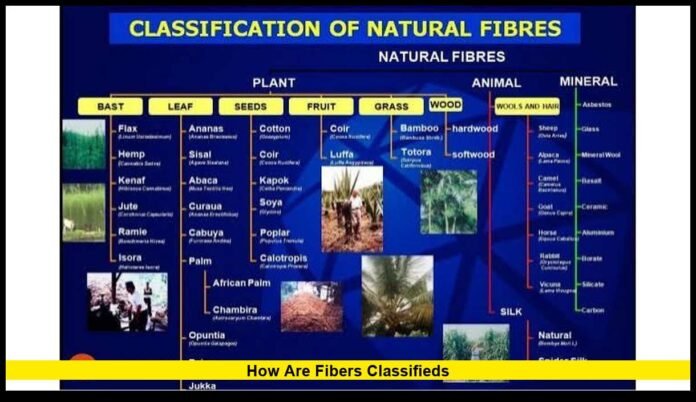
Natural fibers are materials that exist in a fibrous form in nature. They are generally divided according to their biological source.
Plant fibers are primarily cellulose-based. Cotton is obtained from the seed hairs of the cotton plant, while flax comes from the stem of the flax plant and is used to make linen.
Other plant-based examples include hemp, jute, ramie, and sisal.
Animal fibers are generally protein-based. Wool is obtained from sheep and other wool-producing animals, while specialty animal fibers include cashmere, mohair, alpaca, and camel hair.
Silk occupies another important place among animal fibers because it is produced from the cocoon of the silkworm.
Mineral fibers form a much smaller category. Some naturally occurring mineral materials can exist in fibrous forms, although their modern use is heavily influenced by safety considerations.
Plant Fibers Can Be Grouped by Their Source
Plant fibers are not all obtained from the same part of a plant.
Seed fibers develop around seeds, with cotton being the best-known example.
Bast fibers come from the inner portions of plant stems. Flax, hemp, jute, and ramie fall into this group.
Leaf fibers are obtained from leaves. Sisal is a familiar example.
This source-based system helps explain why different plant fibers can have substantially different strength, texture, fineness, absorbency, and processing characteristics.
Manufactured Fibers Changed the Textile Industry
Manufactured fibers are produced through industrial processing rather than simply being collected from a naturally occurring fibrous structure.
The category is broad and includes both fibers derived from naturally occurring polymers and fibers made from chemically synthesized polymers.
The development of manufactured fibers has allowed producers to create materials with characteristics tailored to specific purposes. Depending on their chemical structure and production method, these fibers can be designed for strength, elasticity, resistance to abrasion, quick drying, dimensional stability, or other performance requirements.
Regenerated Fibers Use Natural Polymers
Regenerated fibers occupy an important position between conventional natural fibers and fully synthetic materials.
These fibers generally begin with naturally occurring polymers such as cellulose. The raw material is processed and transformed into a new fiber structure.
Rayon is a major example. Viscose is one of the most common forms of regenerated cellulose fiber.
Modal and lyocell are also cellulose-based manufactured fibers. They are widely used in apparel and household textiles because of their softness, drape, and comfort characteristics.
The fact that these materials originate from cellulose does not make them natural fibers in the same sense as cotton. Their classification reflects the manufacturing process used to turn the raw material into a textile fiber.
Synthetic Fibers Are Made From Synthesized Polymers
Synthetic fibers are manufactured from polymers produced through chemical synthesis.
Polyester is one of the most widely used synthetic textile fibers. It is valued for durability, dimensional stability, resistance to wrinkling, and versatility.
Nylon is another major synthetic fiber. Its strength and resistance to abrasion have made it useful in clothing, hosiery, carpets, ropes, and numerous technical applications.
Acrylic fibers are frequently used in products designed to provide characteristics similar to wool. Polypropylene is used in apparel and technical textiles where light weight and low moisture absorption can be beneficial.
Spandex, also known as elastane in many markets, is particularly important where stretch is required. It is commonly blended with other fibers in activewear, swimwear, underwear, denim, and fitted garments.
Chemical Composition Provides Another Classification
Textile professionals can also classify fibers according to their chemical composition.
Cellulosic fibers include cotton and several regenerated materials such as rayon and lyocell.
Protein fibers include wool and silk.
Synthetic polymer fibers include polyester, nylon, acrylic, and polypropylene.
Elastomeric fibers such as spandex are characterized by their ability to stretch substantially and recover their original dimensions.
This chemical approach is useful because molecular structure strongly influences how a fiber responds to moisture, heat, chemicals, dyes, and mechanical stress.
Why Fiber Classification Matters to Consumers
The classification of a fiber can provide clues about how a garment or fabric will perform.
Cotton is known for its familiar natural feel and moisture absorption. Wool is associated with warmth and resilience. Polyester is valued for durability and easy-care characteristics. Nylon is recognized for strength and abrasion resistance, while spandex contributes stretch.
These characteristics explain why manufacturers often combine different fibers.
A cotton-polyester blend, for example, can combine properties associated with both materials. A small amount of spandex can add stretch to a fabric that would otherwise have limited elasticity.
Fiber Labels Help Identify Textile Composition
Fiber classification also has a direct connection with clothing labels in the United States.
Covered textile products generally must disclose their constituent fiber content using recognized generic fiber names and percentages by weight. The information helps consumers understand what a product is made from before purchasing it.
For many covered products, fibers representing at least 5% of the total fiber weight are identified by their generic names, while smaller amounts are generally handled under applicable labeling rules as “other fiber,” subject to specific exceptions.
This is why labels commonly display descriptions such as “100% Cotton” or “60% Cotton, 40% Polyester.”
How Are Fibers Classified in Everyday Textile Studies?
The easiest way to understand how are fibers classified is to consider three questions: Where did the material originate? How was the fiber produced? What is its chemical composition?
A fiber can therefore be described from several angles at once.
Cotton is a natural plant fiber and is primarily cellulose-based. Wool is a natural animal fiber and is protein-based. Rayon is a manufactured regenerated cellulose fiber. Polyester is a manufactured synthetic fiber.
These descriptions provide considerably more information than simply naming the fabric.
Blended and Specialized Fibers Add More Complexity
Modern textile production does not always rely on a single fiber category.
Manufacturers can blend two or more fibers to achieve a particular combination of properties. Advanced textiles can also use specially engineered fiber structures, including bicomponent and multicomponent fibers.
Technical textiles introduce even more possibilities. Glass, carbon, ceramic, and metallic fibers can be manufactured for specialized industrial purposes, including reinforcement, insulation, filtration, and other demanding applications.
As textile technology advances, classification can become increasingly detailed, but the basic natural-versus-manufactured distinction remains a useful foundation.
The Bottom Line
Knowing how are fibers classified makes it easier to understand the materials behind everyday clothing and textiles. Natural fibers originate in nature, while manufactured fibers are produced through controlled industrial processes. Manufactured materials can then be distinguished as regenerated, synthetic, or inorganic fibers according to their composition and production method.
For consumers, the classification system helps make sense of clothing labels and fabric characteristics. For textile professionals, it provides a framework for selecting, processing, blending, dyeing, and developing materials for specific uses.