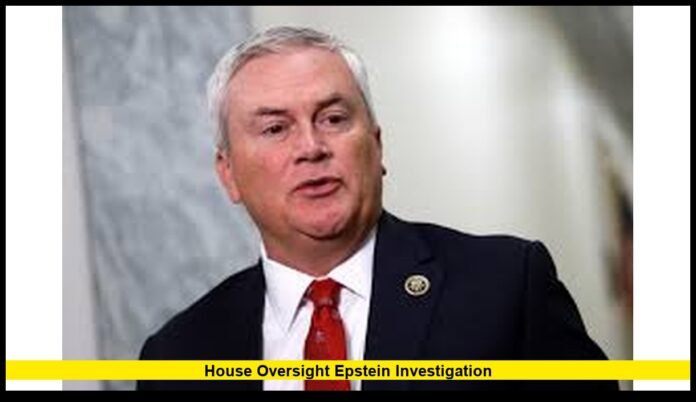

As of December 12, 2025, the House Oversight Epstein investigation remains one of the most closely watched inquiries in Washington. Lawmakers from both parties are demanding answers about how Jeffrey Epstein, a convicted sex offender with deep social and financial ties to powerful people, was able to operate for years — and how federal agencies handled his detention and death in 2019.
The House Oversight Committee’s renewed focus comes amid growing public pressure for transparency. Lawmakers are now examining whether key federal agencies failed to protect Epstein, preserve evidence, or disclose crucial details to Congress and the public.
Why the House Oversight Epstein Investigation Matters
The renewed investigation is not about reopening Epstein’s criminal case but about uncovering how systemic failures allowed one of the most notorious inmates in U.S. history to die in federal custody.
The committee’s work centers on three main goals:
- Accountability: Identifying who failed to perform their duties at the Metropolitan Correctional Center (MCC) in New York.
- Transparency: Determining whether agencies withheld information from investigators or the public.
- Reform: Preventing another high-profile failure like this in the future.
Committee Chairman Rep. James Comer (R-KY) emphasized that the effort is about “facts, not speculation,” and that both parties share an interest in restoring public trust in government oversight.
New Evidence and Records Obtained
Recent developments show that the House Oversight Epstein probe is uncovering new material from the Bureau of Prisons (BOP) and the Department of Justice (DOJ).
Committee investigators have obtained internal emails, guard logs, and inspection reports from the MCC, where Epstein was being held before his death. Early findings reveal:
- Epstein was left unsupervised for long stretches, despite prior safety warnings.
- Security cameras near his cell malfunctioned during critical hours.
- The facility was understaffed, with exhausted guards working overtime.
Lawmakers are now analyzing discrepancies between official reports and what internal records actually show. These findings will be central to upcoming hearings.
Upcoming Congressional Hearings
The committee has announced a series of hearings scheduled for January 2026. Witnesses will include:
- Former MCC Warden Lamine N’Diaye
- Officials from the Department of Justice’s Inspector General Office
- Bureau of Prisons representatives
The hearings will examine how Epstein’s detention was managed, why key surveillance footage was lost, and whether internal warnings about safety were ignored.
Members of both parties are also expected to push for more details about how Epstein’s broader financial and social networks were monitored before his arrest.
Bipartisan Unity on Oversight
One striking feature of the House Oversight Epstein investigation is its bipartisan cooperation. Both Republicans and Democrats agree that the Epstein case exposed serious flaws in how the federal government handles high-profile inmates.
Rep. Nancy Mace (R-SC) called the failures “an embarrassment for federal law enforcement.”
Rep. Jamie Raskin (D-MD) added that “this isn’t about politics — it’s about public accountability and truth.”
Lawmakers on both sides want to ensure that no details are hidden and that future oversight systems prevent such lapses from happening again.
Focus on Federal Accountability
Epstein’s death inside a federal facility remains a defining failure for the Bureau of Prisons. Multiple reports have shown:
- Guards falsified records to hide their absence during key hours.
- The facility ignored mandatory cell checks on high-risk inmates.
- Surveillance footage that could have clarified events was lost or damaged.
The House Oversight Committee’s current work is centered on determining whether these failures resulted from mismanagement or a deliberate cover-up.
Lawmakers are reviewing whether disciplinary action taken against staff was sufficient and whether higher-ranking officials were ever held accountable.
Investigating the Broader Epstein Network
While the committee’s main focus is on government oversight, it is also revisiting Epstein’s wider network — particularly how his financial and personal operations escaped scrutiny for so long.
The committee has asked the Treasury Department’s Financial Crimes Enforcement Network (FinCEN) for documentation on any suspicious financial transactions tied to Epstein’s companies or charities.
Lawmakers are also investigating whether previous warnings about Epstein’s conduct were ignored by federal or local agencies prior to his 2019 arrest.
Rep. Comer said, “This investigation isn’t just about one man. It’s about how power and privilege allowed someone to evade accountability for years.”
The Role of the Department of Justice and Inspector General
The DOJ’s Office of the Inspector General (OIG) previously released a report identifying multiple failures within the Bureau of Prisons. However, members of Congress say the report did not answer every question.
The Oversight Committee wants further clarification on:
- Why Epstein’s security classification was lowered.
- Why safety protocols were not enforced even after a prior suicide attempt.
- How internal warnings about staff shortages went unaddressed.
Several of these questions will be discussed in the committee’s upcoming hearings, with subpoenas issued to current and former DOJ officials.
Public Calls for Transparency
Public interest in the Epstein case has not faded, and pressure on lawmakers continues to grow. Advocacy groups representing survivors of Epstein’s crimes have urged Congress to make the findings of the House Oversight investigation public in full.
Committee leaders have promised to release reports and relevant documents once redaction reviews are complete. They have also proposed new transparency measures, including:
- Requiring public disclosure of high-profile inmate safety reports.
- Mandating independent oversight boards for federal detention centers.
- Improving chain-of-custody procedures for surveillance evidence.
These steps, if adopted, could represent the most significant federal prison oversight reform in years.
Bureau of Prisons Under Pressure
The Bureau of Prisons is facing renewed scrutiny not just for Epstein’s death, but for a broader pattern of mismanagement. A recent audit requested by the committee revealed systemic problems:
- High staff turnover and inadequate training.
- Repeated violations of safety protocols.
- Poor documentation of inmate supervision.
House Oversight members argue that the Epstein case is a symptom of a much larger problem within the federal prison system. Strengthening accountability at the top levels of the Bureau has become a priority.
Proposed Legislative Reforms
Several new bills are being drafted in response to what the Epstein investigation has uncovered. Among them:
- The Federal Inmate Oversight and Transparency Act, which would require external inspections of all federal prisons every six months.
- The Prison Surveillance Integrity Act, aimed at preserving video evidence and enforcing stricter storage policies.
- The Custodial Accountability Act, mandating minimum staffing levels for high-risk inmates.
Lawmakers expect bipartisan support for these proposals, given the widespread recognition that Epstein’s case exposed dangerous gaps in oversight.
Public and Media Reaction
The American public has followed the House Oversight Epstein hearings closely. Many view it as a long-overdue effort to bring transparency to one of the most controversial chapters in modern U.S. criminal history.
Media coverage has largely emphasized the committee’s fact-based approach. By avoiding partisan framing, the investigation has maintained credibility with both sides of the political spectrum.
For many Americans, the hearings are not just about Epstein — they represent a broader reckoning with how power and privilege influence justice.
What Comes Next
The House Oversight Committee plans to issue an interim report in early 2026 summarizing its findings to date. The final report, expected later next year, will likely include recommendations for major reforms within the Bureau of Prisons and Department of Justice.
Further subpoenas and witness testimonies are expected as the investigation continues into early spring.
Final Thoughts
The House Oversight Epstein investigation is not just revisiting the past — it’s reshaping how Congress handles accountability across the justice system. Epstein’s death remains a dark mark on federal oversight, but the lessons learned from this inquiry could lead to real, lasting reforms.
Do you think Congress will finally deliver full transparency in the Epstein investigation? Share your thoughts in the comments below.