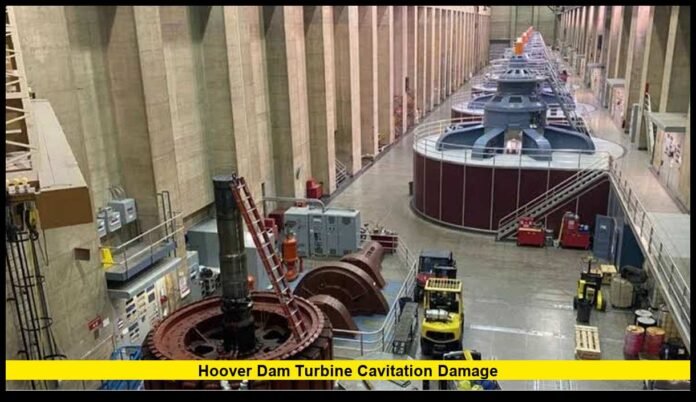

Hoover Dam turbine cavitation damage remains a major engineering concern as low water levels at Lake Mead place increasing pressure on the facility’s aging hydropower equipment. The latest confirmed development is a roughly $52 million investment announced in May 2026 to improve Hoover Dam’s infrastructure and replace up to three older turbines with wide-head designs. The planned upgrades aim to protect electricity generation when reservoir levels fall below 1,035 feet.
The issue matters because Hoover Dam supplies hydroelectric power to customers across the American Southwest. Its turbines must operate under changing water conditions while maintaining reliable performance. When cavitation damages turbine components, operators face additional maintenance requirements and potential limits on generating capacity.
The replacement plan represents a targeted response to those challenges. However, the announced funding does not mean that the turbine replacements are complete or that all cavitation risks have disappeared. The latest confirmed information establishes the intended upgrades and their expected benefits, while the project’s eventual performance will depend on implementation and operating conditions.
Understanding Turbine Cavitation at Hoover Dam
Cavitation develops when water pressure drops enough for vapor bubbles to form inside a flowing liquid. When those bubbles enter higher-pressure areas, they collapse and create localized forces against nearby surfaces.
Inside a hydraulic turbine, repeated bubble collapse can gradually wear away metal. Engineers describe this process as cavitation erosion because it removes material from exposed components over time.
Hoover Dam relies on Francis-type turbines to convert the energy of moving water into rotational motion. That motion drives generators, which produce electricity for regional power customers.
The turbine runner plays a particularly important role. Its blades guide the water through the machine, so their shape and surface condition influence hydraulic performance. Cavitation can gradually damage these surfaces and increase the need for inspection and repair.
The severity of damage varies with the turbine’s design, operating conditions, and exposure to unfavorable pressure patterns. Cavitation does not automatically cause immediate equipment failure, but severe erosion can create significant operational problems.
At Hoover Dam, the main concern is the relationship between declining Lake Mead levels and the operating limits of older turbines. Engineers must protect equipment while maintaining as much useful generating capacity as conditions allow.
Why Lake Mead’s Water Level Matters
Lake Mead supplies the water that passes through Hoover Dam’s powerplant. Its elevation affects the hydraulic head available to drive the turbines.
Hydraulic head represents the energy available from differences in water elevation and pressure. When reservoir levels decline, the available head generally decreases, reducing the potential power output for a given flow rate.
Lower water levels can also change the pressure distribution inside a turbine. Depending on the design and operating conditions, these changes may increase cavitation risk.
The Bureau of Reclamation has identified 1,035 feet as a critical elevation for older Hoover Dam turbines. Technical assessments indicate that these units could sustain severe cavitation damage below that level.
This threshold does not represent an automatic shutdown point for the entire dam. Instead, it identifies conditions that can significantly restrict generating capability and increase the risk of equipment damage.
The reservoir’s recent readings illustrate the importance of this issue. Official daily records placed Lake Mead at approximately 1,037.4 feet on October 16, 2026, just above the identified threshold.
That reading was provisional and could change as new measurements become available. Nevertheless, the narrow margin highlights why turbine performance has become a priority for the facility.
The Latest Turbine Replacement Plan
The most important confirmed development is the approximately $52 million investment announced in May 2026. The funding supports critical infrastructure, operations, and maintenance at Hoover Dam.
A substantial portion will go toward purchasing and replacing up to three older turbines with wide-head designs. These replacement units aim to maintain effective operation at lower reservoir elevations.
The planned work addresses a specific engineering problem rather than replacing the entire powerplant. By targeting selected units, the project seeks to improve the facility’s ability to generate electricity during low-water conditions.
The announcement identifies several important details:
- Total announced investment: Approximately $52 million.
- Planned turbine replacements: Up to three older units.
- Replacement technology: Wide-head hydraulic turbines.
- Expected capacity restoration: At least 160 megawatts.
- Lower operating range: The new designs are intended to operate effectively below 1,035 feet.
- Expected cavitation performance: The turbines are designed to operate near 950 feet without excessive damage.
These figures describe the announced plan and its expected results. They do not confirm that the replacement work has been completed or that the additional generating capacity is already available.
The project also includes broader infrastructure and maintenance priorities. Those activities matter because reliable power generation depends on the condition of the complete facility, not just individual turbine runners.
How Wide-Head Turbines Could Improve Reliability
Wide-head turbines are designed to operate across a broader range of hydraulic head conditions. At Hoover Dam, that capability could help reduce the limitations that older equipment faces as Lake Mead declines.
Traditional turbine designs must match the expected hydraulic conditions of their installation. When those conditions move outside the preferred operating range, efficiency and component durability can suffer.
A wide-head design aims to accommodate a wider range of conditions without excessive damage. This gives operators greater flexibility when reservoir elevations change.
For Hoover Dam, the principal advantage is the ability to continue generating electricity at lower lake levels. The replacement units are expected to restore at least 160 megawatts of capacity, helping offset some of the effects of drought.
The new turbines will not eliminate every challenge associated with declining water levels. Available water, operating decisions, equipment condition, and electricity demand will continue to influence output.
However, improved tolerance for lower hydraulic head can help preserve useful generating capability. That makes the planned replacements an important part of Hoover Dam’s long-term maintenance strategy.
How Much Generating Capacity Is at Risk?
The latest technical assessment highlights a substantial change in estimated generating capability at the 1,035-foot reservoir elevation.
Earlier estimates placed Hoover Dam’s capacity at that elevation at 1,302 megawatts. Updated operational data indicated that the available capacity could fall to 382 megawatts.
The difference between those figures is 920 megawatts. It illustrates the potential impact of operating limitations on older turbine equipment.
These numbers describe estimated generating capacity under the specified conditions. They do not mean that Hoover Dam produces exactly 382 megawatts every time Lake Mead reaches 1,035 feet.
Actual output depends on several factors, including the number of available units, water flow, operating restrictions, and equipment performance.
The planned replacements aim to improve this situation. The expected restoration of at least 160 megawatts would provide additional generating capability, although it would not automatically eliminate the entire projected shortfall.
The distinction matters when evaluating the project. Its expected benefit is meaningful, but the final effect will depend on which units operators replace and how the upgraded equipment performs.
Why Hoover Dam’s Aging Equipment Needs Attention
Hoover Dam has supplied electricity for decades, making equipment maintenance an essential part of its operation.
The installation of the final generating units was completed in 1961. A major plant uprating program concluded in 1993, increasing the facility’s generating capability.
Long service does not automatically mean that every turbine is damaged or unreliable. Equipment condition varies, and operators can maintain machinery through inspections, repairs, and component replacements.
However, the latest cavitation assessment identifies a particular problem for older turbines under lower reservoir conditions. Their operating limitations can become more significant as Lake Mead approaches and falls below the critical elevation.
Continuing to maintain these units remains important, but maintenance alone may not address every design limitation. Replacement turbines can provide capabilities that older equipment does not offer across the same range of hydraulic conditions.
The planned upgrade therefore combines the need to preserve existing infrastructure with the need to adapt equipment to changing operating requirements.
How Engineers Monitor and Repair Cavitation Damage
Cavitation management begins with understanding where damage develops and how quickly it progresses. Engineers and maintenance teams use inspections and operating information to assess turbine condition.
Physical inspections can reveal pitting, erosion, and other surface changes on accessible components. Technicians evaluate the severity of the damage before deciding whether a repair is necessary.
Operating measurements also help engineers understand turbine behavior. Flow conditions, vibration, pressure patterns, and performance changes can provide useful evidence about equipment operation.
When a runner suffers erosion, qualified specialists may repair damaged areas using approved engineering procedures. They must preserve the component’s intended shape and structural integrity.
The repair process requires care. Altering blade contours can affect how water moves through the turbine, potentially creating new performance problems.
Maintenance teams must therefore balance immediate repairs with longer-term reliability. If a particular design cannot safely accommodate the required operating range, replacing the equipment may provide a more effective solution.
At Hoover Dam, the announced wide-head turbine plan addresses that broader engineering challenge. It aims to reduce the consequences of low-water operation rather than relying exclusively on repairs to older units.
How the $52 Million Will Support Hoover Dam
The funding comes from Hoover Dam’s Post Retirement Benefit Fund. The Western Area Power Administration collected the money from power customers to cover unfunded retirement benefit costs for Hoover employees.
The fund became available for other authorized purposes after employees began receiving benefits under federal retirement systems. The money could then support eligible operational and maintenance needs.
The approximately $52 million investment provides a way to address infrastructure priorities without treating the entire amount as a turbine-only budget.
The announced plan includes the purchase and replacement of up to three older turbines. Other work will support essential infrastructure, operations, and maintenance.
The exact final cost of each turbine installation and the detailed project completion schedule have not been established in the announcement. Those details should not be treated as confirmed until further information becomes available.
What is clear is the purpose of the investment: strengthen Hoover Dam’s infrastructure and protect hydropower reliability as reservoir conditions become more challenging.
What Cavitation Damage Means for Southwest Electricity Customers
Hoover Dam supplies hydropower to customers in Nevada, Arizona, and California. Its generating capacity contributes to electricity supplies across a region with substantial energy demand.
When the facility produces less electricity, power customers may need to obtain additional supply from other available resources. The financial and operational effects depend on regional demand, supply arrangements, and the amount of hydropower available.
The Bureau of Reclamation has reported that drought has already reduced Hoover Dam’s generation by about 30%. It has also warned that further declines could threaten the facility’s long-term financial viability and place additional pressure on customer rates.
These concerns explain why turbine reliability matters beyond the dam itself. Lower generating capability can affect planning for electricity purchases and the overall management of regional power resources.
However, the available information does not establish a specific rate increase for households or businesses resulting from cavitation damage. Any precise estimate would require additional verified financial and operating data.
Replacing older turbines could help protect generating capability and reduce the impact of low reservoir levels. The project cannot control drought, but it can improve the equipment’s ability to operate under difficult conditions.
What Happens When Lake Mead Falls Below 1,035 Feet?
Crossing the 1,035-foot threshold does not mean Hoover Dam must stop generating electricity. It means older turbines face a serious risk of cavitation damage under the conditions identified in the technical assessment.
Operators must consider the capabilities of individual units and the water conditions available at the time. Some equipment may face greater restrictions than other units.
The planned wide-head turbines are intended to provide more flexibility below this elevation. Their design aims to support operation near 950 feet without excessive cavitation damage.
That lower figure describes the approximate operating capability cited for the replacement technology. It is not a guarantee of maximum output at that elevation, nor does it establish that every turbine can operate identically.
Generating capacity will still depend on hydraulic head, available flow, equipment condition, and operational requirements.
Continued monitoring of Lake Mead and the replacement program will help determine how the facility responds as conditions change.
Has Hoover Dam Solved Its Turbine Cavitation Problem?
The available confirmed information does not establish that the problem has been completely resolved.
The May 2026 announcement provides a clear response: invest in critical infrastructure and replace up to three older turbines with wide-head designs. The replacements are expected to restore at least 160 megawatts of capacity.
However, announcing funding does not confirm completed installation, commissioning, or long-term performance. The project must progress through the necessary engineering and implementation work before its final results can be assessed.
The wider challenge also remains. Hoover Dam depends on Lake Mead, and declining reservoir levels affect the hydraulic conditions available for power generation.
The strongest conclusion is that the planned upgrades target a specific limitation in older turbine equipment. They could help preserve generating capacity during low-water conditions, but they cannot remove the effects of drought or guarantee a fixed electricity output.
Future project milestones and operating data will provide a clearer picture of the upgrades’ effectiveness.
Key Facts About Hoover Dam Turbine Cavitation Damage
- The critical reservoir elevation identified for older turbines is 1,035 feet.
- The May 2026 investment announcement outlined approximately $52 million for infrastructure and maintenance.
- The plan includes replacing up to three older turbines.
- Wide-head turbines are designed to operate effectively at lower reservoir elevations.
- The planned replacements are expected to restore at least 160 megawatts of hydropower capacity.
- Updated estimates indicate that generating capability at 1,035 feet could fall to 382 megawatts, compared with an earlier estimate of 1,302 megawatts.
- The announcement describes planned work, not confirmed completion of all turbine replacements.
Final Outlook for Hoover Dam’s Turbines
Hoover Dam turbine cavitation damage highlights the difficulty of maintaining older hydropower equipment as reservoir levels decline. The planned wide-head turbine replacements offer a targeted way to improve performance under lower-water conditions and protect part of the facility’s generating capability.
The approximately $52 million investment signals a commitment to infrastructure reliability, but its ultimate value will depend on implementation and measurable operating results. Lake Mead’s elevation, turbine condition, and future maintenance decisions will remain important factors.
What do you think Hoover Dam’s turbine upgrades mean for the future of Southwestern hydropower? Share your thoughts and stay updated as new, verified developments emerge.