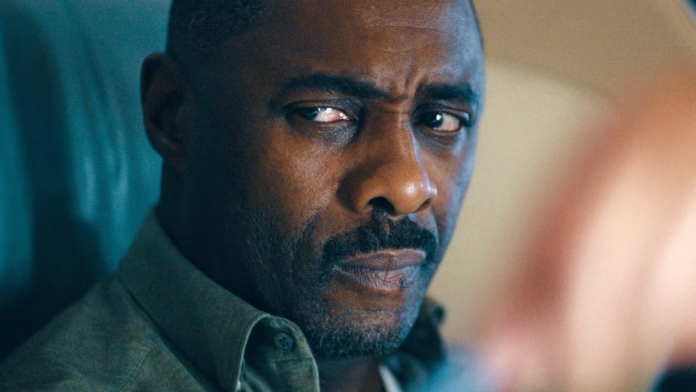

The return of hijack season 2 marks a bold new chapter for the real-time thriller that captivated audiences with its nerve-shredding intensity and high-pressure storytelling. The series is back with a fresh setting, a new group of lives in danger, and an even more complex web of decisions where every second carries weight. With its signature blend of psychological tension and tightly controlled pacing, the new season delivers a gripping narrative built around human vulnerability, strategic thinking, and the fragile balance between order and chaos.
A Shift in Location That Changes Everything
This season trades open skies for an urban environment, placing its crisis within the enclosed world of a busy underground rail system. The change in setting transforms the dynamics of the threat. Instead of isolation at altitude, the danger now unfolds beneath a living city, where movement continues above ground while fear spreads below.
The tunnels create a sense of inescapability. Passengers are cut off from daylight, communication becomes unreliable, and the physical limits of the space intensify every confrontation. The environment itself becomes a character, amplifying anxiety with narrow corridors, echoing sounds, and the constant awareness that help is close in distance but far in access.
The Negotiator at the Center of the Storm
At the heart of the story stands Sam Nelson, a corporate negotiator known for his ability to read people and defuse volatile situations. Once again, he finds himself thrust into a life-or-death scenario, forced to rely on psychological insight rather than physical force.
This time, the challenge is layered. The group behind the takeover operates with discipline and coordination, making their intentions difficult to decode. Nelson must interpret subtle behavioral cues, identify leadership within the group, and keep fragile lines of communication open while panic threatens to overtake rational thought.
The season explores the toll such situations take on someone who must remain composed while surrounded by fear. Doubt, fatigue, and the pressure of knowing that a single misjudgment could trigger irreversible consequences add depth to his role.
Multiple Lives, Intersecting Fates
The narrative broadens its scope by following a diverse group of passengers whose stories intersect under extraordinary circumstances. Commuters heading to work, visitors unfamiliar with the city, security personnel, and individuals with hidden connections all become part of the same unfolding drama.
Each character brings a distinct perspective. Some respond with quiet resilience, others with visible terror, and a few with unexpected courage. Their interactions reveal how quickly social roles shift when normal routines collapse. Authority is questioned, trust becomes fragile, and alliances form based on instinct rather than status.
The series gives space to these personal moments, allowing viewers to understand what is at stake beyond statistics. The crisis is not abstract; it is measured in individual fears, hopes, and the desperate desire to return to ordinary life.
Pressure on Both Sides of the Divide
While the danger is concentrated underground, a parallel battle unfolds above. Law enforcement, emergency services, and government officials work against the clock to contain the situation without provoking further harm. Coordination is complicated by limited information and the need to make rapid decisions that could affect hundreds of people at once.
The contrast between the controlled environments of command centers and the chaos inside the tunnels highlights the complexity of crisis management. Orders must be clear, strategies must adapt quickly, and communication must remain precise even as circumstances shift.
This dual perspective reinforces the scale of the event and the delicate balance between decisive action and restraint.
Real-Time Storytelling and Unbroken Momentum
One of the defining features of the series is its commitment to real-time progression. Each episode represents a continuous stretch of the unfolding emergency, with no temporal shortcuts. The audience experiences the story moment by moment, sharing the same uncertainty as the characters.
This structure creates sustained tension. There is little room for narrative pause, and even brief lulls feel charged with anticipation. Conversations carry added weight because they unfold without the safety of hindsight. Plans must work the first time, or be rapidly replaced.
The format also emphasizes realism. Negotiations take time. Fear does not disappear instantly. Trust must be built in fragments, often under extreme emotional strain.
Psychology as the Primary Battleground
Rather than relying solely on physical confrontation, the season places psychological strategy at the forefront. The central conflict revolves around communication, perception, and control.
The negotiator’s role is to slow the pace of escalation, to introduce doubt where certainty could lead to violence, and to create openings for peaceful resolution. Every word is chosen carefully, every silence observed for meaning. The hijackers, in turn, use their own tactics to assert dominance and test the limits of authority.
This mental duel forms the core of the drama, making the series as much about understanding human behavior as it is about action.
Visual Language and Atmosphere
The production design reinforces the story’s intensity. Dim lighting, confined spaces, and the constant presence of mechanical noise create an atmosphere of unease. The camera often stays close to faces, capturing subtle shifts in expression that reveal fear, determination, or deception.
Movement is carefully choreographed. When the train is in motion, the sense of instability is heightened. When it stops, the stillness feels heavy, as if the air itself is waiting for the next development.
Sound design plays a crucial role, using echoes, distant announcements, and the hum of infrastructure to remind viewers of the world beyond the immediate crisis.
Themes of Control and Responsibility
Beyond suspense, the season examines broader themes. It asks how authority is established in moments of chaos and how responsibility is shared when lives are at risk. The negotiator carries the burden of influence, knowing that his guidance can shape outcomes. The authorities must weigh decisive intervention against the possibility of worsening the situation. The passengers must decide whether to comply, resist, or trust.
These questions give the story moral weight. The crisis becomes a test of character as much as a test of strategy.
A Story That Builds Rather Than Explodes
While action sequences punctuate the narrative, the season’s power lies in its gradual build. Tension accumulates through small shifts: a change in tone during a conversation, a delayed response, a sudden movement in a crowded space.
This approach keeps the focus on anticipation rather than spectacle. The audience is drawn into a state of constant alertness, aware that any moment could become the turning point.
Why the New Chapter Resonates
The series succeeds by blending a high-concept premise with grounded human detail. It avoids reducing its characters to simple roles, instead portraying them as individuals shaped by fear, duty, and the instinct to survive.
The urban setting adds relevance, reflecting the vulnerability of everyday routines and the thin line that separates normalcy from crisis. The real-time format ensures that the story never feels distant or abstract.
For viewers, the experience is immersive and emotionally charged, combining the immediacy of live events with the depth of character-driven drama.
The Broader Impact
As a piece of television storytelling, the season demonstrates how suspense can be sustained without relying on constant action. By prioritizing dialogue, psychology, and atmosphere, it creates a sense of realism that lingers after each episode ends.
The focus on negotiation over force also offers a perspective rarely centered in thrillers. It highlights the power of communication and the importance of understanding human motives in preventing disaster.
Looking Ahead
While the season tells a complete story, its structure allows for future scenarios that could place similar skills in different environments. The concept of real-time crisis negotiation has the flexibility to explore new locations, new threats, and new moral challenges.
For now, the current chapter stands as a tense, meticulously crafted narrative that proves how compelling a story can be when it respects both the intelligence and the emotions of its audience.
The body of the season reinforces the enduring appeal of hijack season 2 by delivering a tightly woven story where timing, psychology, and human connection determine the outcome as much as any physical action.