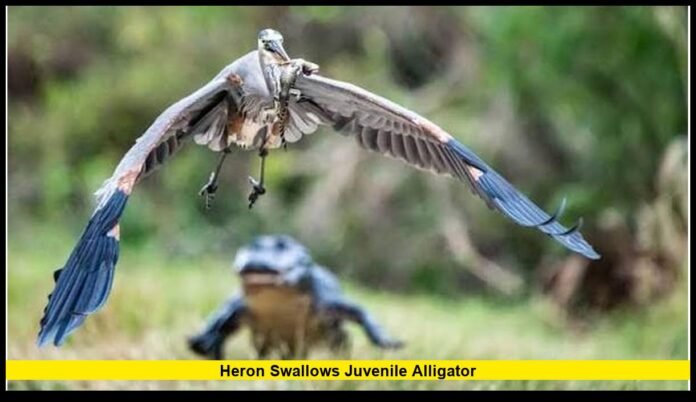

A heron swallows juvenile alligator encounter has captured renewed attention after wildlife photography showed a great blue heron handling a young alligator in Florida. The unusual scene stands out because the bird is commonly associated with fish and other small wetland animals, while alligators are usually viewed as predators rather than prey.
The encounter is not a fictional wildlife scenario. Great blue herons have been documented capturing and eating very young alligators in Florida on multiple occasions. Earlier observations at Florida wetlands have shown similar behavior, providing important context for the latest images circulating online.
The sight of a tall wading bird carrying a small alligator may seem almost impossible at first glance. Yet the size of the reptile is the crucial detail. A juvenile alligator is vastly different from the large adult animals commonly associated with Florida waterways.
Great blue herons are capable hunters with long legs, powerful bills and a varied diet. When an appropriately small animal comes within reach, the bird can act quickly.
The Florida Encounter Behind the Viral Interest
The latest attention centers on wildlife photographer Matthew Blake, whose photography has documented the remarkable interaction. Images shared through his social media presence show a great blue heron with a juvenile alligator in its bill.
The photographs are striking because they capture a predator-prey relationship that most people would never expect to see.
The heron appears to have secured the young reptile and carried it while standing in a wetland environment. The bird’s wings and long neck make the encounter particularly dramatic in photographs.
Blake described the scene with a reference to dinosaurs, reflecting the ancient appearance of both animals. Birds and alligators are separated by millions of years of evolutionary history, but their shared connection to ancient reptilian lineages makes the comparison visually understandable.
The photograph does not show an adult alligator being attacked by a bird. The animal involved is a juvenile, and that distinction is essential when interpreting the encounter.
Young alligators face considerably more threats than mature animals. Their small size makes them vulnerable to a range of predators, including larger birds.
Why the Size of the Alligator Matters
An adult American alligator can become a large and powerful predator. A young alligator, however, begins life at a much smaller size.
That difference changes the relationship between the two species.
A great blue heron cannot realistically treat a full-grown alligator as ordinary prey. A small juvenile is another matter. If the reptile is sufficiently small, the bird can seize it with its bill and attempt to consume it.
This is one reason the latest photographs have attracted so much attention. People tend to associate alligators with strength and dominance, but those characteristics develop as the animal grows.
At an early stage, an alligator occupies a very different position within the ecosystem.
The young reptile can become food for other animals while also growing into a predator capable of hunting fish, birds, turtles and other wildlife.
The transition illustrates how dramatically an animal’s role can change as it matures.
Great Blue Herons Are More Versatile Hunters Than Many People Realize
Great blue herons are among the most recognizable wading birds in North America.
Their tall bodies, long legs and extended necks make them easy to identify around ponds, marshes, rivers and lakes. They often stand motionless near shallow water while watching for prey.
That stillness can be deceptive.
A heron can launch a rapid strike when an opportunity appears. Its long bill functions as a precise hunting instrument, allowing the bird to grab prey with considerable speed.
Fish form an important part of the bird’s diet, but the species is not restricted to fish.
Great blue herons can consume a wide variety of animals, including amphibians, reptiles, insects, small mammals and other creatures that they can capture.
That flexible feeding strategy helps explain why a young alligator can occasionally become prey.
The encounter may look extraordinary to human observers, but it fits the broader pattern of an opportunistic predator taking advantage of available food.
Earlier Florida Encounters Provide Important Context
The latest images are not the first time a great blue heron has been documented eating a young alligator.
In 2017, footage from the Viera Wetlands near Melbourne showed a great blue heron consuming a baby alligator. The encounter attracted considerable attention after it was recorded and reported to wildlife officials.
The bird was observed handling the small reptile before eventually swallowing it.
Another widely reported incident occurred in 2020 near Lake Apopka.
Wildlife photographer Shellie Gilliam captured a great blue heron with a juvenile alligator. The bird spent an extended period manipulating the reptile before consuming it.
The Lake Apopka incident demonstrated just how difficult swallowing relatively large prey can be for a bird. The heron had to position the animal carefully before it could consume it.
A separate encounter in 2022 at Orlando Wetlands Park also attracted attention. A photographer captured a great blue heron carrying a young alligator while an adult alligator was nearby.
Taken together, these documented observations show that the behavior has occurred more than once in Florida.
The latest photographs therefore fit into an established record of unusual interactions between the two species.
The Difference Between Carrying Prey and Swallowing It
Photographs of a heron holding an alligator can sometimes leave viewers wondering whether the bird actually consumed the reptile.
That distinction matters.
A great blue heron may capture prey without immediately swallowing it. Large or awkward prey can require considerable manipulation.
The bird may move the animal, reposition it or repeatedly adjust its grip.
This behavior is particularly noticeable when the prey has a shape that makes swallowing difficult.
A small fish can often be swallowed quickly. A young alligator presents a very different challenge.
Its body is elongated, its legs can interfere with positioning, and its relatively rigid body makes it harder to maneuver.
Earlier documented encounters showed herons spending substantial time handling young alligators before consumption.
Therefore, photographs of the latest encounter need to be considered alongside the broader record of this behavior rather than interpreted from a single frame alone.
Florida Wetlands Create Opportunities for Both Species
Florida provides an ideal setting for encounters between great blue herons and alligators.
The state contains an enormous variety of wetlands and freshwater environments. Lakes, marshes, ponds and slow-moving waterways support both species.
Great blue herons use shallow water to search for food.
Young alligators also spend much of their early lives around aquatic habitats.
That overlap creates opportunities for encounters.
A juvenile alligator moving through shallow water or resting in exposed vegetation may come within range of a hunting heron.
The interaction depends heavily on timing and size.
The heron needs to detect the young reptile and successfully capture it. The alligator must be small enough for the bird to handle.
These conditions explain why the behavior remains unusual despite being documented several times.
A Young Alligator Faces More Risks Than an Adult
Newly hatched alligators have a difficult early life.
Their small bodies leave them exposed to predators that would have little chance against a mature alligator.
Birds are among the animals capable of preying on young alligators.
The risk decreases as the reptile grows.
Larger juveniles become increasingly difficult for birds to handle. Eventually, the alligator becomes too large and dangerous for a great blue heron to consider as prey.
This creates a changing balance between predator and prey.
During the earliest stages, the alligator can be vulnerable.
Later, it becomes a predator itself.
That transformation helps explain why an image of a bird eating an alligator does not contradict the familiar role of alligators in Florida ecosystems.
The photograph captures one particular stage of the reptile’s life.
Why the Encounter Looks So Dramatic in Photographs
Wildlife photography can make unusual natural events appear even more dramatic.
A great blue heron already has an imposing silhouette. Its long neck, sharp bill and large wings give the bird a distinctive appearance.
Adding a juvenile alligator creates a powerful visual contrast.
The two animals represent very different branches of the modern animal world, yet they are interacting directly within the same habitat.
The bird’s ability to lift or manipulate the reptile also surprises viewers.
Many people underestimate the strength and feeding flexibility of large wading birds.
A great blue heron does not need to overpower a large animal. Instead, it relies on its reach, speed and bill to capture prey that fits within its physical limits.
That strategy works especially well against small aquatic animals.
The Encounter Does Not Mean Herons Regularly Hunt Alligators
The images should not be interpreted as evidence that young alligators form a major part of the great blue heron’s normal diet.
The documented encounters are notable precisely because they are unusual.
Great blue herons have broad diets, but that does not mean they routinely search wetlands for alligators.
The available evidence supports a more straightforward explanation.
When a small animal is accessible and manageable, the bird can take advantage of the opportunity.
Young alligators sometimes meet those conditions.
The result can be a remarkable feeding event that is rarely witnessed by people.
This distinction is important because dramatic wildlife photographs can sometimes lead to exaggerated claims about animal behavior.
The documented evidence supports the encounter without suggesting that it represents a major change in the natural behavior of either species.
A Rare Look at the Food Chain in Action
The encounter also provides a clear example of how complicated food chains can become.
People often picture ecosystems as simple arrangements in which one predator eats smaller animals. Real ecosystems are more flexible.
An animal can occupy different positions depending on its size, age and circumstances.
The juvenile alligator is a useful example.
As a small hatchling, it can become prey.
As it grows, its position changes.
Eventually, a mature alligator can become one of the dominant predators within its environment.
The great blue heron follows a different path. It remains a predator throughout its life but targets prey that it can physically capture and consume.
The latest photographs capture one moment within that much larger ecological relationship.
Why Florida Remains the Focus of These Encounters
Florida’s combination of warm weather, extensive wetlands and abundant wildlife creates many opportunities for unusual animal interactions.
Birdwatchers and wildlife photographers frequently visit wetland areas to observe animals in their natural surroundings.
Most visits do not produce extraordinary photographs.
A photographer may see herons feeding on fish, alligators resting along the shoreline or birds moving between feeding areas.
Occasionally, however, two species interact in an unexpected way.
Those moments can become widely shared once photographs or videos reach social media.
The young-alligator encounters involving great blue herons have followed that pattern.
A moment witnessed by one photographer can eventually be viewed by thousands or millions of people who would otherwise never encounter the behavior.
What Viewers Should Take Away From the Images
The most important detail is the age and size of the alligator.
The bird is not taking on a large adult reptile.
It is exploiting an opportunity involving a much smaller animal.
That fact puts the dramatic image into proper ecological context.
The encounter also demonstrates the importance of looking beyond an animal’s familiar reputation.
Alligators are powerful predators, but young alligators remain vulnerable.
Great blue herons look relatively calm and graceful, but they can be effective hunters.
Together, these facts produce an encounter that seems surprising while remaining consistent with documented wildlife behavior.
Heron Swallows Juvenile Alligator: Why the Story Matters
The unusual Florida encounter has attracted attention because it challenges a familiar assumption about the relationship between birds and alligators.
Great blue herons are capable of taking much more than fish. Young reptiles can become prey when they are small enough for the bird to capture and handle.
Earlier observations from Florida have documented similar incidents, including encounters at Viera Wetlands, Lake Apopka and Orlando Wetlands Park.
The latest photography adds another striking example to that record.
It also provides a reminder that wildlife does not always behave according to the simple roles people assign to individual species.
A young alligator can be vulnerable today and become a formidable predator later in life. A great blue heron can appear peaceful while remaining ready to seize an unexpected meal.
That contrast is what makes these photographs so memorable.
The encounter is unusual, but the underlying lesson is simple: size, opportunity and habitat can dramatically change the outcome of a wildlife interaction.
Have you ever witnessed an unexpected predator-prey encounter in the wild? Share your thoughts and stay informed about remarkable wildlife moments like this one.