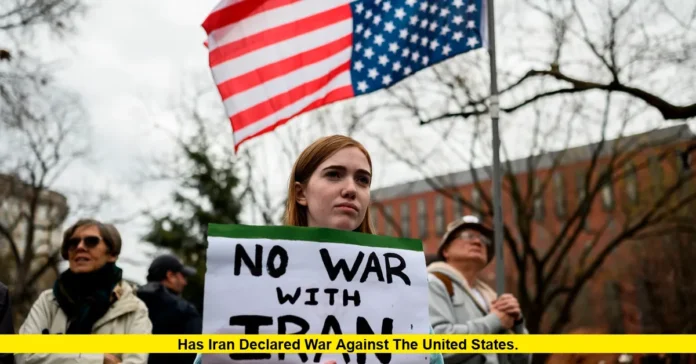

Growing tensions in the Middle East have fueled online searches and public concern, with many Americans asking a direct and serious question: has Iran declared war against the united states? Based strictly on confirmed, current facts, Iran has not formally or legally declared war on the United States. Despite intense rhetoric, military actions, and economic pressure, no official declaration meeting international legal standards has been issued by Tehran or Washington.
Understanding what is happening requires looking beyond headlines and examining how modern conflicts unfold without formal announcements.
Why the Question Keeps Resurfacing
The relationship between Iran and the United States has been strained for decades, but recent developments have pushed tensions into sharper focus. Statements from Iranian leaders describing the country as being under “full-scale” attack, combined with direct U.S. military action in the region, have created widespread confusion.
In previous eras, wars often began with formal declarations. Today, conflicts unfold through sanctions, airstrikes, cyber operations, and regional alliances, often without clear legal markers. This shift makes it harder for the public to determine when a conflict crosses the threshold into war.
What Counts as a Declaration of War
A declaration of war is a formal legal act issued by a government that explicitly states a state of war exists between two countries. It typically involves legislative or executive authority and carries significant international consequences.
In modern geopolitics, most conflicts do not begin this way. Governments avoid declarations because they can trigger automatic defense treaties, global economic disruptions, and broader military escalation.
Iran’s leadership has chosen strong language but has stopped short of taking this formal step.
Iran’s Public Position
Iranian officials have repeatedly stated that their country is facing what they describe as a comprehensive war involving the United States and its allies. This description includes:
- Economic sanctions that restrict trade and financial access
- Military threats and direct strikes on strategic facilities
- Intelligence operations and cyber pressure
- Regional confrontations involving allied groups
From Iran’s perspective, these combined actions represent warfare even without a traditional battlefield. This framing plays a central role in domestic messaging and international positioning.
However, describing conditions as “war” does not equal issuing a legal declaration. Iran has not filed any official notice or taken any procedural step that would formally place it in a declared war with the United States.
Military Actions Without War Status
The past year has seen some of the most direct military interactions between the two countries in decades.
The United States has conducted targeted strikes on Iranian military and nuclear infrastructure. These actions marked a serious escalation and demonstrated a willingness to use force directly rather than solely through regional allies.
Iran responded through missile launches, drone operations, and actions involving aligned forces across the region. U.S. military systems intercepted several of these attacks, preventing wider damage.
Despite the seriousness of these exchanges, both governments have avoided framing them as acts of declared war. Instead, they have described them as defensive, retaliatory, or preventive actions.
The Role of Proxy Conflicts
A defining feature of this confrontation is the use of proxy forces.
Iran maintains influence over several armed groups operating in neighboring regions. These groups have engaged in actions targeting U.S. interests and allies, allowing Iran to apply pressure without direct attribution.
The United States views these actions as indirect aggression. Iran frames them as resistance against external interference. This dynamic keeps the conflict active while maintaining a degree of separation between state actors.
Proxy warfare allows both sides to escalate or de-escalate without crossing the legal threshold of formal war.
U.S. Government Messaging
The United States has been careful in its language. While warning of severe consequences if Iran advances certain military programs, U.S. officials have avoided statements that would imply a declared war.
There has been no congressional declaration, nor any executive action designating Iran as an enemy state in a formal war context. Military operations have been justified as protective measures for national security and regional stability.
This approach reflects a broader U.S. strategy of deterrence without full-scale mobilization.
Economic Pressure as a Battleground
Economic measures play a major role in the current conflict.
Iran’s economy is under heavy strain. Its currency has weakened significantly, inflation remains high, and public frustration has grown. Iranian leaders frequently cite these conditions as evidence of economic warfare.
From Iran’s viewpoint, sanctions are not merely diplomatic tools but deliberate attempts to destabilize the country internally. This perspective reinforces the government’s narrative that Iran is already under attack, even without open conflict.
For the United States, sanctions are framed as leverage to influence behavior rather than acts of war.
Domestic Factors Inside Iran
Internal pressures shape Iran’s external messaging.
Economic hardship has led to protests and growing dissatisfaction among citizens. In this environment, portraying the nation as under siege can strengthen unity and redirect frustration toward external adversaries.
Strong rhetoric also serves to project strength, signaling that Iran will not yield under pressure. This messaging resonates domestically but does not alter the legal reality of the international situation.
Why a Formal Declaration Is Unlikely
Several factors make a declaration of war improbable in the near term:
- It would invite broader international involvement
- It could trigger automatic military responses from allied nations
- It would severely disrupt global energy markets
- It would limit diplomatic options for all parties
By avoiding a declaration, Iran retains strategic flexibility. The same applies to the United States.
How This Affects Global Stability
The absence of a formal declaration does not mean the situation is safe.
Undeclared conflicts carry significant risks. Miscalculations, miscommunication, or accidental escalation can rapidly push tensions beyond control.
At the same time, the lack of a declared war leaves room for negotiation, mediation, and de-escalation. This delicate balance defines the current moment.
Addressing the Central Question Clearly
So, returning to the core issue — has Iran declared war against the united states?
The confirmed answer remains no.
What exists instead is an intense, multi-layered confrontation involving military force, economic pressure, and political messaging. It is serious, volatile, and consequential, but it has not crossed the formal legal line into declared war.
Why Americans Are Watching Closely
For U.S. citizens, this distinction matters deeply.
A declared war would have immediate effects on military readiness, government policy, global markets, and everyday life. While tensions are high, the current status means those outcomes are not automatic.
Still, the situation demands attention. Developments can shift quickly, and decisions made by leaders on either side will shape the global landscape.
The Road Ahead
The coming months will test whether restraint continues or whether escalation accelerates. History shows that prolonged undeclared conflicts can either fade through diplomacy or explode through sudden confrontation.
For now, the world remains in a tense holding pattern, watching closely as both nations navigate a conflict that exists somewhere between open war and uneasy standoff.
Follow this developing story and share your perspective as global events continue to unfold.