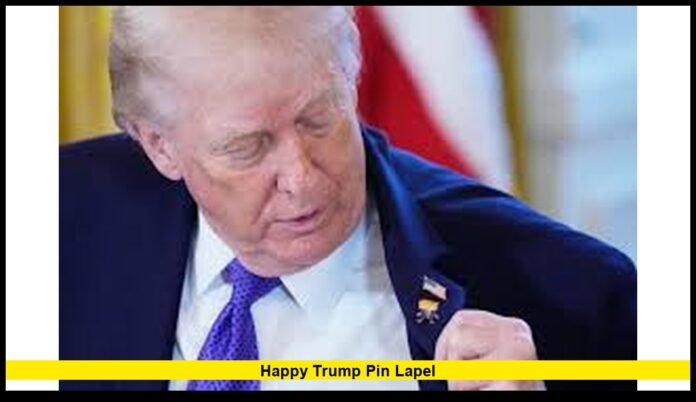

The happy trump pin lapel drew nationwide attention after President Donald Trump appeared at the White House wearing a small, smiling caricature pin of himself during a formal meeting with energy executives, creating a viral political image that quickly spread across television, social media, and public discussion in the United States.
What began as a simple accessory on a suit jacket evolved into one of the most talked-about visual details of the week, raising questions about political symbolism, personal branding, and how even minor elements of presidential appearance can shape national conversation.
A Small Pin That Created a Big Reaction
Lapel pins have long been part of American political tradition. Most presidents wear the U.S. flag pin as a sign of national unity and respect for office. In this case, however, the accessory was different. The happy trump pin lapel showed a cartoon-style image of the president with a cheerful expression, placed directly alongside the traditional flag pin.
The contrast between a serious policy meeting and a playful personal symbol made the image instantly memorable. Cameras captured the pin clearly, and within minutes, screenshots and video clips began circulating widely online.
The Setting That Sparked the Moment
The pin appeared during a high-level White House meeting focused on domestic and international energy policy. The session brought together senior administration officials and major oil and gas executives to discuss production, investment, and long-term supply planning.
While the agenda centered on economic and geopolitical issues, the visual of the president’s lapel unexpectedly became one of the most discussed aspects of the event. When asked about it, Trump acknowledged the pin with humor, noting that it had been given to him and joking about the contrast between the smiling image and his own claim of always pushing for more progress.
That brief exchange added personality to an otherwise formal setting and helped the image travel quickly through news coverage and digital platforms.
Visual Politics in the Modern Media Era
In today’s media environment, images often travel faster than policy statements. A single photograph can reach millions of people within minutes, shaping impressions long before detailed analysis follows.
The happy trump pin lapel fit perfectly into this visual-first culture. It was:
- Instantly recognizable
- Easy to crop and share
- Emotionally expressive
- Open to interpretation
Supporters saw it as confident and lighthearted. Critics viewed it as theatrical. Neutral observers saw it as another example of how modern political communication blends seriousness with spectacle.
Personal Branding and Presidential Image
Throughout his political career, Donald Trump has relied heavily on visual branding. From campaign hats to rally backdrops and color-coded ties, image has always played a role in how he communicates.
The smiling lapel pin adds a new layer to that strategy. Unlike campaign merchandise, which is designed for supporters, this accessory appeared in an official governing setting. That placement blurred the line between personal brand and presidential presentation.
For many Americans, the pin reinforced Trump’s reputation for using unconventional methods to remain visually distinctive, even during routine government business.
Public Response Across the Political Spectrum
Reaction to the happy trump pin lapel was swift and varied.
Supportive Voices
Many supporters described the pin as:
- A sign of confidence
- A touch of humor in a serious environment
- A symbol of optimism
- A reflection of Trump’s unfiltered personality
Some saw it as a reminder that the president does not conform to traditional expectations and is comfortable projecting his own image in unconventional ways.
Critical Views
Others argued that:
- The accessory distracted from policy discussions
- It placed personal branding above institutional dignity
- It encouraged spectacle over substance
For these viewers, the pin represented a broader concern about the blending of entertainment and governance.
Cultural Observers
Beyond political alignment, cultural commentators focused on what the moment revealed about modern leadership imagery. They noted that even small, symbolic details now carry weight in shaping how leaders are perceived.
The Role of Accessories in Political Messaging
Clothing and accessories have long been used to send subtle messages in politics. Examples throughout history include:
- Military jackets during wartime visits
- Rolled-up sleeves to signal readiness for work
- Specific colors to convey unity or mourning
- Commemorative ribbons during national crises
The happy trump pin lapel fits into this tradition, though in a more personalized way. Rather than referencing a national cause, it referenced the leader himself, turning the focus inward and making personal identity part of the visual message.
Impact on Political Merchandise Culture
Almost immediately after the pin became visible, public interest in similar items increased. Searches for Trump-themed lapel pins and novelty political accessories rose sharply. Collectors, supporters, and casual observers alike began looking for items that captured the same playful tone.
This response highlights how quickly a spontaneous visual moment can influence the political merchandise ecosystem. Campaigns and advocacy groups have long used buttons and pins for identification and fundraising. A viral accessory now has the potential to:
- Inspire limited-edition collectibles
- Drive online sales
- Reinforce supporter identity
- Create new visual symbols associated with a political era
Even without an official release, the demand itself demonstrated the power of imagery in modern political culture.
Shaping the Narrative of the Trump Presidency
Every presidency develops a visual archive that later defines how the era is remembered. Photographs of key moments often become symbolic markers in history books and documentaries.
The happy trump pin lapel may join that archive as:
- A representation of Trump’s unconventional style
- An example of how personal branding remained central to his public presence
- A snapshot of how politics and media spectacle intersected during his time in office
For historians, such moments help illustrate how leadership presentation evolves with technology and culture.
Influence on Future Political Presentation
The attention generated by the pin could influence how future leaders think about visual communication. It demonstrates that:
- Even minor accessories can become major talking points
- Personal symbols can travel as widely as policy headlines
- Image management now extends to the smallest details
This may encourage other political figures to be more deliberate about symbolic elements of their attire, knowing that any visual cue can become part of the national conversation.
Public Expectations in the Age of Viral Imagery
The widespread discussion around the happy trump pin lapel reflects changing expectations. Many Americans now anticipate moments that are:
- Visually distinctive
- Easily shareable
- Emotionally engaging
- Interpretable across multiple viewpoints
In this environment, leadership is not only evaluated through decisions and speeches but also through how moments look on screen and in still images.
Media Framing and Long-Term Memory
News cycles move quickly, but certain visuals endure. A single frame can come to represent an entire period or attitude. The smiling pin, worn during a serious policy meeting, created a juxtaposition that made it memorable.
Over time, such images can be referenced when discussing:
- The tone of a presidency
- The communication style of an administration
- The blending of politics with pop-culture aesthetics
The pin’s legacy may lie less in its physical design and more in what it revealed about the era’s visual politics.
A Reflection of Broader Cultural Shifts
Beyond partisan interpretation, the moment speaks to broader cultural trends:
- The personalization of public roles
- The influence of branding techniques in governance
- The speed at which symbolism spreads in digital spaces
- The merging of seriousness and spectacle in public life
In many ways, the reaction to the happy trump pin lapel mirrors how society now consumes leadership through both information and imagery at the same time.
Conclusion
The happy trump pin lapel began as a small, unexpected accessory on a suit jacket but quickly became a focal point of national attention. Its appearance during a high-level White House meeting transformed it into a symbol discussed across political, cultural, and media circles.
Whether viewed as humorous, strategic, controversial, or simply memorable, the pin demonstrated how modern politics is shaped not only by policy and rhetoric but also by visual moments that resonate instantly with a wide audience.
In an age where images travel faster than words, even the smallest detail can leave a lasting impression, and the smiling lapel pin now stands as one of those moments that captured the attention of the country.