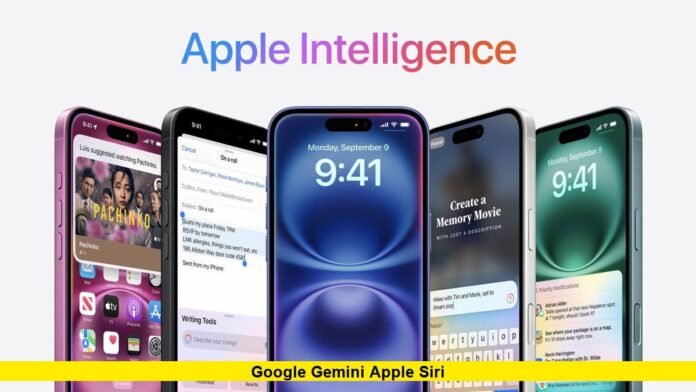

Apple has taken a decisive step into the next phase of artificial intelligence by confirming a major partnership with Google that will reshape the future of Siri and Apple Intelligence. Under a new multi-year agreement, Apple will integrate Google’s Gemini AI technology into its foundational AI systems, marking one of the most important changes in the company’s digital assistant strategy to date.
This move places google gemini apple siri at the center of Apple’s long-term AI roadmap, signaling that the company is ready to combine its hardware ecosystem and privacy-first philosophy with one of the world’s most advanced large language models. The result is expected to be a smarter, more contextual, and more capable Siri experience arriving later in 2026.
The announcement follows years of growing pressure on Apple to modernize Siri and keep pace with rapid advances in generative AI. With competitors rolling out increasingly powerful assistants, Apple’s decision to build its next generation of AI on Gemini represents both a technological leap and a strategic pivot.
Why Apple Turned to Gemini
Apple evaluated multiple AI model providers before selecting Google’s Gemini as the foundation for its upcoming AI systems. The company concluded that Gemini’s large-scale language understanding, reasoning capabilities, and multimodal processing offered the strongest platform for the next evolution of Apple Intelligence.
Rather than replacing Apple’s own AI development, Gemini will support and enhance it. Apple will continue to design, customize, and optimize its models to run within its ecosystem, while Gemini provides the underlying intelligence that powers more advanced understanding, faster responses, and richer contextual awareness.
This partnership reflects a growing trend in the technology industry: even the largest companies are now collaborating to accelerate AI development, recognizing that building everything independently can slow innovation in a field evolving at unprecedented speed.
What This Means for Siri
Siri has been part of Apple devices for over a decade, but its limitations have become increasingly apparent in the age of conversational AI. While it excels at simple commands, it has struggled with complex queries, multi-step reasoning, and natural dialogue.
The integration of Gemini is expected to change that in several key ways:
Deeper Understanding of Natural Language
Siri will be better equipped to understand how people actually speak, including follow-up questions, indirect requests, and conversational context. Users should be able to ask for information in a more natural flow without repeating details or simplifying their language.
Contextual Awareness Across Apps
With more advanced AI reasoning, Siri will be able to draw connections between calendars, messages, emails, reminders, and other apps to provide responses that reflect the user’s real-world situation. For example, it could combine travel details with schedule information to offer proactive suggestions.
Smarter Task Execution
The upgraded assistant will move beyond basic voice commands and handle more complex actions, such as summarizing long documents, organizing information, and performing multi-step tasks across different applications.
Richer, More Helpful Answers
Gemini’s language models can generate detailed, structured responses and explain concepts clearly, making Siri more useful for research, learning, and decision-making.
Apple Intelligence and the Broader AI Upgrade
Siri is only one part of Apple’s broader AI strategy. Apple Intelligence, the company’s system-wide suite of AI features, will also benefit from the Gemini foundation. These tools are designed to work across devices, offering capabilities such as:
- Intelligent text rewriting and summarization
- Advanced image recognition and search
- Smart notifications that prioritize what matters most
- On-device understanding of personal context for tailored suggestions
By strengthening the core models that power these features, Apple aims to deliver a more cohesive and capable AI experience across iPhone, iPad, Mac, and future devices.
Privacy Remains Central
One of the most important aspects of this partnership is how it aligns with Apple’s long-standing focus on user privacy. Apple has emphasized that the integration of Gemini does not change its approach to data protection.
Most AI processing will continue to happen on the device or within Apple’s own private cloud infrastructure, which is designed so that personal information cannot be accessed or stored by external parties. Google provides the underlying model technology, but Apple retains control over how it is deployed, customized, and secured.
This architecture allows Apple to benefit from advanced AI capabilities while maintaining its strict standards for user data confidentiality.
Impact on the Tech Industry
The collaboration between Apple and Google represents a notable shift in competitive dynamics. For years, the two companies have been rivals across mobile platforms, services, and ecosystems. Their decision to work together on core AI technology highlights how central artificial intelligence has become to the future of computing.
The deal also strengthens Google’s position as a leading provider of large-scale AI models and cloud infrastructure. By powering features on hundreds of millions of Apple devices, Gemini gains one of the largest distribution platforms in the world.
For the broader market, the partnership raises expectations for what consumers will soon experience from voice assistants and built-in AI tools. It also intensifies competition among other AI providers seeking to become the default intelligence layer for major platforms.
Timeline and Rollout Expectations
Apple has indicated that the first major wave of Gemini-powered features will arrive in 2026, beginning with a significantly enhanced version of Siri. These updates are expected to be delivered through major operating system releases, allowing the new capabilities to reach a wide range of supported devices.
The company is likely to introduce the upgraded assistant in stages, starting with core conversational improvements and gradually expanding to deeper system integration and advanced automation.
Strategic Significance for Apple
This partnership signals a clear recognition by Apple that artificial intelligence is now as foundational to user experience as hardware design and operating system performance. By aligning with Google’s most advanced AI models, Apple positions itself to deliver competitive, future-ready intelligence across its product lineup.
At the same time, Apple maintains control over the user experience, interface design, and privacy framework, ensuring that the integration feels native rather than outsourced.
The result could be a new generation of Apple devices where AI is no longer a background feature, but a central, intuitive part of everyday interaction.
What Users Can Look Forward To
For everyday users, the most noticeable change will be a Siri that feels more helpful, more conversational, and more aware of personal context. Tasks that once required multiple steps or manual searches may be handled through simple, natural requests.
Over time, as Apple continues to refine its AI models on top of the Gemini foundation, the assistant could evolve into a more proactive digital companion, capable of anticipating needs, organizing information, and simplifying complex workflows.
The broader Apple Intelligence features will also benefit, creating a more seamless experience across writing, communication, photo management, and productivity.
A Turning Point for Voice Assistants
The combination of Apple’s ecosystem and Google’s AI research marks a turning point for voice assistants on mobile devices. For years, users have expected these tools to become more conversational and more capable, but progress has been gradual.
With this partnership, Apple is signaling that the next leap forward is imminent. The convergence of powerful language models, on-device processing, and privacy-focused design could finally deliver the kind of intelligent, reliable assistant that users have long envisioned.
Looking Ahead
As 2026 approaches, anticipation will grow around how the new Siri and Apple Intelligence features perform in real-world use. The success of this initiative will depend not only on the power of the underlying models, but on how thoughtfully Apple integrates them into daily workflows.
What is clear is that Apple’s collaboration with Google represents a major investment in the future of AI on its platforms — one that could redefine how people interact with their devices for years to come.
What are your expectations for the next generation of Siri and Apple’s AI features? Share your thoughts and stay tuned for more updates.