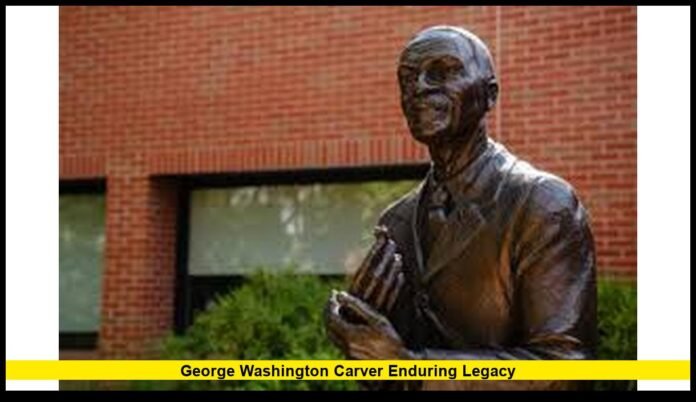

George Washington Carver remains a central figure in U.S. history today, with museums, universities, and national institutions continuing to spotlight his contributions to agriculture, science education, and sustainable land use as of the current year.
Although more than a century has passed since his most influential work began, public interest in his life and ideas remains strong. Educational programs, digital exhibits, and cultural observances across the United States continue to examine how his research reshaped farming practices and expanded access to scientific knowledge.
Early Life Shaped by Adversity
Born into slavery in Missouri in the early 1860s, Carver’s life began under extreme hardship. As an infant, he was kidnapped along with his sister during a raid. He was later recovered, but his parents were never found.
After the Civil War, he was raised by the family that had previously enslaved him. From an early age, he showed intense curiosity about nature, plants, and the environment around him.
Because local schools barred Black students, he traveled long distances to pursue education. This determination laid the foundation for his lifelong commitment to learning.
Education Against the Odds
Carver’s formal education began later than most due to segregation and limited access. He attended several schools before earning admission to Simpson College in Iowa.
He initially studied art and music. Professors soon recognized his talent for botany and encouraged him to pursue agricultural science. He later transferred to Iowa State Agricultural College, where he earned both bachelor’s and master’s degrees.
He became the institution’s first Black faculty member, marking a historic achievement at the time.
Transition to Teaching and Research
In 1896, Booker T. Washington invited Carver to lead the agriculture department at Tuskegee Institute in Alabama. He accepted and remained there for the rest of his career.
At Tuskegee, his mission focused on practical science that could improve daily life. Rather than working only in laboratories, he prioritized field research and direct engagement with farmers.
His work emphasized problem-solving grounded in real-world conditions.
Transforming Southern Agriculture
Southern soil had suffered decades of damage from cotton monoculture. Continuous planting depleted nutrients and reduced crop yields.
Carver introduced crop rotation as a solution. He encouraged farmers to alternate cotton with nitrogen-restoring crops such as peanuts, sweet potatoes, and legumes.
This approach:
- Improved soil health
- Reduced erosion
- Increased long-term productivity
His recommendations helped stabilize farm economies across the region.
Innovation Through Plant Research
Carver developed hundreds of practical applications for crops he promoted. His research focused on turning agricultural byproducts into useful goods.
Examples included:
- Food products
- Industrial oils
- Household items
- Natural dyes
- Agricultural treatments
These innovations helped farmers find new income sources and reduced waste.
Addressing Common Myths
One of the most persistent myths credits Carver with inventing peanut butter. Historical records do not support this claim.
Peanut-based spreads existed before his research. His true contribution was expanding the economic value of peanuts through diverse applications.
He rarely sought patents and focused instead on sharing knowledge freely.
Commitment to Farmer Education
Carver believed knowledge should reach people where they lived. He helped create mobile teaching units that traveled to rural communities.
These outreach efforts:
- Demonstrated new farming techniques
- Provided printed bulletins
- Answered farmer questions directly
This hands-on approach helped bridge gaps between academic research and everyday agricultural practice.
Teaching Philosophy and Values
Carver believed education should empower individuals to improve their own lives and communities. He emphasized observation, patience, and respect for nature.
His teaching principles included:
- Learning by doing
- Adapting science to local needs
- Serving others through knowledge
These values remain relevant in modern education systems.
Recognition During His Lifetime
Carver earned widespread respect for his work while he was still alive. He advised government officials and spoke before national audiences.
His reputation extended beyond agriculture into broader discussions of innovation and education.
Despite his fame, he lived modestly and continued teaching until his health declined.
National Honors and Memorials
After his death in 1943, recognition of his contributions continued to grow. The United States established the George Washington Carver National Monument in Missouri.
The site remains active today and features:
- Preserved landscapes
- Educational exhibits
- Interactive learning spaces
It holds the distinction of being the first national monument honoring a Black American.
Role in Modern STEM Education
Carver’s life story plays a major role in science and history classrooms across the country. Educators highlight his ability to connect scientific theory with practical outcomes.
He is often presented as:
- A model of perseverance
- A pioneer of applied science
- An advocate for accessible education
These themes align with current efforts to diversify STEM fields.
Sustainability Before the Term Existed
Long before sustainability entered common language, Carver promoted environmentally responsible practices.
His work encouraged:
- Soil conservation
- Resource efficiency
- Renewable plant use
Many modern agricultural principles reflect ideas he championed decades earlier.
Economic Influence Beyond the Farm
By helping farmers diversify crops, Carver indirectly supported regional economic stability. His research reduced dependence on a single commodity and opened new markets.
This diversification strengthened rural communities and improved food security.
His influence extended well beyond academic circles.
Faith and Personal Motivation
Carver was deeply spiritual and believed his scientific insights came through reflection and observation of nature.
He viewed science as a tool to serve humanity rather than a path to personal wealth.
This belief shaped his generosity and commitment to public service.
Preserving Historical Accuracy
Over time, exaggerated claims have emerged about his inventions and patents. Scholars and educators continue working to correct these inaccuracies.
Verified records show:
- He focused on teaching, not patenting
- His influence came from application, not ownership
- His legacy rests on service and innovation
Accuracy ensures his true achievements receive proper recognition.
Public Interest in the Digital Age
Carver’s work continues to reach new audiences through digital platforms. Educational videos, virtual museum tours, and classroom resources introduce his story to younger generations.
Online interest often increases during:
- Black History Month
- Academic semesters
- National park programs
These moments renew public engagement.
Why His Legacy Still Resonates
Food sustainability, environmental responsibility, and educational equity remain pressing issues today. Carver’s methods addressed these challenges directly.
His example shows how science can serve communities rather than profit alone.
Later discussions of george washington carver often emphasize how his ideas remain applicable in modern contexts.
Institutions Carrying His Work Forward
Universities, museums, and historical organizations continue to develop programming centered on his life and research.
These efforts focus on:
- Agricultural education
- Youth science engagement
- Historical preservation
They ensure continued access to his ideas.
Lessons for Future Generations
Carver’s life demonstrates how persistence and curiosity can overcome systemic barriers. His work shows the power of applying knowledge to real problems.
Students often connect with his story because it blends science, history, and social impact.
A Legacy Still Growing
Carver’s influence did not end with his lifetime. Each generation finds new relevance in his ideas and methods.
As agriculture and education evolve, his contributions continue to guide conversations about innovation with purpose.
How does Carver’s work connect to today’s challenges in food, science, or education? Share your thoughts and stay engaged as his legacy continues to inspire.