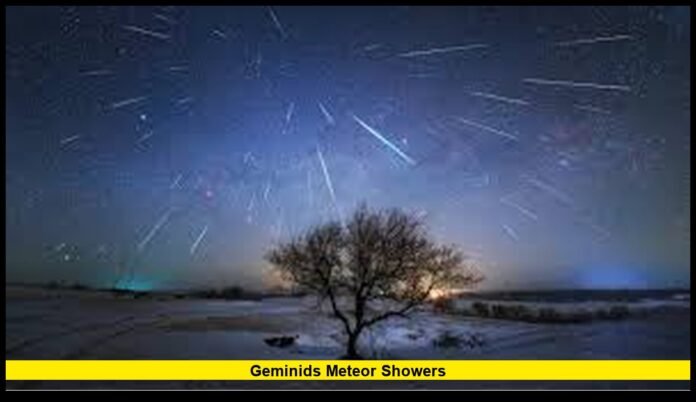

geminids meteor showers reach their strongest activity overnight from December 13 into the early hours of December 14, making them one of the most anticipated celestial events for U.S. skywatchers. Known for frequent, bright streaks and steady activity, this annual display often rewards patient viewers with dozens of meteors during a single night under clear, dark skies.
Unlike many other meteor events that feel subtle or inconsistent, the Geminids have built a reputation for reliability. Even casual observers stepping outside for short periods often catch multiple flashes, while dedicated viewers can experience sustained bursts during peak hours.
Why the Geminids stand out each year
The Geminids consistently rank among the strongest annual meteor events because of both volume and brightness. Many meteors appear white or yellow, while some show hints of green, blue, or orange as they burn through the atmosphere. Short, sharp streaks are common, along with occasional longer fireballs that leave glowing trails for a second or two.
Another reason for their popularity is timing. Mid-December nights are long, giving viewers extended darkness compared with spring or summer meteor events. This allows more flexibility for observation, even on busy schedules.
Peak timing for U.S. viewers
The most active window occurs late on December 13 through pre-dawn on December 14. In most parts of the United States, activity increases noticeably after sunset and builds steadily through the night.
The most productive hours typically arrive after midnight, when Earth’s rotation places observers on the side of the planet facing directly into the meteor stream. During these hours, Gemini rises higher in the sky, increasing the number of visible streaks.
If conditions allow, watching between 2 a.m. and sunrise often delivers the highest counts.
How many meteors are realistic to expect
Under ideal conditions—dark rural skies, clear weather, and an unobstructed view—watchers may see dozens of meteors per hour at peak. In exceptional circumstances, counts can climb higher for brief stretches.
In suburban locations, light pollution reduces visibility, especially for fainter streaks. Even so, many observers still report steady activity, with bright meteors cutting through the glow. Urban viewers may need patience but can still catch the brighter, more dramatic events.
The key factor is time spent watching. A 10-minute glance may produce nothing, while a 45-minute session often reveals multiple meteors.
Moon conditions during the peak
Moonlight plays a major role in how many meteors are visible. In years when the Moon is near full, fainter streaks disappear, leaving only the brightest flashes.
For the current peak, moonlight is not expected to overwhelm the sky, allowing a good balance between darkness and visibility. Any moon present during viewing hours can usually be managed by positioning yourself so it sits behind a structure, hill, or tree line.
This simple adjustment can significantly improve contrast without affecting your overall field of view.
Understanding where the meteors come from
Most meteor showers originate from debris shed by comets, but the Geminids are different. They are linked to a rocky object called 3200 Phaethon, which follows an orbit that brings it close to the Sun.
Over time, this object has released debris along its path. When Earth crosses that stream each December, tiny particles collide with the atmosphere at high speed, producing the flashes seen from the ground.
This unusual origin helps explain why Geminid meteors tend to be denser and brighter than those from many comet-based showers.
Where to look in the sky
Meteors can appear anywhere, but they seem to radiate from the constellation Gemini. Gemini rises in the east during the evening and climbs higher as the night goes on.
Rather than staring directly at Gemini, many experienced viewers look about halfway up the sky, away from bright lights and toward darker regions. This approach increases the chance of seeing longer streaks that travel farther across the sky.
You do not need to identify stars or constellations precisely. A wide, relaxed gaze works best.
Simple timing guide for casual watchers
For viewers planning around work or family schedules, here’s a straightforward approach:
- Early evening: Light activity, good for short looks
- Late evening: Gradual increase in visible meteors
- After midnight: Stronger, more consistent activity
- Pre-dawn: Often the most rewarding period
Even a single hour during late night or early morning can deliver an impressive experience if skies cooperate.
Choosing the best viewing location
Location matters as much as timing. Light pollution remains the biggest obstacle for meteor watching.
Rural areas, state parks, beaches, and open farmland offer the darkest skies. Even moving a short distance away from city centers can make a noticeable difference.
If travel is not an option, look for the darkest corner of your neighborhood. Turn off nearby lights if possible and avoid looking at illuminated screens while observing.
What to bring for a comfortable session
Comfort directly affects how long you can stay outside, and time equals results.
Bring a reclining chair or blanket so you can look up without straining your neck. Dress in warm layers, even if the evening starts mild. December temperatures can drop quickly after midnight.
Hot drinks, snacks, and gloves make extended viewing more enjoyable. A red-filter flashlight helps preserve night vision if you need light.
Allow your eyes at least 20 minutes to fully adapt to darkness.
No equipment required
One of the biggest advantages of meteor watching is simplicity. Telescopes and binoculars are unnecessary and can actually limit your field of view.
The naked eye remains the best tool. Wide vision allows you to catch sudden streaks that appear without warning.
Photography enthusiasts can try capturing meteors with cameras or phones using long-exposure modes, but visual enjoyment requires nothing more than patience.
Tips for photographing meteors realistically
Meteor photography often requires persistence. Most frames will show only stars.
Use a tripod, point the camera toward a dark area of sky, and shoot continuous long exposures. Wide-angle lenses work best.
Smartphones with night or long-exposure modes can capture bright meteors, especially fireballs, but expectations should remain realistic. Many memorable moments are best enjoyed live.
Identifying meteors versus other lights
Not every moving light is a meteor.
Meteors appear suddenly, move fast, and vanish quickly. Satellites glide slowly and steadily across the sky. Aircraft show blinking lights and consistent paths, sometimes with sound.
Once you spot a true meteor, the difference becomes immediately clear.
Weather considerations and flexibility
Clear skies are essential. Clouds, haze, or fog can completely block visibility, even during peak activity.
If weather looks uncertain, remain flexible. Sometimes conditions improve after midnight. Checking the sky periodically can pay off.
Cold, clear nights often deliver the sharpest views.
If you miss the peak night
The Geminids remain active for several nights before and after the peak. While counts drop outside the strongest window, bright meteors still appear.
Watching on adjacent nights can still be worthwhile, especially if peak night is cloudy.
The overall experience remains similar, just with fewer streaks per hour.
Why patience matters
Meteor watching rewards stillness. Long gaps between sightings are normal, followed by sudden bursts of activity.
Avoid distractions, keep your gaze relaxed, and let your eyes adjust fully. Many first-time viewers underestimate how dramatically patience improves results.
Over time, your brain also becomes better at detecting subtle flashes in peripheral vision.
A winter sky bonus
Beyond meteors, mid-December skies offer classic winter constellations rising earlier each night. Bright stars and planets add depth to the experience, turning meteor watching into a full sky tour.
Even on slower nights, the quiet atmosphere and wide-open sky create a memorable setting.
With clear skies and a bit of planning, geminids meteor showers offer one of the most dependable and visually striking nighttime events of the year for U.S. observers.