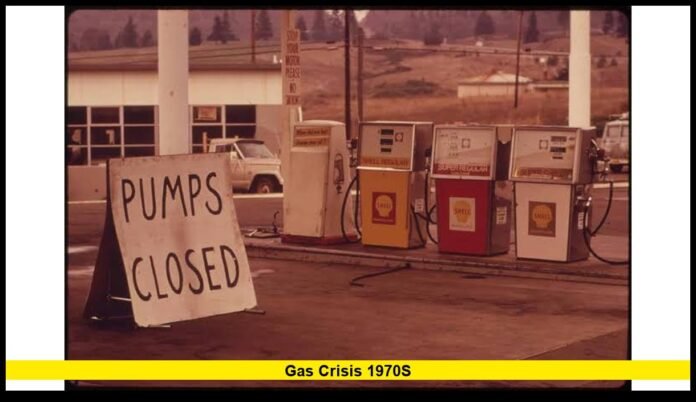

The gas crisis 1970s period remains one of the most important chapters in U.S. energy history, marked by gasoline shortages, long lines at service stations, rapidly rising oil prices and major changes in federal policy. The crisis unfolded through a series of international events rather than one isolated shortage. The 1973 Arab oil embargo triggered the first major shock, while political upheaval in Iran created another severe disruption later in the decade.
The effects reached nearly every American household. Drivers struggled to find fuel, businesses faced higher transportation costs and consumers confronted an economy increasingly affected by expensive petroleum. The experience also changed how Washington approached energy security.
Today, memories of those events often return whenever oil markets become unsettled. Yet the United States now operates within a very different petroleum system. The country has emergency crude reserves, different production patterns, more efficient vehicles and a far more interconnected global energy market.
Understanding what happened in the 1970s helps explain why gasoline shortages became such a powerful symbol of economic vulnerability in the United States.
America Entered the 1970s With Growing Oil Dependence
The conditions behind the crisis developed before gasoline stations began running dry.
American petroleum consumption had grown rapidly during the postwar period. Cars became central to everyday life, highways expanded and businesses increasingly depended on trucks and other petroleum-powered transportation.
Domestic oil production, however, was no longer keeping pace with consumption.
U.S. dependence on imported petroleum increased substantially during the early 1970s. Net petroleum imports accounted for about 22% of total U.S. oil consumption in 1970. By 1978, that figure had risen to approximately 47%.
That dependence became especially important because the United States had limited ability to quickly replace lost foreign supplies.
The problem was not simply the number of barrels entering the country. Refiners, pipelines, storage facilities and gasoline distributors all formed part of the system that moved petroleum from producers to American drivers.
A disruption at the international level could therefore create consequences thousands of miles away.
The 1973 Arab Oil Embargo Triggered the First Major Shock
The most important turning point came in October 1973.
The Yom Kippur War began when Egypt and Syria attacked Israel. The United States provided support to Israel during the conflict.
Several Arab members of the Organization of Petroleum Exporting Countries responded by restricting oil shipments to the United States and other countries.
The action became known as the Arab oil embargo.
Arab oil production fell by roughly 25%. With global spare production capacity limited, the reduction placed extraordinary pressure on petroleum markets.
Oil prices climbed sharply.
The consequences quickly reached American motorists.
Some service stations ran out of gasoline. Drivers encountered long queues as motorists tried to fill their tanks before supplies disappeared. The shortage became visible on ordinary streets across the country.
The disruption also demonstrated how quickly international political events could affect daily American life.
Why Gas Stations Ran Out of Fuel
The shortage involved more than the headline price of crude oil.
Petroleum moves through a complicated supply chain. Crude must reach refineries, refineries must produce finished gasoline, and fuel must then travel through distribution networks before reaching service stations.
When supplies tighten at several points, local shortages can become severe.
Consumers also reacted to the uncertainty.
Drivers who feared future shortages often purchased gasoline earlier than planned. That behavior increased demand at precisely the moment supplies were under pressure.
Long lines then became self-reinforcing.
A station that normally served a manageable number of customers could suddenly face hundreds of vehicles. Its underground tanks could empty much faster than distributors could replenish them.
The result was a familiar sight of the era: motorists waiting in long lines for gasoline.
Federal Price Controls Added Another Layer of Complexity
Washington attempted to manage the disruption through new rules.
Congress passed the Emergency Petroleum Allocation Act in November 1973. The legislation established a complicated system for allocating petroleum and controlling prices.
Domestic crude oil received different treatment depending on when and where it had been produced.
Older domestic oil faced price controls, while some newer production could receive market-based prices. Imported crude remained subject to different pricing conditions.
The system was intended to protect consumers from rapidly rising costs and allocate limited petroleum supplies.
However, it also created distortions within the oil market.
Price controls could weaken incentives to increase production from existing fields. At the same time, refiners faced different costs depending on where their crude originated.
The complicated system remained a major feature of U.S. petroleum policy for years.
Americans Began Changing Their Driving Habits
The crisis altered the way many Americans viewed automobiles.
Large vehicles had long been a major part of the U.S. auto market. Many offered powerful engines but consumed considerably more fuel than the smaller vehicles that gained attention during the energy crisis.
Suddenly, fuel economy mattered much more.
A vehicle that traveled farther on every gallon became financially attractive when gasoline supplies were uncertain and prices were rising.
Smaller cars gained popularity.
The shift was not permanent in every respect. American consumers later returned to larger vehicles as energy conditions changed. However, the 1970s established fuel efficiency as an important consideration in federal transportation policy and automobile design.
The government responded with fuel-economy requirements that shaped the industry for decades.
The 55-Mph Speed Limit Became a Symbol of Conservation
Energy conservation reached America’s highways.
The federal government introduced a national maximum speed limit of 55 miles per hour during the energy crisis.
The reasoning was straightforward. Vehicles generally consume more fuel at higher highway speeds. Reducing speed could therefore reduce petroleum consumption.
The rule became one of the most recognizable energy policies of the period.
It also became controversial.
Many drivers disliked the restriction, particularly in regions where highways had previously allowed considerably higher speeds. States and motorists debated whether the reduction was worth the inconvenience.
The federal 55-mph limit eventually remained in place for many years before Congress ended the national requirement in 1995.
Congress Created New Energy Policies
The crisis convinced federal policymakers that emergency measures alone were not enough.
Congress passed the Energy Policy and Conservation Act in 1975.
The legislation addressed several areas of energy policy. It created the foundation for the Strategic Petroleum Reserve and established federal fuel-economy requirements for passenger vehicles.
The changes were significant.
Fuel-economy standards pushed automobile manufacturers toward more efficient vehicles. Passenger-car standards were designed to rise substantially from the levels common during the early 1970s.
The policy helped establish fuel efficiency as a long-term national objective rather than simply a temporary response to a shortage.
The crisis also encouraged greater attention to domestic energy production.
The Strategic Petroleum Reserve Was a Direct Legacy of the Crisis
Perhaps the most important long-term response was the creation of the Strategic Petroleum Reserve.
The federal government established the reserve after the 1973 disruption to provide emergency crude oil during serious supply interruptions.
Officials selected underground salt formations along the Gulf Coast for storage.
Salt caverns offered enormous capacity and could be connected to major petroleum infrastructure.
The first oil entered the reserve in 1977.
The concept was simple: if a major disruption threatened U.S. petroleum supplies, the government could release crude from the reserve into the market.
The reserve did not eliminate the possibility of shortages. Instead, it created an additional layer of protection against severe supply disruptions.
Its existence remains one of the clearest institutional reminders of the lessons learned during the 1970s.
The Second Shock Came After the Iranian Revolution
The energy crisis continued after the 1973 embargo.
Political turmoil in Iran created another major petroleum disruption toward the end of the decade.
Iran was an important oil producer. When the Iranian Revolution intensified in 1978 and 1979, oil production dropped sharply.
In January 1979, the Shah of Iran left the country. The disruption to Iranian exports contributed to a worldwide petroleum shortage.
Other oil-producing nations increased output, but they could not immediately eliminate the effects of the lost Iranian supply.
The second shock showed that the American energy problem had not been solved.
Even after new conservation measures and policies had been introduced, the global petroleum market remained vulnerable to political instability in major producing regions.
The Iran-Iraq War Made Conditions Worse
The situation became even more difficult after Iran and Iraq went to war in 1980.
Both countries were significant oil producers, so fighting in the region threatened additional supplies.
OPEC production fell substantially from its 1978 level by 1981.
Oil prices increased sharply, adding further pressure to economies that were already dealing with inflation and weak growth.
For American consumers, expensive petroleum meant more than a costly trip to the gas station.
Transportation costs increased. Businesses that depended on fuel faced higher operating expenses. Petroleum-intensive industries experienced greater costs.
The energy shock therefore became part of a much larger economic problem.
Oil Prices Helped Fuel Inflation
The 1970s are closely associated with stagflation, a difficult combination of high inflation and weak economic growth.
Energy prices played an important role.
Oil is used throughout the economy. Transportation depends heavily on petroleum, while many industries rely on energy-intensive processes.
When oil prices rise sharply, the effects can spread beyond gasoline.
Truckers pay more for diesel. Airlines face higher jet-fuel costs. Manufacturers can face higher energy expenses. Consumers may then encounter higher prices for goods and services.
This broad economic impact made the energy crisis especially damaging.
It was not simply a problem for motorists.
Domestic Oil Production Was Also Under Pressure
The United States tried to increase domestic production, but existing oil fields faced declining output.
Crude production from the lower 48 states fell from about 9 million barrels per day in 1973 to just under 7 million barrels per day by 1980.
That decline occurred during a period when petroleum demand remained high.
The gap between domestic production and consumption contributed to America’s reliance on imports.
The federal government therefore pursued multiple approaches at the same time: conservation, efficiency, domestic production and emergency reserves.
No single policy could address every part of the problem.
Alaska Became Increasingly Important
The energy crisis also increased attention on Alaska’s oil resources.
The Trans-Alaska Pipeline System became a major infrastructure project during the decade.
Construction began in 1975, allowing crude from Alaska’s North Slope to eventually travel to the port of Valdez.
Alaskan oil became an important addition to the U.S. petroleum supply.
The project demonstrated another lesson from the decade: energy security depended not only on international relationships but also on domestic infrastructure.
Pipelines, refineries, ports, storage facilities and transportation networks all mattered.
The Crisis Changed the American Auto Industry
Automakers could no longer ignore fuel economy.
Before the crisis, large American vehicles dominated much of the market. Their size, power and comfort appealed to many consumers.
Rising gasoline costs changed the calculation.
Smaller vehicles became increasingly attractive. Foreign automakers also gained opportunities as American consumers looked for cars that could travel farther on less fuel.
Federal fuel-economy standards reinforced that shift.
The Energy Policy and Conservation Act established requirements that pushed passenger-car efficiency substantially higher.
The changes influenced vehicle engineering for years.
What Made the 1970s Different From Today?
Modern gasoline-price increases can evoke memories of the 1970s, but the two periods are not identical.
The United States now has a Strategic Petroleum Reserve. The country also has a different domestic production profile, a larger and more interconnected petroleum infrastructure system and vehicles that generally use fuel more efficiently than those sold during the early 1970s.
The global oil market has also changed.
International supply disruptions can still cause prices to rise. Political events in major producing regions remain important to petroleum markets.
However, modern comparisons need to consider the different levels of production, inventories, consumption and emergency resources.
A rise in gasoline prices alone does not recreate the conditions of the 1970s.
The defining feature of that earlier period was the combination of severe international supply disruptions, limited spare capacity, rising U.S. import dependence and a domestic market that had fewer tools for absorbing sudden shocks.
Why the 1970s Still Matter to American Drivers
The most important lesson is that energy disruptions can affect everyday life surprisingly quickly.
A conflict overseas can reduce global oil supplies. Reduced supply can push crude prices higher. Higher crude prices can increase refinery costs. Those costs can then appear at gas stations.
The chain is not always immediate, and many other factors influence gasoline prices. Refinery capacity, seasonal fuel requirements, inventories, transportation costs and regional market conditions can all matter.
Still, the experience of the 1970s established a lasting connection between energy security and economic security.
That connection remains relevant whenever global petroleum markets become unstable.
Key Events From the Decade
| Year | Major development |
|---|---|
| 1973 | Arab oil embargo begins after the Yom Kippur War |
| 1973–74 | Oil prices surge and U.S. gasoline shortages develop |
| 1973 | Emergency Petroleum Allocation Act becomes law |
| 1975 | Energy Policy and Conservation Act becomes law |
| 1975 | Federal fuel-economy policy gains a major new foundation |
| 1977 | First crude oil enters the Strategic Petroleum Reserve |
| 1978–79 | Iranian Revolution disrupts oil production |
| 1979 | Worldwide petroleum shortage develops |
| 1980 | Iran-Iraq War begins |
| 1981 | OPEC production remains substantially below its 1978 level |
The Long-Term Legacy
The gasoline shortages of the 1970s changed American energy policy in ways that lasted long after service stations stopped displaying empty pumps.
The United States built emergency petroleum reserves. Automakers faced stronger efficiency requirements. Consumers became more conscious of fuel consumption. Domestic production and energy infrastructure received greater attention.
The period also showed policymakers the risks of relying too heavily on a single source of energy.
Most importantly, it demonstrated that petroleum markets operate globally.
American drivers could experience the consequences of an international political crisis even when the event occurred far from the United States.
That lesson remains relevant today.
The history of the decade explains why oil supply disruptions receive such close attention from consumers, businesses and government officials. It also explains why gasoline availability is about much more than what happens at a neighborhood service station.
The painful experience of the 1970s permanently changed the way America thinks about fuel, transportation and energy security.
What do you remember about the 1970s energy crisis, or what part of this history surprised you most? Share your thoughts and stay informed as energy markets continue to evolve.