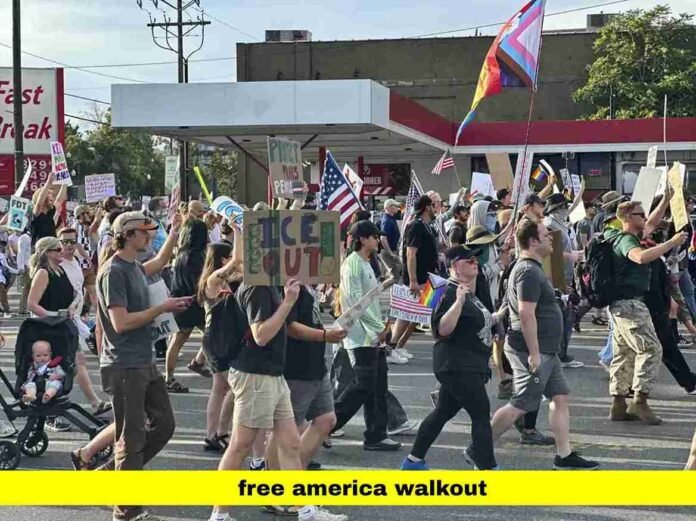

Millions of Americans took to the streets and withdrew from school, work, and everyday routines on Tuesday in what was called a free america walkout — a coordinated nationwide protest marking the one-year anniversary of President Donald Trump’s second inauguration.
This large-scale civic action unfolded across all 50 states, inspiring thousands of participants to leave workplaces, campuses, and regular activities to make a visible stand. People across cities, towns, and small communities gathered to show their opposition to perceived authoritarian policies, express concern over recent developments in law enforcement, and press for a shift in national priorities.
At its core, the walkout was both a symbolic and practical demonstration of widespread concern about the trajectory of governance, civil liberties, and social justice in the United States. Below, we take a detailed look at what the walkout involved, how it was organized, where major events took place, and why it resonated with so many Americans in early 2026.
Origins of the Nationwide Walkout Movement
This year’s nationwide protest was intentionally scheduled for January 20, chosen to coincide with the anniversary of Donald Trump’s return to the White House. Organizers called on people across America to step away from their daily responsibilities at 2 p.m. local time, creating a synchronized withdrawal of labor, commerce, and social participation.
The event was driven by coalitions of activist groups who sought to highlight collective power by interrupting the routines that underpin everyday economic and civic life — belief being that when enough people step out simultaneously, the impact becomes visible and difficult to ignore.
What the Walkout Aimed To Highlight
Participants and organizers emphasized several core messages during the walkout:
- Opposition to immigration policies and enforcement tactics seen as overly aggressive
- Protest against expanded use of federal power in domestic contexts
- Concerns about threats to civil liberties, individual rights, and democratic norms
- A call for broad social and political change
Rather than traditional weekend marches, the walkout format was intended to show how integral participation in work and school is to the structure of society, and what happens when that participation is disrupted in a coordinated way.
This approach reflected a desire to shift from expression of opinion to an active demonstration of people’s collective agency.
How the Walkout Was Organized
The nationwide walkout was not the product of a single group. Instead, it emerged from a coalition of established and grassroots organizations working together.
Participants were encouraged to organize local walkout events in their own communities. Many were planned around existing civic spaces such as city halls, state capitols, and public parks, while others focused on universities, high schools, and downtown commercial districts.
Leadership from activist networks guided participants on how to organize walkouts, propose peaceful demonstrations, and amplify local impact through social media and community networks.
By framing the action as a coordinated moment of mass non-participation, organizers aimed to make the effects of withdrawal visible without promoting confrontation or disorder.
Major Participation Across the Country
Large and small communities alike saw walkout activity from coast to coast and across state lines.
In California, cities including Pasadena and Ventura saw walkouts take place with participants leaving workplaces and joining organized walks that merged public expression with civil engagement.
In the Midwest, walkouts were reported in cities such as Milwaukee and Hayward, where residents met at central public spaces to gather and demonstrate in peaceful ways.
Connecticut communities from Hartford to New Haven participated in simultaneous events, drawing hundreds of residents to protest sites where they voiced concerns over policy decisions and law enforcement actions.
Metro Atlanta schools and colleges reported coordinated departure from classes, with students joining the nationwide call to action.
Additional cities including Albuquerque, Boston, Columbus, and others reported local walkouts, each with its own flavor and focus but united under the broader nationwide theme of collective withdrawal.
These events demonstrated how a dispersed but coordinated effort could bring together diverse communities at a shared moment in time.
What Happened During the Walkouts
Although the walkouts took place in varied locations, several common patterns emerged:
- Groups gathered at prominent public meeting points at the designated time
- Participants waved signs, chanted messages, and sometimes held brief speeches or vigils
- Many events were peaceful, with local law enforcement present to maintain order
- In some areas, organizers provided guidance on safe conduct and respect for public space
Local organizers emphasized that the walkouts were meant to be peaceful demonstrations of collective agency, not confrontational rallies. Participants were encouraged to remain nonviolent, uphold public safety, and express their concerns in ways that highlighted unity and strength.
Some walkouts also included educational elements, with small groups discussing civic engagement, democratic values, and community solidarity.
The Role of Schools and Students
A notable feature of this nationwide walkout was the involvement of schools and students. In multiple regions, high school and college students participated by temporarily leaving classes to join marches and gatherings.
In metro Atlanta, for example, more than a dozen schools had planned walkout participation. Students often organized around themes of social justice, human rights, and democratic participation, with many framing their involvement as a chance to engage directly with civic issues that impact their futures.
While school participation raised conversations about academic responsibilities, it also underscored a generational engagement with broader national discussions about governance, equity, and citizen power.
Public Safety and Peaceful Demonstration
Across the country, organizers and local authorities coordinated to ensure demonstrations remained safe and lawful.
In Pasadena, event organizers explicitly advised participants to stay on sidewalks, obey all traffic signals, and work with local police to ensure peaceful protest.
This focus on minimizing conflict helped keep the walkout day free from major incidents, even as public expression surged in cities large and small.
Both organizers and participants emphasized that the walkouts were about visibility and impact through peaceful collective action rather than through disruption or violence.
Voices from the Streets: What Participants Are Saying
On the ground, many individuals who took part in the walkouts described their involvement as deeply personal and significant.
People spoke about concerns ranging from immigration enforcement and labor rights to civil liberties and political accountability. For many, stepping away from daily routines was a way to make demands visible and tangible.
Some framed their participation as a continual commitment to democratic engagement, expressing hope that mass involvement could drive conversation and, potentially, policy reevaluation.
In city centers and public squares, walkouts brought together people of different ages and backgrounds, demonstrating how diverse communities can align around collective concerns.
How the Walkout Builds on Past Actions
This nationwide protest did not emerge in isolation. It built on a longer history of public action and civic response.
Activist traditions in the United States have long included walkouts, sit-ins, and mass departures from everyday activity to highlight inequities and demand change. Modern organizers described the January 20 event as part of this legacy — a continuation of strategies aimed at turning public energy into visible pressure.
For many participants, this was a chance to draw inspiration from earlier movements while applying those lessons to contemporary concerns.
Economic Effects of a Midday Walkout
One of the central ideas behind this nationwide walkout was that withdrawing participation from the economy — even for a few hours — creates visibility and momentum. When workers leave their jobs, students walk out of classrooms, and customers pause their shopping routines, the collective absence creates a moment that ordinary daily life cannot ignore.
Although it was a single-day event, the walkout illustrated how coordinated pauses in participation can draw attention to broader themes of civic life, economic reliance, and everyday contributions that support institutions and systems.
This strategic pause highlighted how collective action can move beyond rhetoric and into the physical rhythms of everyday life.
What Comes Next After the Walkout
While the walkout itself was a one-day event, organizers and participants view it as part of a continuum of civic engagement.
Some community groups are planning follow-up discussions, local forums, and related events to keep momentum moving forward. Others are using the visibility of walkouts to build support for ongoing advocacy and engagement efforts.
By choosing a weekday for the action, organizers emphasized how collective pauses in ordinary life can become a powerful tool for communication, awareness, and influence.
United Yet Diverse: How Walkouts Varied Locally
Although the walkout was nationwide, each community added its own expression to the day.
In some cities, walkouts took the form of marches leading to public squares. In others, they looked like group vigils on sidewalks or community discussions outside schools and workplaces.
These diverse expressions reflect how people across the country adapted the central idea of the action to local priorities, showing both unity and regional distinctiveness.
The Broader Message Behind the Actions
At its core, the walkout was about community agency and collective presence. People from all walks of life stepped out of their everyday routines to show concern about trends they see as affecting national life.
Whether the messages focused on civil liberties, immigration, human rights, or democratic values, the shared action was meant to make those concerns visible on a broad scale.
As the day unfolded, the walkouts made clear that coordinated public action remains a dynamic part of civic life in the United States.
What did you experience or observe during this nationwide walkout? Share your perspective and stay connected to how these moments shape civic engagement across the country.