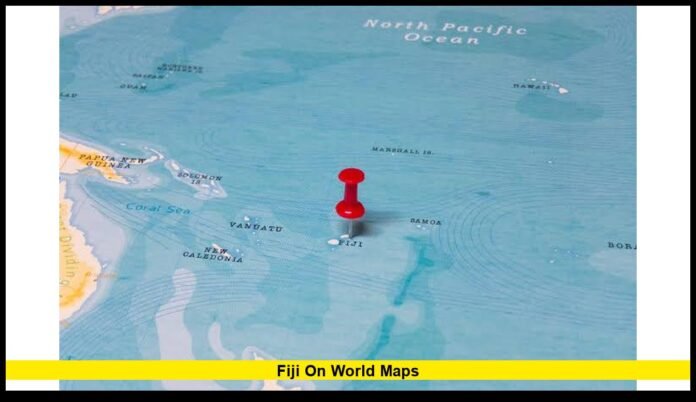

If you’re searching for Fiji on world map, you’re likely wondering exactly where this beautiful island nation is located. Fiji is a tropical archipelago in the South Pacific Ocean, famous for its crystal-clear waters, coral reefs, and welcoming culture. Although it appears small on most world maps, Fiji is an important country in Oceania and a popular travel destination.
This guide explains where Fiji is on the world map, its neighboring countries, geography, and why it is strategically important in 2026.
Key Points Summary
╔════════════════════════════════════════════════════════════════════╗
║ – Fiji is an island nation located in the South Pacific Ocean.    ║
║ – It lies northeast of New Zealand and east of Australia.         ║
║ – Fiji consists of more than 330 islands, with about 110 inhabited.║
║ – Suva is the capital city, located on the island of Viti Levu.   ║
║ – Fiji continues to play an important role in Pacific diplomacy.  ║
╚════════════════════════════════════════════════════════════════════╝
Where Is Fiji on the World Map?
Fiji is located in Oceania, in the South Pacific Ocean, approximately two-thirds of the way between Hawaii and New Zealand. It sits just west of the International Date Line, making it one of the first countries in the world to welcome each new day.
On a world map, Fiji can be found:
- East of Australia
- Northeast of New Zealand
- South of Tuvalu
- West of Tonga
- North of New Zealand
Because Fiji is made up of many small islands, it often appears as tiny dots on standard world maps.
Which Continent Is Fiji In?
Although many people ask which continent Fiji belongs to, the country is actually part of the Oceania region rather than a traditional continent.
Oceania includes:
- Australia
- New Zealand
- Papua New Guinea
- Fiji
- Samoa
- Tonga
- Vanuatu
- Solomon Islands
- Numerous Pacific island nations
Fiji’s Exact Geographic Location
Fiji is positioned near the following coordinates:
- Latitude: Approximately 18° South
- Longitude: Approximately 175° East
Its location gives Fiji a warm tropical climate throughout the year.
Map Overview of Fiji
Fiji consists of an archipelago of over 330 islands, with around 110 permanently inhabited. The two largest islands dominate the country’s land area and population:
Viti Levu
- Largest island
- Home to Suva (capital)
- Contains Nadi International Airport
- Houses the majority of Fiji’s population
Vanua Levu
- Second-largest island
- Known for rainforests and agriculture
- Less densely populated than Viti Levu
Smaller island groups include:
- Yasawa Islands
- Mamanuca Islands
- Lau Islands
- Kadavu
- Lomaiviti Group
Countries Near Fiji
Fiji has no land borders because it is entirely surrounded by the Pacific Ocean.
Nearby countries include:
| Country | Approximate Direction |
|---|---|
| Australia | West |
| New Zealand | Southwest |
| Tonga | East |
| Vanuatu | West |
| Samoa | Northeast |
| Tuvalu | North |
Size of Fiji
Although Fiji appears tiny on a world map, it covers approximately:
- 18,274 square kilometers
- Over 1,100 kilometers of coastline
- An Exclusive Economic Zone (EEZ) of roughly 1.29 million square kilometers, giving Fiji stewardship over a vast area of the Pacific Ocean.
Capital City
The capital of Fiji is Suva.
Located on the southeastern coast of Viti Levu, Suva serves as:
- Government center
- Financial hub
- Largest urban area
- Major Pacific regional headquarters
Why Fiji Is Important on the World Map
Despite its modest land area, Fiji has significant regional and global importance.
Tourism
Millions of visitors are attracted by:
- White-sand beaches
- Coral reefs
- Luxury resorts
- Diving and snorkeling
- Tropical islands
Tourism remains one of Fiji’s largest economic sectors.
Pacific Leadership
Fiji is an influential member of several regional organizations and regularly hosts international meetings involving Pacific nations.
Transportation Hub
Nadi International Airport connects Fiji with:
- Australia
- New Zealand
- United States
- Japan
- Singapore
- Other Pacific Islands
Climate
Fiji enjoys a tropical marine climate featuring:
- Warm temperatures year-round
- Dry season (May–October)
- Wet season (November–April)
Average temperatures generally range between 22°C and 31°C (72°F–88°F).
Population
As of recent estimates, Fiji has a population of roughly 950,000 people.
Its multicultural society includes:
- Indigenous iTaukei Fijians
- Indo-Fijians
- Europeans
- Chinese
- Other Pacific Island communities
Interesting Facts About Fiji
- Fiji has more than 330 islands.
- About 110 islands are permanently inhabited.
- English, Fijian, and Fiji Hindi are official languages.
- Rugby is the country’s most popular sport.
- Fiji won Olympic gold in Rugby Sevens.
- The nation lies close to the International Date Line.
- Fiji is renowned worldwide for coral reefs and marine biodiversity.
Fiji in 2026
In 2026, Fiji continues to strengthen its international presence through tourism, regional cooperation, and diplomacy. One notable development this year is a landmark defense and economic partnership with Australia, highlighting Fiji’s growing strategic importance in the Pacific while maintaining its independent foreign policy.
Frequently Asked Questions
Where is Fiji on the world map?
Fiji is located in the South Pacific Ocean, east of Australia and northeast of New Zealand.
Is Fiji part of Australia?
No. Fiji is an independent sovereign nation located in Oceania.
How many islands are in Fiji?
Fiji has more than 330 islands, with approximately 110 permanently inhabited.
What is the capital of Fiji?
Suva is the capital city of Fiji.
Why is Fiji famous?
Fiji is famous for its tropical islands, luxury resorts, coral reefs, friendly culture, and world-class diving.
Found this guide helpful? Leave a comment below or stay updated for more geography guides and world map insights!