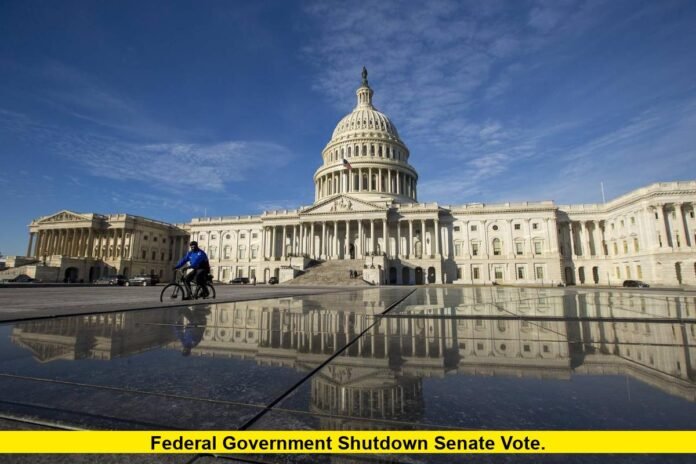

The federal government shutdown senate vote continues to dominate Washington as the nation moves deeper into the second week of the federal funding lapse. Lawmakers in the Senate have now held seven separate votes to end the shutdown, but each attempt has failed to reach the 60-vote threshold required to advance legislation, leaving hundreds of thousands of federal workers without pay and critical services disrupted nationwide.
Senate Struggles to Break the Deadlock
On Thursday, the Senate held its seventh vote on a short-term funding measure aimed at reopening the government through late November. The measure fell short by a 54–45 vote, failing to clear the procedural hurdle needed to move forward. This marked yet another setback in a series of unsuccessful efforts to end the impasse.
Earlier in the week, two competing proposals — one from Senate Republicans and one from Senate Democrats — also failed to advance. The Republican plan sought to temporarily fund the government through November 21, while the Democratic version included extensions of Affordable Care Act tax credits and provisions to reverse certain health care cuts. Neither proposal achieved the supermajority needed to break a filibuster.
The repeated failures underscore deep partisan divisions in the upper chamber. Although a handful of senators crossed party lines in recent votes, the margin remains insufficient to reach the 60-vote requirement. This persistent gridlock has left federal agencies in limbo and heightened uncertainty for millions of Americans who depend on government programs and services.
Why the Senate Votes Keep Falling Short
The 60-Vote Threshold
Unlike the House of Representatives, where a simple majority can pass legislation, the Senate requires 60 votes to overcome procedural obstacles and move most bills forward. With neither party holding a filibuster-proof majority, bipartisan cooperation is essential. So far, both sides have refused to yield on key policy priorities, preventing any proposal from gaining enough support.
Policy Riders and Health Care Disputes
One of the most significant sticking points is the inclusion of health care provisions in the funding bills. Democrats are pushing to extend Affordable Care Act tax credits and reverse recent Medicaid cuts as part of any continuing resolution. Republicans, meanwhile, argue that the funding measure should be “clean,” meaning free of policy riders unrelated to government operations.
This policy divide has turned what is typically a straightforward short-term spending measure into a broader battle over the future of health care policy.
Back Pay for Federal Workers
Another source of tension involves whether furloughed federal employees will receive back pay once the shutdown ends. While previous shutdowns typically included retroactive pay for affected workers, recent statements from the administration have created uncertainty. Without a clear legislative guarantee, hundreds of thousands of workers face the prospect of lost income for the duration of the closure.
The Real-World Impact of the Shutdown
The continued failure of each federal government shutdown senate vote has tangible consequences far beyond Capitol Hill.
- Federal Employees: Roughly 900,000 workers have been furloughed, while another 700,000 are continuing to work without pay in critical roles such as air traffic control, law enforcement, and border security.
- Public Services: Numerous agencies have suspended operations or scaled back significantly. Regulatory enforcement, research programs, and grant disbursements have been paused, delaying essential services and projects across the country.
- Travel Delays: Airports are experiencing staffing shortages, leading to longer wait times and increased flight delays in several major cities.
- Economic Ripple Effects: Small businesses that rely on federal contracts and tourism linked to national parks and monuments are facing significant financial strain as the shutdown persists.
The longer the shutdown continues, the more severe these impacts are expected to become. Economists have warned that an extended funding lapse could reduce overall economic growth for the quarter.
Political Stakes Intensify
The standoff has also become a defining political moment for both parties. Republicans argue that Democrats are holding up government funding to push unrelated health care policies. Democrats counter that protecting Affordable Care Act provisions and reversing Medicaid cuts are essential to safeguarding millions of Americans’ access to health care.
Both sides are also feeling pressure from their respective bases. Republican leadership faces calls to stand firm on excluding policy riders, while Democrats are under pressure to resist what they describe as short-term fixes that ignore urgent policy issues. With a presidential election year on the horizon, neither side appears eager to make concessions that could be viewed as political weakness.
Senate Vote Timeline
| Date | Proposal | Vote Result | Status |
|---|---|---|---|
| Early October | Republican short-term funding bill through Nov 21 | 52–42 | Failed |
| Early October | Democratic proposal with ACA extensions | 45–55 | Failed |
| October 9 | Republican funding bill (7th vote) | 54–45 | Failed |
| October 9 | Democratic alternative | Insufficient votes | Failed |
This sequence of failed votes highlights how entrenched the positions have become, with neither party able to secure the bipartisan support required to end the shutdown.
What Comes Next
Senate leaders are expected to hold additional votes in the coming days, potentially testing modified versions of the existing proposals. Some senators have floated the idea of separating contentious policy provisions from the funding bill in hopes of advancing a narrower measure that could pass more easily. Others are calling for bipartisan negotiations to craft a compromise package that addresses both funding and health care concerns.
Meanwhile, the House remains largely sidelined until the Senate can produce a bill with enough support to move forward. The continued stalemate raises the possibility that the shutdown could extend well into mid-October, further straining federal operations and the broader economy.
Conclusion
The federal government shutdown senate vote has become the central battleground in the ongoing funding crisis. Repeated failed votes, entrenched policy disputes, and high political stakes have combined to keep the government partially closed for more than a week. With no breakthrough yet in sight, attention now turns to whether upcoming Senate votes can finally produce the bipartisan agreement needed to end the shutdown.
What are your thoughts on the Senate stalemate? Share your perspective or keep following for more updates as this critical situation unfolds.