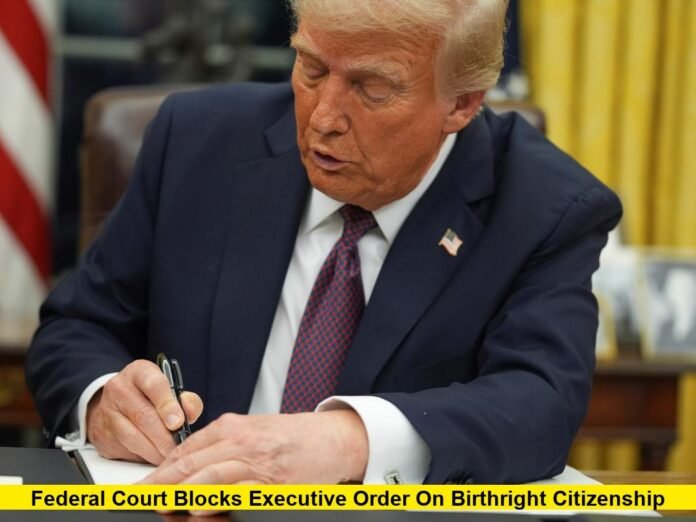

The legal landscape surrounding birthright citizenship took another significant turn this week as a federal judge issued a nationwide injunction blocking implementation of a recent executive order that would have modified how citizenship is granted to children born in the United States.
What Happened
U.S. District Judge Joseph Laplante in New Hampshire granted a preliminary injunction in a lawsuit brought by the American Civil Liberties Union and others on behalf of three non-citizen parents, also granting class action status to the plaintiffs, meaning his order applies nationwide to babies born to undocumented immigrants.
The executive order in question would have limited birthright citizenship to those who have at least one parent who is a U.S. citizen or permanent resident, and would deny citizenship to children whose mothers are temporarily in the United States, including those visiting under the Visa Waiver Program.
Initial Legal Reactions & Injunctions
Early Lawsuits & Injunctions
Almost immediately after President Trump signed Executive Order 14160 on January 20, 2025, lawsuits were filed across the country challenging its constitutionality under the 14th Amendment’s Citizenship Clause. Plaintiffs included state governments, immigrant rights groups, civil rights organizations, and individual families who argued that the order unlawfully stripped U.S.-born children of their right to citizenship.
- Washington v. Trump
- Filed by the state of Washington along with immigrant advocacy groups.
- Judge John C. Coughenour of the U.S. District Court for the Western District of Washington issued one of the first preliminary injunctions, describing the executive order as “blatantly unconstitutional.”
- The ruling prevented enforcement of the order nationwide in its early days.
- CASA de Maryland v. Trump
- Filed in Maryland on behalf of immigrant families and advocacy organizations.
- Judge Deborah Boardman granted a nationwide preliminary injunction, ruling that the plaintiffs were likely to succeed in proving that the order violated the 14th Amendment.
- The court emphasized that the Supreme Court’s 1898 decision in Wong Kim Ark strongly supported the challengers’ claims.
- Barbara v. Trump (New Hampshire)
- Brought by immigrant families in New Hampshire, this case later became central after the Supreme Court’s Trump v. CASA ruling (which restricted universal injunctions).
- The court eventually certified a nationwide class of “all U.S.-born children of non-citizen, non-resident parents,” ensuring protection beyond the original plaintiffs.
- This class-action approach restored broad injunctive relief even under the narrowed framework established by the Supreme Court.
- Massachusetts v. Trump
- Filed by a coalition of 18 state Attorneys General, led by Massachusetts, challenging the executive order’s constitutionality and its conflict with longstanding birthright citizenship precedent.
- Federal courts in Massachusetts quickly issued injunctions blocking implementation, reinforcing earlier rulings from Washington and Maryland.
Number of Injunctions
By mid-2025, at least four different federal judges—in Washington, Maryland, New Hampshire, and Massachusetts—had issued preliminary injunctions that blocked the executive order nationwide. These rulings created a patchwork of judicial blocks, but collectively ensured that the order could not take effect while litigation continued.
The Constitutional Framework
The debate centers around the interpretation of the 14th Amendment to the U.S. Constitution, which states that “all persons born or naturalized in the United States, and subject to the jurisdiction thereof, are citizens of the United States.” Legal scholars have long debated the precise meaning of this language, particularly the phrase “subject to the jurisdiction thereof.”
Supporters of the executive order argue that this phrase creates exceptions for certain categories of births, while opponents contend that the amendment’s language is clear and has been consistently interpreted by courts for over a century.
Multiple Legal Challenges
This New Hampshire ruling is part of a broader pattern of legal challenges across the country. Courts in various states have been examining similar cases, with multiple judges issuing injunctions on related matters. The legal proceedings reflect the complex interplay between federal immigration policy, constitutional interpretation, and judicial authority.
What’s Next
The executive order is set to go into effect July 27 under the high court’s decision. However, the preliminary injunction means that implementation remains on hold while legal proceedings continue.
The case will likely proceed through the federal court system, with the possibility of eventual Supreme Court review. Given the constitutional questions involved and the nationwide scope of the policy, this legal battle may take months or even years to fully resolve.
Broader Implications
This development highlights several important aspects of the American legal system:
Separation of Powers: The case demonstrates how the judicial branch serves as a check on executive action, particularly when constitutional rights are at stake.
Federal vs. State Authority: Immigration law is primarily a federal matter, but states and advocacy groups can still challenge federal policies in court when they believe constitutional violations have occurred.
Class Action Procedures: The granting of class action status shows how individual cases can become vehicles for broader policy challenges affecting thousands of people.
Key Takeaways
The legal process is working as designed, with courts carefully examining the constitutionality of executive actions. Regardless of one’s political perspective, this case underscores the importance of constitutional interpretation and the role of federal courts in resolving disputes over fundamental rights.
The ultimate resolution of this matter will likely require higher court review and may set important precedents for how birthright citizenship is understood and applied in the United States.
As this situation continues to develop, it’s worth noting that the legal system provides mechanisms for challenging government actions through established judicial processes, ensuring that constitutional questions receive thorough examination by the courts.
This is a developing legal story. Court decisions and appeals may affect the status of these proceedings. For the most current information, readers should consult official court documents and established news sources.