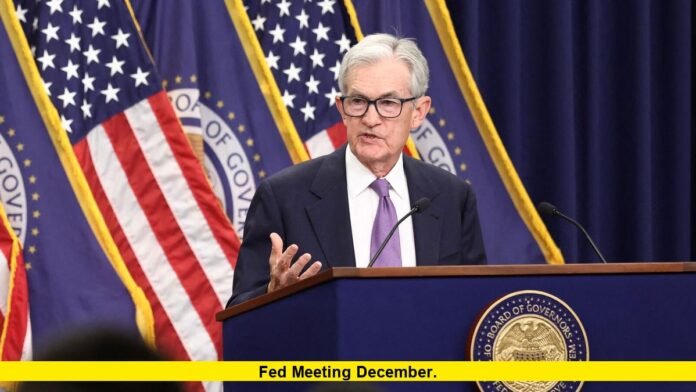

The upcoming December 2025 meeting — often referred to as the key “fed meeting December” — is shaping up to be one of the most consequential for U.S. monetary policy in months. With markets largely pricing in another rate reduction and economic signals showing mixed strength, all eyes are on the Federal Reserve (the Fed) as it debates whether to ease borrowing costs again — and how cautious it may remain about future moves.
Why This Meeting Matters: Economic Jitters and Policy Pressure
This December gathering of the Federal Open Market Committee (FOMC) — scheduled December 9–10 — concludes a busy 2025 for the Fed. After two rate cuts already this year, officials now face mounting pressure to address signs of economic softness, especially in the labor market.
According to rate-futures pricing and bond-market signals, the likelihood of a quarter-point rate cut by the Fed this week stands very high. A decision now could bring the federal funds rate down to a new target range of roughly 3.50 %–3.75 %. Many economists and financial firms have revised their forecasts in recent days to reflect this shift.
Economic Reality: Jobs Slumping, Inflation Lingering, Data Gaps
Labor Market Wobbling
Recent private-sector data — especially from payroll processors — reveal troubling trends. In November, U.S. businesses reportedly cut 32,000 jobs, a sharp contrast to expectations of job growth. Much of the decline came from small businesses, often seen as a barometer of broader economic health. Losses ranged across sectors such as manufacturing, information, business services, and construction.
These labor losses unfold against the backdrop of an unusually long government shutdown earlier this fall, which disrupted official jobs and inflation reporting from federal agencies. That data vacuum has complicated the Fed’s ability to fully gauge the economic landscape. Without recent, authoritative figures, policymakers must rely on private reports and estimates — a less than ideal situation when making decisions with potentially vast consequences.
Inflation: Cooling, But Still Elevated
Inflation remains a critical concern. While price growth has cooled from its mid-2022 highs, inflation still hovers above the Fed’s long-term target of 2%. Core inflation remains sticky, particularly in sectors like housing and services — areas where prices tend to react sluggishly. This persistent inflation exerts pressure on Fed decision-makers who worry that further rate cuts could reignite price pressures.
On the other hand, weaker job growth and rising unemployment suggest inflation may ease if demand cools. Some Fed voices argue that a rate cut now could provide insurance against a deteriorating labor market without derailing progress on inflation.
What the Fed Might Do: Cut, but With Caution
A Probable Quarter-Point Cut
Given recent data — weak employment numbers paired with still-elevated inflation — many analysts expect the Fed to lower rates by 25 basis points. Several leading financial institutions have recently shifted their forecasts, aligning on a cut. The expectation is that the Fed would lower the target rate to 3.50 %–3.75 %.
However, this meeting is not expected to be a run-of-the-mill decision. A growing number of policymakers within the FOMC have voiced hesitation. While some see a cut as necessary to support jobs, others remain cautious, citing inflation risks and uneven economic signals. That division means any decision could come with nuanced guidance about future policy.
A “Hawkish Cut”: Easing Now, Signaling a Pause
Market watchers believe the coming rate decision might be a “hawkish cut.” This would mean the Fed lowers rates but uses its accompanying statement to signal that it won’t necessarily keep cutting. The idea would be to strike a balance: provide relief to borrowing costs while maintaining flexibility to respond to inflation or economic surprises.
Much will hinge on the Fed’s public messaging after the meeting — especially in commentary from the Fed chair. Investors, homeowners, and business leaders will be watching closely for language about how the central bank views labor-market risks, inflation trends, and the possibility of further cuts.
Also likely to surface: updated economic projections and the quarterly “dot plot,” which outlines where individual Fed members foresee future interest rates. These projections often shape market expectations well beyond the immediate rate decision.
How Consumers, Borrowers, and Markets Could Be Affected
Borrowing Costs: Mortgages, Loans, Credit Cards, You name it
If the Fed lowers rates, borrowing costs may fall — making mortgages, credit-card rates, auto loans, and adjustable-rate loans more affordable. For homeowners or homebuyers looking to refinance or secure new mortgages, this could be a window of opportunity. That said, a Fed cut doesn’t guarantee the fastest drop in mortgage rates. Mortgage pricing depends on multiple factors, including demand for longer-duration Treasury bonds.
For savers, though, raiding your mattress might not be as attractive — lower rates generally translate to lower yields on savings accounts, CDs, and money-market funds.
Stock Market and Bond Market Reactions
Equity markets often respond positively to rate cuts, especially growth-oriented sectors like tech, which benefit from lower borrowing costs and discounting pressures. On the flip side, if the Fed signals a cautious approach to further easing, markets might react with volatility — particularly rate-sensitive sectors such as real estate, financials, and housing.
In the bond market, investors are already repositioning. Many are pulling away from long-duration Treasuries, which tend to benefit most in aggressive easing cycles, and shifting toward mid-maturity bonds. That suggests a growing expectation that the Fed may slow down its pace of rate cuts after December.
Why December’s Meeting Could Be a Turning Point
Rounding Out 2025 and Setting the Tone for 2026
This meeting is the final scheduled policy decision of 2025. As such, what the Fed does — and how it talks about its future path — could set the economic tone for the first half of 2026. If it cuts and signals a pause, markets may brace for a data-dependent year ahead, rather than a predictable sequence of rate drops.
Such a shift would influence everything from borrowing costs and mortgages to business investment and savings rates. For many households and businesses, clarity heading into 2026 will mean the difference between acting now — or waiting for further economic signals.
The Fed’s Internal Balancing Act: Inflation vs. Jobs
Policymakers face a delicate balancing act. On one hand, an unemployment rise and shrinking job creation argue for rate cuts to support the labor market. On the other, inflation remains stickier than the Fed would like. With key data reports delayed due to a recent government shutdown, the leadership must make decisions under uncertainty — a scenario that underscores the importance of caution and flexibility.
If the Fed cuts, it may mark the final reduction for a while. Alternatively, if economic indicators rebound, or inflation shows new signs of sticking around, this could represent a policy shift toward a wait-and-see approach.
What to Watch During and After the Announcement
When the FOMC decision comes down at 2:00 p.m. Eastern on December 10, here’s what matters most:
- Size of rate move: Will it be the expected 0.25% cut, or will something else happen?
- Forward guidance: Will the Fed hint at more cuts, or stress a cautious stance?
- Updated economic projections and the dot plot: These could reshape expectations for 2026.
- Public remarks by the Fed chair: Words will matter almost as much as numbers — especially regarding labor and inflation outlook.
Markets, businesses, and consumers alike will respond quickly. Expect shifts in bond yields, stock prices, and mortgage interest rates — potentially in rapid succession.
What a Moderate Cut Means for 2026: Stability, Not a Rate Party
If the Fed goes ahead with a cut but signals that it may pause further reductions, the immediate result could be a period of relative stability. Rather than a predictable march downward, rates might stay flat or change only slowly.
For borrowers, that translates to modest relief — but not a guarantee of steeply falling rates over the next year. For investors and companies, that may mean planning around a “new normal,” where borrowing rates are lower than mid-2025 but not plunging further.
Consumer spending and business investment could see a modest boost, though growth will likely depend heavily on how inflation evolves and whether labor-market softness worsens or stabilizes.
Why the Fed Could Still Surprise: The Case for Holding Steady
While a rate cut remains probable, the decision isn’t locked in. Several factors could sway the outcome:
- Inflation remains sticky, especially in housing and services.
- The Fed has acknowledged increased “uncertainty about the economic outlook,” making officials more cautious.
- Some FOMC members believe the cost of cutting further might outweigh the benefits, especially given poor visibility on official data.
- Consumer behavior around holiday spending could shift inflation and demand patterns unexpectedly.
With so many variables in flux — including economic data delays and geopolitical uncertainty — the Fed may decide to pause and see how the economy responds before committing to further easing.
Who Stands to Gain — and Who Should Watch Closely
A lower rate environment could benefit:
- Homebuyers and homeowners who want to refinance or buy at more affordable rates.
- Businesses looking to invest or expand with cheaper financing.
- Consumers shopping for cars, big-ticket items, or planning debt refinancing.
But some groups may be cautious:
- Savers and retirees depending on CD or money-market yields might see returns slip.
- Fixed-income investors who had hoped for aggressive rate cuts — they may have to settle for a more gradual path.
- People sensitive to inflation, if price pressures return unexpectedly.
Final Word: Proceed With Cautious Optimism — This Could Be the Calm Before a Slow Turn in 2026
The December meeting stands as a pivotal moment. A 25-basis-point cut seems likely — but what matters more is the Fed’s tone and guidance afterward. If the statement is cautious and forward-looking, markets could shift quickly, and borrowing costs may stay relatively stable through 2026.
Given the fragility in the job market and the persistent inflation backdrop, what the Fed does — and says — in the coming days may shape the financial path for businesses, homeowners, and consumers for months to come.
Share your thoughts below — this decision could redefine the economic landscape and affect all of us differently.