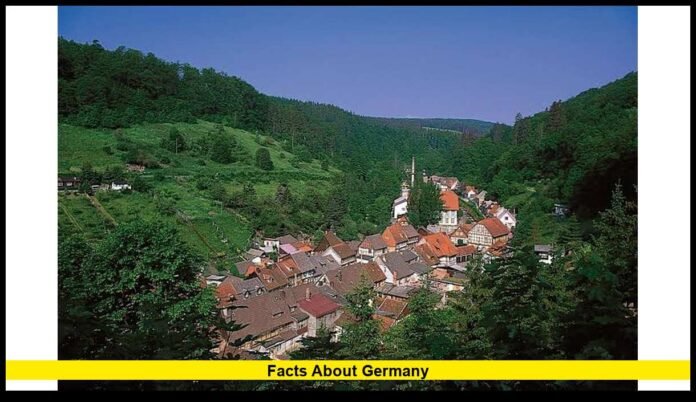

Facts about Germany reveal a country at the center of Europe with a population of more than 83 million, a major industrial economy and a federal political system spread across 16 states. In 2026, the country is also dealing with major changes in energy, trade, demographics and infrastructure.
Germany remains the European Union’s largest economy. Its central location connects it with nine neighboring countries, while its ports, railways, highways and rivers support extensive trade across Europe and beyond.
For Americans, Germany is especially important because of its close economic relationship with the United States. German manufacturers operate throughout the American market, and U.S. companies have substantial business interests in Germany.
The country is known for much more than automobiles and engineering. Its history, universities, cities, forests, rivers, food traditions, scientific achievements and cultural institutions all contribute to its international reputation.
Germany’s Basic Profile
Germany is officially known as the Federal Republic of Germany. Berlin is the national capital, German is the official language and the euro is the national currency.
The country covers about 357,569 square kilometers. Its population was approximately 83.6 million based on the latest European Union figures.
Germany is a federal parliamentary republic. The federal government operates alongside 16 state governments, and each state has its own political institutions and responsibilities.
Three states are also city-states:
- Berlin
- Bremen
- Hamburg
This federal structure is one of the defining features of modern Germany. Political responsibilities are divided between the national government and the states rather than being concentrated entirely in Berlin.
Germany’s Location Makes It a European Hub
Germany sits in Central Europe and shares land borders with nine countries.
They are Denmark, Poland, the Czech Republic, Austria, Switzerland, France, Luxembourg, Belgium and the Netherlands.
That position gives Germany direct connections to much of the European market. Goods can move by road and rail from German industrial centers to neighboring countries without crossing a large geographic barrier.
The country also has access to the North Sea and Baltic Sea. Important ports support international shipping, while major rivers provide additional transportation routes.
Germany’s geography has therefore played an important role in its economic development.
Berlin Is the Capital
Berlin is Germany’s capital and one of Europe’s best-known cities.
The city serves as the headquarters of the federal government and the meeting place of the Bundestag, Germany’s federal parliament.
Berlin also carries enormous historical significance. The city was divided after World War II, and the Berlin Wall became one of the most recognizable symbols of the Cold War.
The wall fell in November 1989. German reunification followed on October 3, 1990.
Modern Berlin is very different from the divided city of the 20th century. It is now a major center for government, culture, technology, education, tourism and international business.
Germany Has 16 States
Germany’s federal system divides the country into 16 Länder, or states.
These states vary greatly in size, geography and economic activity.
Bavaria covers a large area in the south and includes Munich, one of Germany’s biggest cities. North Rhine-Westphalia has the country’s largest population and contains major industrial and commercial centers.
Other states include Baden-Württemberg, Hesse, Saxony, Brandenburg, Schleswig-Holstein, Thuringia and Rhineland-Palatinate.
The three city-states—Berlin, Hamburg and Bremen—combine the functions of a city and a state.
This arrangement allows regional governments to manage many areas of public administration while remaining part of the federal republic.
Germany’s Population Is Changing
Germany has one of the largest populations in Europe, but its demographic structure is changing.
Recent population data show that the country has entered a period in which aging is becoming increasingly important. The number of older residents continues to rise, while the natural balance between births and deaths remains negative.
That creates challenges for the labor market.
A large number of workers are approaching retirement age. At the same time, businesses need employees in manufacturing, health care, construction, technology, transportation and other sectors.
Migration has helped offset some of the demographic pressure. However, Germany still faces the broader challenge of maintaining a large enough workforce as its population ages.
This is one of the most important long-term issues shaping the country’s economy.
Germany Remains Europe’s Largest Economy
Germany has the largest national economy in the European Union.
Manufacturing plays an unusually large role compared with many other advanced economies. German companies are well known for automobiles, machinery, chemicals, electrical equipment, pharmaceuticals and industrial technology.
The economy has experienced a difficult period in recent years. Weak industrial activity, high energy costs, international competition and uncertainty surrounding global trade have weighed on businesses.
There are signs of improvement in 2026, but the recovery remains uneven.
Recent economic indicators show stronger investor sentiment and increased export orders. At the same time, low river levels on the Rhine have created transportation problems for industries that depend on inland shipping.
Germany’s economic performance therefore remains closely connected to both global demand and domestic infrastructure.
Exports Are Central to the Economy
International trade is a major part of Germany’s economic model.
German manufacturers sell products across Europe, North America, Asia and other global markets. Vehicles, machinery, chemicals, electrical products and pharmaceuticals are among the country’s important exports.
The automotive industry has traditionally been one of Germany’s most visible global sectors.
Companies based in Germany have built major international brands and manufacturing networks. The industry is now undergoing a major transformation as electric vehicles, batteries, software and new competitors reshape the global automobile market.
This transition matters far beyond Germany because automotive manufacturing supports a large network of suppliers and specialized businesses.
Germany Is Investing More in Infrastructure
Infrastructure has become a major economic priority.
Roads, railways, bridges, energy networks and digital systems all require investment. The federal government has also placed greater emphasis on public investment as it seeks to strengthen long-term economic growth.
Infrastructure spending can support construction and manufacturing while improving the efficiency of the broader economy.
However, projects can take time to complete because of planning requirements, permitting procedures and administrative capacity.
For Germany, improving infrastructure is not simply a transportation issue. It is closely connected to productivity and industrial competitiveness.
Renewable Energy Is Reshaping Electricity Generation
Germany has made renewable energy a major part of its electricity system.
Wind and solar power are particularly important. Renewable sources accounted for a majority of Germany’s electricity generation in 2025.
Solar capacity has expanded rapidly, while wind power remains one of the country’s largest sources of renewable electricity.
This transition is changing how Germany produces and manages electricity. Renewable generation can fluctuate depending on weather conditions, creating a need for stronger transmission networks, storage systems and flexible electricity infrastructure.
The country therefore faces a dual challenge: expanding clean electricity while ensuring that the power system remains reliable and affordable.
The Rhine Has an Important Role in Germany
The Rhine is one of Europe’s most important commercial rivers.
It passes through major industrial areas and connects Germany with important European transportation routes.
In August 2026, unusually low water levels have created additional challenges. Large cargo vessels cannot always carry full loads in shallow sections, raising transportation costs and slowing deliveries.
This demonstrates how geography and climate conditions can influence a modern industrial economy.
When river transportation is disrupted, companies can face higher costs even when factories and international orders remain strong.
Germany’s Automotive Industry Is Changing
Cars are deeply associated with German industry.
Germany has produced some of the world’s best-known automobile brands and has developed a reputation for precision engineering.
The industry now faces a fundamental transition.
Electric vehicles require different technologies, supply chains and manufacturing processes than traditional gasoline-powered vehicles. Software and battery systems are becoming increasingly important.
German manufacturers are therefore investing in new technologies while competing with established and emerging producers from the United States, China and elsewhere.
The transition is significant because automobile production supports millions of jobs directly and indirectly throughout Europe.
Germany Is Known for Engineering and Research
Scientific and technical achievements form another important part of the country’s identity.
German universities and research institutions have contributed to fields including physics, chemistry, medicine, engineering and mathematics.
The country also has a strong vocational education tradition. Apprenticeship programs combine classroom learning with practical workplace experience.
That system has helped create a workforce with specialized technical skills.
Germany’s research and industrial traditions often work together. Universities, research organizations and companies collaborate on technologies that can later enter commercial markets.
German Culture Varies by Region
There is no single cultural experience that describes every part of Germany.
Regional differences are visible in food, architecture, festivals, dialects and traditions.
Bavaria has cultural traditions associated with southern Germany and the Alps. Northern areas have strong maritime influences. The Rhineland is famous for carnival celebrations.
Berlin has developed a distinctly international cultural identity.
Food also varies by region. Bread, sausages, pretzels, potatoes, pastries and regional meat dishes are common elements of German cuisine, but local specialties differ considerably.
Germany is also famous for its Christmas markets, which take place in cities and towns during the holiday season.
German Is the Official Language
German is the official language of the country.
It is one of Europe’s major languages and is spoken by the vast majority of the population.
Germany also has regional dialects and language varieties. People from different regions can sometimes use noticeably different vocabulary and pronunciation.
English is widely taught and commonly encountered in tourism, business, universities and international settings.
For American visitors, major cities and tourist destinations generally provide many opportunities to communicate in English.
Germany Has Diverse Landscapes
Germany’s geography changes considerably from north to south.
Northern Germany contains broad plains and coastal areas. Central Germany includes hills, forests and river valleys.
The southern region contains the Bavarian Alps.
The Zugspitze, at 2,962 meters, is Germany’s highest mountain.
The country also has major rivers, including the Rhine, Danube, Elbe and Weser.
Forests cover large portions of the country and contribute to its distinctive landscapes.
This geographical variety helps explain why Germany offers such different travel experiences within a relatively compact area.
The Autobahn Is a Major German Infrastructure Symbol
Germany’s Autobahn network is internationally famous.
It consists of controlled-access highways connecting cities and regions across the country. Some sections have no general speed limit, although many stretches have mandatory limits.
Speed restrictions can apply around cities, construction zones and areas where road conditions require additional safety measures.
The Autobahn also has an important economic function. Germany depends heavily on road transportation for moving industrial components, finished products and consumer goods.
Germany Is a Major Football Country
Football is one of Germany’s most popular sports.
The men’s national team has won the FIFA World Cup four times. Those victories came in 1954, 1974, 1990 and 2014.
Domestic football is also highly popular.
The Bundesliga is Germany’s highest professional league, and clubs attract large crowds throughout the season.
Football stadiums are an important part of the country’s sporting culture, while German clubs also have strong international followings.
Germany Is a Major European Union Member
Germany has been a member of the European Union since its founding era. It joined the European Economic Community in 1958 and later became part of the European Union.
The country uses the euro and has been part of the euro area since 1999.
Germany is also part of the Schengen Area, which allows passport-free movement across participating countries under the area’s rules.
Because of its population and economic size, Germany has considerable influence within European institutions.
Its decisions on trade, energy, defense, finance and industrial policy can affect the wider European economy.
Germany Has Important Connections With the United States
The relationship between Germany and the United States extends across trade, investment, technology, education and culture.
German companies have substantial operations in the United States. American businesses also have a significant presence in Germany.
The two economies are connected through manufacturing supply chains and international investment.
Germany is also an important destination for American travelers. Berlin, Munich, Frankfurt, Hamburg and other cities attract visitors throughout the year.
Historical ties between the two countries also remain visible through military, diplomatic and cultural relationships.
Germany’s Economic Outlook Remains Mixed in 2026
The country’s current economic picture combines encouraging developments with significant risks.
Investor confidence improved in August 2026, while export orders provided support for some manufacturers. Government investment is also expected to play a larger role in supporting economic activity.
At the same time, high energy costs, weak industrial capacity and transportation disruptions continue to weigh on businesses.
Low Rhine water levels have become an additional concern because the river is an important commercial route.
The broader outlook therefore remains dependent on whether stronger investment and exports can offset structural challenges.
Why Germany Remains Important
Germany combines economic strength, political influence, industrial expertise and cultural importance in a way few European countries can match.
Its population is larger than 83 million. Its economy is the largest in the European Union. Its companies operate across global markets, while its universities and research institutions contribute to science and technology.
The country is also changing.
An aging population is putting pressure on the labor market. Renewable energy is transforming electricity generation. Automakers are adapting to electric vehicles. Infrastructure investment is becoming more important, and global trade conditions continue to influence manufacturers.
These developments make Germany a country worth watching in 2026.
Its future will depend partly on how successfully it manages the transition from an established industrial model toward one that is more digital, energy-efficient and adaptable to demographic change.
The Bottom Line
Germany remains one of the most influential countries in Europe, combining a large population, powerful manufacturing industries, diverse landscapes, deep cultural traditions and a central role in European affairs.
The latest developments show a country working through significant economic and demographic changes while continuing to invest in infrastructure, renewable energy and industrial competitiveness.
What fact about Germany do you find most interesting? Share your thoughts in the comments and stay informed as the country’s story continues to develop.