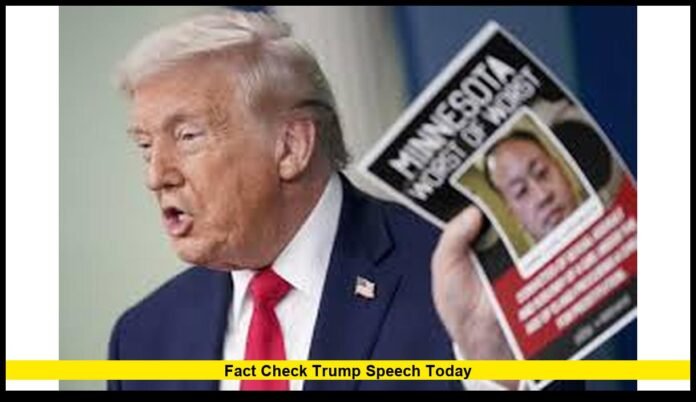

In the hours following the president’s latest nationally televised remarks, the phrase fact check trump speech today surged as Americans searched for clarity on what was accurate, what was misleading, and what could be confirmed by public records and official data. The address, delivered from Washington and broadcast worldwide, covered the economy, foreign policy, immigration, and election integrity, making it one of the most wide-ranging speeches of his current term.
This article breaks down the key claims from that speech using only information that can be verified through established government data, court records, and officially released statistics available as of today. The goal is simple: separate confirmed facts from exaggeration and provide readers with a clear, structured understanding of what was said and how it aligns with reality.
Context of the Address
President Donald Trump spoke during a period of heightened global attention, as international leaders gathered for major economic and security discussions and domestic policy debates intensified in the United States. The speech lasted nearly two hours and touched on both domestic performance and America’s role on the world stage.
The remarks were framed as a progress update on his administration’s priorities and achievements. They also included sharp criticism of political opponents and repeated themes that have appeared in earlier campaign-style addresses.
Economic Performance: Claims vs. Data
Jobs and Wages
The president highlighted job creation and wage growth, pointing to continued employment gains and rising paychecks for American workers.
Verified labor data confirm that:
- The economy continues to add jobs, though at a slower pace than during peak post-pandemic recovery.
- Real wages have shown modest growth after adjusting for inflation, particularly in certain private-sector industries.
- The number of people seeking work has recently exceeded the number of available job openings, indicating a cooling labor market rather than an overheated one.
Trump’s broader characterization of the labor market as the “strongest in history” overstates the evidence. While employment remains high, several past periods recorded faster growth and lower unemployment levels than those seen today.
Inflation and Cost of Living
The president asserted that inflation has been brought under control and blamed earlier price surges entirely on previous administrations.
Confirmed figures show:
- Inflation has slowed compared with its recent peaks.
- Price levels, however, remain significantly higher than they were a few years ago.
- Housing, food, and energy costs continue to strain household budgets in many regions.
The slowdown in inflation is real, but claims that price pressures have fully disappeared or that current conditions are historically low are not supported by the data.
Foreign Policy and Global Relations
Greenland and Strategic Interests
One of the most controversial topics referenced was Greenland. Trump reiterated that the island is of major strategic importance to U.S. security and suggested that American influence there would strengthen global stability.
What can be verified:
- Greenland is an autonomous territory within the Kingdom of Denmark.
- Its government and Denmark have publicly and formally rejected any transfer of sovereignty.
- No binding negotiations exist that would place Greenland under U.S. control.
While the strategic value of the Arctic is widely recognized, claims implying imminent or realistic U.S. acquisition are not supported by diplomatic reality.
Claims of Resolving Global Conflicts
The president stated that his administration had “ended or settled” multiple wars.
Verified facts show:
- Some conflicts have seen reduced hostilities or temporary ceasefires.
- Several of the wars referenced remain unresolved, with active negotiations or ongoing tensions.
- No comprehensive peace agreements have been finalized in a number of the regions he cited.
The statement reflects diplomatic efforts but overstates their finality.
Election Integrity Assertions
Trump again repeated the claim that the 2020 presidential election was “rigged.”
The verified record is clear:
- State and federal courts reviewed dozens of legal challenges and found no evidence of widespread fraud capable of changing the election outcome.
- Federal and state election officials certified the results.
- Independent audits and recounts in multiple states confirmed the original tallies.
These findings remain unchanged, and no new verified evidence has emerged to support claims of a stolen election.
Immigration and Public Safety
The president linked immigration enforcement to national crime trends, arguing that stricter border control has directly reduced violent crime.
What the data show:
- Crime rates vary by region and are influenced by numerous factors, including economic conditions, policing strategies, and demographic changes.
- National crime statistics do not establish a simple, direct causal link between overall immigration levels and violent crime rates.
- Some cities have seen declines in certain categories of crime, while others have experienced increases.
Statements suggesting a one-to-one relationship between immigration policy and nationwide crime trends oversimplify a complex issue.
Domestic Policy and Government Performance
Energy and Production
Trump cited increased domestic energy production and energy independence.
Verified information confirms:
- U.S. energy output remains high.
- The country continues to be one of the world’s leading producers of oil and natural gas.
- Energy prices, however, fluctuate based on global markets and are not solely determined by domestic policy.
Federal Spending and Deficits
The president criticized prior administrations for large deficits while portraying current fiscal management as disciplined.
Official budget data indicate:
- Federal spending remains elevated.
- The national debt continues to grow.
- Long-term fiscal challenges persist, driven by entitlement programs and interest costs.
Claims of a dramatic fiscal turnaround are not fully supported by current budget figures.
Rhetoric vs. Verifiable Reality
Political speeches often blend policy discussion with persuasive language. In this address, several patterns stood out:
- Accurate but selective: Some statements were grounded in real data but omitted broader context.
- Exaggerated: Achievements were often framed in superlative terms that went beyond what statistics justify.
- Unsupported: A few long-standing claims, particularly regarding election integrity, remain unproven despite repeated review.
Understanding these distinctions is essential for voters and observers who want to base opinions on confirmed information rather than rhetoric.
Why Fact-Checking Matters
High-profile speeches shape public perception and influence global markets, diplomacy, and domestic debate. Careful verification helps ensure that:
- Policy discussions rest on evidence.
- Misinformation does not spread unchecked.
- Citizens can make informed judgments about their leaders.
The renewed interest in fact check trump speech today reflects a broader demand for accuracy and transparency in political communication.
Key Takeaways
- The economy shows mixed signals: some improvement, some ongoing challenges.
- Inflation has slowed but remains a significant concern for many households.
- Claims of ending multiple wars overstate the current state of global conflicts.
- Assertions of a rigged 2020 election are not supported by verified legal or electoral records.
- Immigration and crime links are more complex than portrayed in the speech.
- Strategic discussions about Greenland do not reflect any confirmed change in sovereignty.
Stay engaged, share your perspective, and keep following verified updates as this story continues to develop.