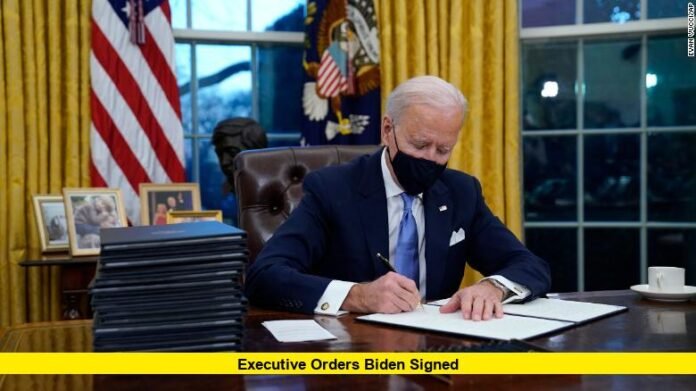

President Donald Trump has declared he will void a sweeping array of federal policies and directives — those he claims were signed by former President Joe Biden using an autopen. The decision, announced late Friday, centers on the assertion that thousands of executive orders, proclamations, and other presidential actions lack legal legitimacy because they were not hand-signed by Biden himself. That claim quickly triggered intense debate in Washington over executive power, constitutional precedent, and the future of numerous programs and regulations.
What Trump Announced — In His Own Words
In a post on his social media platform, Trump stated flatly that “any document signed by [Biden] with the Autopen, which was approximately 92% of them, is hereby terminated, and of no further force or effect.” He added that he was “cancelling all Executive Orders, and anything else that was not directly signed” by Biden personally. Trump accused Biden’s staff of acting illegally, suggested that Biden lacked control over the autopen process, and warned that if Biden claimed otherwise, he could face perjury charges.
According to supporters, this action marks a dramatic reset of federal governance under the Trump administration. According to critics, it is a sweeping assertion of power based on a disputed premise — one that could unravel years of policy planning.
History and Legal Background: Autopen Has Been Used for Decades
The device at the heart of this controversy is the autopen: a mechanical apparatus programmed with a person’s signature and capable of replicating it in ink on paper. Long before Biden or Trump, presidents have used autopens at times to expedite document signing — especially when traveling, facing heavy workloads, or handling routine paperwork. The first major use dates back to the early 19th century.
In modern times, administrations have often relied on autopens to manage high volumes of paperwork, including everyday correspondence, pardons, and even some executive orders. Importantly, a widely cited legal position from 2005 held that a president does not need to physically sign a bill personally for it to become law — a designee may affix the signature after the president has approved the act. By extension, many previous presidents have used autopens under conditions of trust and authorization.
That history makes the current claim unusual. While autopen use is far from unknown — and has precedent — the notion that it automatically invalidates executive actions lacks clear precedent.
What’s at Stake — Policy, Agencies, and Legal Precedent
Massive Potential Disruption Across Agencies
If the revocation proceeds, federal agencies may need to immediately review, suspend, or reverse countless actions adopted under the canceled orders and directives. This could affect:
- Environmental regulation initiatives put in place under the previous administration
- Labour, workplace, and union-related directives
- Border, immigration, and asylum policies
- Public health measures and COVID-era pandemic response plans
- Technology and cybersecurity regulations, including those on AI, data privacy, and digital oversight
- Social equity, civil rights, and federal assistance guidelines
Agencies may face chaos: staff would need to identify which actions qualify, determine which programs are affected, and issue internal guidance — all while grappling with legal uncertainty. Many initiatives might be halted midstream, causing delays, confusion, and potential harm to communities depending on them.
Legal Challenges Almost Certain to Follow
Legal experts are already sounding alarms. Critics point out that the autopen has been an accepted tool for decades, and past presidents — including Trump himself — have used it to sign significant documents. They argue that the mechanism by which a signature is applied does not change the substance or legality of the document, as long as the president authorized it.
Courts may soon be asked to rule on whether a mechanical signature method — even if used — truly invalidates presidential directives. Such a ruling could set a monumental precedent, not just for this administration but for all future presidencies. The outcome may reshape how executive power is exercised and interpreted in the United States.
A Constitutional and Ethical Rubicon
By making autopen use the basis for voiding executive orders — rather than evaluating the merits of the policies themselves — the administration is effectively saying that form (how a signature is made) overrides substance (what the order says). That shift raises serious questions: if accepted, it could open the door for any future administration to challenge past orders based on technicalities, destabilizing decades of policymaking.
The move also casts doubt on the trust and continuity of federal governance. Agencies may hesitate to act decisively, fearing their orders could be revoked by the next president. Stakeholders — from business groups to community organizations — may lose confidence in long-term plans and regulatory consistency.
What Is and Isn’t Known — For Now
What we know:
- Trump publicly declared he will “terminate” all executive orders and documents signed via autopen under Biden.
- The number cited — roughly 92% of Biden’s documents — is large, suggesting a broad scope covering possibly hundreds of directives, orders, and memoranda.
- Autopen is a longstanding tool, historically used by multiple presidents, including in critical contexts.
- Previous legal guidance determined a president’s authorization — not the physical act of signing — confers validity to legislation.
What remains unclear:
- The administration has not released a specific list of orders and actions being rescinded.
- Agencies do not yet have official instructions on how to implement the cancellations.
- The criteria for determining which documents are “autopen-signed” has not been shared publicly.
- Legal outcomes — including potential court challenges — remain unpredictable.
Without a transparent roadmap, executive agencies may be left scrambling to interpret intent and implement guidance. For many, this will add layers of uncertainty to ongoing programs.
Political Fallout and Institutional Repercussions
This move marks one of the sharpest swings of executive power in recent American history. Politically, it aligns with concerns from a portion of the Republican base that contends the previous administration overreached — particularly on immigration, environmental regulation, and healthcare policy.
Supporters of the revocation argue it restores accountability and demands that presidents personally authorize key decisions. Critics — including many legal scholars and civil-service officials — warn it sets a dangerous precedent that could erode institutional safeguards and threaten continuity across administrations.
For communities and businesses that relied on long-term federal plans — such as environmental compliance, health policy, or immigration reform — the sudden unraveling of executive stability could produce turmoil. Employees, contractors, beneficiaries of federal programs, state governments, and nonprofit organizations might all be caught in a wave of shifting directives and uncertainty.
What Comes Next — In the Courtrooms, Agencies, and Public Eye
In the coming days and weeks, observers expect:
- Legal challenges: Lawsuits likely from states, organizations, or individuals harmed by abrupt policy changes. Judges will have to decide whether autopen-signed orders can legally be voided en masse.
- Agency reviews: Federal departments will scramble to audit which executive acts to maintain, which to reverse, and how to manage ongoing obligations. Administrative chaos seems probable.
- Congressional and . oversight pressure: Some lawmakers may call hearings or draft legislation to clarify whether autopen-based invalidation is lawful or legitimate.
- Public debate: Citizens, interest groups, and stakeholders will weigh in — debating whether overturning executive orders on signature-method grounds is reasonable or reckless.
If allowed to stand, this approach will likely reshape how future presidents exercise power — and could lead to a dramatic shift in the balance between the executive branch’s technical authority and the stability of federal governance.
Why This Matters to Every American
Whether you are a business owner regulated by federal rules, an immigrant affected by border policies, an environmental advocate, or a citizen relying on health or social programs — the ramifications of this move extend far beyond Washington. The revocation, if implemented and upheld, could quickly affect everyday policy decisions, reshape national priorities, and alter the landscape of federal oversight.
Moreover, the precedent this creates may haunt future administrations: if a new president can nullify prior orders based on how they were signed — rather than what they did — the institutional memory of government becomes fragile. It means that core policies might no longer stand on substance, but on the technicalities of procedure. The stability of governance, for decades, could be at risk.
The coming weeks will likely prove decisive. Courts, agencies, and Congress must now determine whether this sweeping cancellation stands — and in doing so, shape the contours of American executive power for generations.