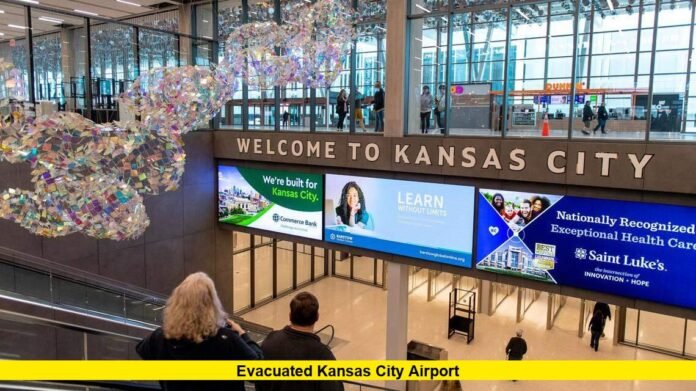

Kansas City International Airport came to a complete standstill on Sunday, March 8, 2026, after a reported potential threat forced the entire terminal to be evacuated kansas city airport wide, sending roughly 2,000 passengers streaming out onto the tarmac as federal law enforcement rushed to the scene.
The incident unfolded quickly and without warning, leaving travelers confused and shaken — but within hours, authorities had swept the facility, reviewed the threat, and declared the all-clear.
👉 Stay right here for the full breakdown of what happened, how it ended, and what it means for travelers.
How the Evacuation Unfolded
Shortly after 11:15 a.m. local time on Sunday morning, airport workers began directing travelers and staff out of the terminal as a precaution following an unspecified threat report. Passengers who had been sitting at gates, waiting to board, or moving through the terminal were told to exit immediately. Many were ushered directly onto the tarmac, still carrying their carry-on bags and personal belongings.
Eyewitness accounts painted a picture of a fast-moving and orderly but tense situation. One traveler who had been waiting to board a flight to Texas described noticing a sudden surge of police officers and K9 units inside the building just moments before an airport worker announced the evacuation. People moved quickly. Luggage was left behind. About 2,000 passengers ended up standing outside in the open air with no immediate explanation for what was happening around them.
Roads leading to the airport from Interstate 29 were also blocked off, with all vehicle traffic rerouted to cell phone waiting lots. Flights that were already in the air and approaching Kansas City were held on the taxiway rather than allowed to pull up to the gate. For a Sunday — historically one of the busiest travel days of the week — the disruption hit at the worst possible time.
FBI and Bomb Squad Called In
The Kansas City Aviation Department confirmed the evacuation and stated that airport police were actively working with the FBI to assess whether the reported threat was credible. Federal agents arrived on scene quickly and began a methodical sweep of the terminal.
While investigators worked inside the building, a secondary concern emerged in the airport’s parking garage. K9 units flagged a vehicle parked on the top floor as suspicious during a routine sweep of the structure. That prompted the Kansas City Police Department’s Bomb and Arson unit to respond. The garage was kept closed for an additional three hours while investigators examined the vehicle and the surrounding area. After a thorough investigation, the Bomb and Arson unit determined there was no threat connected to the vehicle.
Inside the terminal, the sweep continued uninterrupted. Law enforcement moved systematically through the building before eventually clearing it.
All-Clear Issued — FBI Director and Transportation Secretary Weigh In
Just before 1:45 p.m., travelers and airport staff were permitted to re-enter the terminal. The approximately two-hour shutdown had officially come to an end.
FBI Director Kash Patel posted an update publicly confirming that the FBI and its law enforcement partners had responded rapidly, secured the area, reviewed the threat, and found it not to be credible. The terminal had been swept and cleared, and normal operations were resuming.
U.S. Transportation Secretary Sean Duffy also issued a public statement confirming the all-clear, thanking law enforcement and the FBI for their swift response and reaffirming that the safety of passengers, airport staff, and crew members remains the top priority.
The level of involvement from senior federal officials — including the FBI Director and the Secretary of Transportation — underscored how seriously Sunday’s incident was treated from the moment it was first reported.
Flight Delays and Travel Disruptions
The two-hour shutdown produced a ripple effect across the airport’s schedule. Flight tracking data showed 127 delays and two cancellations at Kansas City International in the immediate aftermath of the evacuation. Travelers who had been held on taxiways eventually made it to their gates, and departures that had been paused began to resume once the all-clear was issued.
For many passengers, the experience added several unplanned hours to their journeys. Those who had connecting flights were among the hardest hit, as even short ground delays can cascade into missed connections at hub airports across the country.
Why Airports Respond So Aggressively to Unverified Threats
Sunday’s events at KCI illustrate why American airports operate under a zero-tolerance security posture when any kind of threat surfaces, regardless of whether it turns out to be genuine. Under federal protocols, airport authorities are required to treat every reported threat as potentially serious until law enforcement can fully evaluate it. That means evacuations, grounded planes, road closures, and federal coordination — all set in motion within minutes of a report.
The process is intentionally thorough and deliberately slow. Clearing a major airport terminal, sweeping every concourse, checking vehicles in connected garages, and coordinating between local police, federal agents, and bomb disposal units takes time. Passengers caught in the middle of that process rarely have access to real-time information, which adds to the anxiety of the experience.
The involvement of K9 units, bomb technicians, the FBI, and cabinet-level officials in Sunday’s incident is not unusual — it reflects how seriously the federal government takes airport security in the current environment.
What Remains Unknown
As of Sunday afternoon, authorities had not disclosed the specific nature of the threat that triggered the evacuation. The origin of the report, and whether any individual is connected to it, has not been made public. The investigation into how the threat was reported and where it originated remains ongoing.
The Kansas City Aviation Department has not announced any changes to airport operations going forward, and KCI is expected to return to its normal schedule in the days ahead. Travelers with upcoming flights are encouraged to monitor their airline apps for any residual delay information.
If you were at Kansas City International Airport on Sunday or have thoughts on how airports handle security threats, share your experience in the comments below — your perspective matters to fellow travelers.