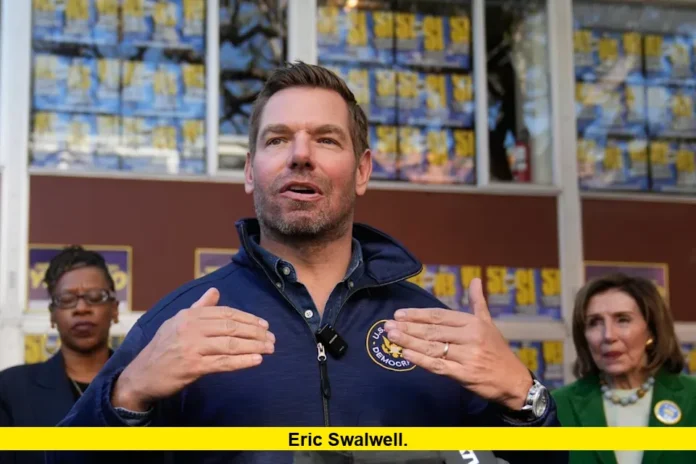

Rep. Eric Swalwell (D–Calif.) is now the subject of a referral to the U.S. Department of Justice over alleged mortgage and tax fraud tied to his Washington, D.C., residence. This marks a significant development in a broader pattern of politically charged housing-finance investigations.
What’s happening
The head of the Federal Housing Finance Agency (FHFA), Bill Pulte, has formally sent a letter to the Attorney General requesting a criminal investigation of Swalwell. The referral claims that Swalwell may have made false or misleading statements in mortgage or loan documents, including misrepresenting his property’s status as a “primary residence” to obtain favorable terms.
Key points include:
- The property in question is a home in Washington, D.C., allegedly purchased by Swalwell in 2020 for about $1.2 million, which he listed as his primary residence.
- The referral alleges that by claiming it was his primary residence, Swalwell may have received lower interest rates, better refinancing options or tax/insurance advantages that would not otherwise apply.
- The referral also signals possible violations beyond mortgage fraud—namely insurance fraud and state or local tax fraud tied to the occupancy claim.
Swalwell’s response
Swalwell has publicly denied wrongdoing and characterized the referral as politically motivated. He noted that as a high-profile Trump critic and the only person still pursuing a civil suit against former President Donald Trump, he believes he is being targeted for his opposition. He declared that he “refuse[s] to live in fear” and that he will not stop speaking out for Californians.
The broader pattern and its implications
This referral isn’t happening in isolation. Bill Pulte and the FHFA have recently made similar referrals involving other prominent Democrats such as Sen. Adam Schiff, New York Attorney General Letitia James and Federal Reserve Governor Lisa Cook. Each of these officials has been accused of misrepresenting occupancy status on loan documents — a highly technical but potentially serious mortgage-fraud violation.
Legal observers highlight several concerns:
- Criminal prosecutions for occupancy misrepresentation are very rare when loans remain current and without loss to the lender.
- The FHFA’s director (rather than its Office of Inspector General) is directly making referrals, which is unusual and raises questions about due-process and oversight.
- Because the referrals repeatedly target political opponents of Donald Trump, critics accuse the process of being weaponized for partisan purposes.
Why this matters
- If the DOJ accepts the referral and moves forward with charges, Swalwell faces potential criminal liability and extremely negative political fallout.
- The case could set a precedent for how occupancy misrepresentation is enforced—and whether the criteria are applied uniformly or selectively.
- Beyond Swalwell himself, the case may reflect broader tensions in U.S. politics: the use of regulatory tools and criminal investigations in a partisan environment.
What comes next
Here’s the likely sequence of events:
- The DOJ reviews the referral and decides whether to open a full investigation.
- If the DOJ proceeds, a grand jury may be convened, and documents (loan files, mortgage data, tax/insurance records) will come under scrutiny.
- Swalwell may challenge the referral’s legitimacy in court, arguing political bias, lack of intent, or lawful occupancy status.
- The broader fallout will include scrutiny of the FHFA’s processes, the independence of criminal referrals, and potential congressional hearings into the agency’s use of power.
Quick Facts
| Item | Detail |
|---|---|
| Referral sent by | FHFA Director Bill Pulte |
| Referred individual | Rep. Eric Swalwell (D-Calif.) |
| Allegation type | Mortgage fraud, plus possible insurance & tax fraud |
| Property in question | Washington, D.C. home purchased 2020 (~$1.2 M) |
| Broader context | Fourth major referral of a Democrat by FHFA under Pulte |
Final thoughts
The referral of Rep. Eric Swalwell to the DOJ over alleged mortgage and tax fraud raises serious questions about fairness, process and politics. At its core, the case will test whether occupancy misrepresentation can be prosecuted—and whether such prosecutions will be applied evenly across the political spectrum. Stay tuned as the story evolves, and feel free to comment below if you have thoughts or insights you’d like to share.