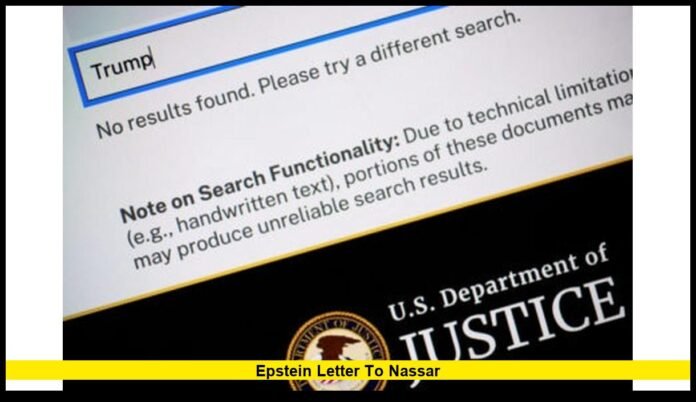

The epstein letter to nassar has become one of the most disturbing documents to surface from the latest release of federal records tied to Jeffrey Epstein, renewing public focus on his final days and the scope of materials collected by investigators. The handwritten note, addressed to Larry Nassar and included in newly disclosed Justice Department files, connects two of the most notorious sexual abuse cases in modern U.S. history and has triggered strong reactions across legal, political, and public spheres.
The letter’s release does not introduce new criminal charges, but it adds a troubling layer to the historical record of Epstein’s communications while in custody and highlights the challenges surrounding transparency, accountability, and victim protection.
Federal Disclosure and the Release of Epstein Records
In December 2025, the U.S. Department of Justice released tens of thousands of pages of unclassified records related to Jeffrey Epstein as part of a federally mandated transparency effort. These materials include investigative files, correspondence, internal reviews, and third-party submissions accumulated over years of inquiry into Epstein’s activities and associates.
Officials emphasized that the records were released to comply with federal law and that many documents reflect raw material collected during investigations rather than verified conclusions. Portions of the files were redacted to protect victim identities and sensitive personal information.
Among the newly disclosed documents is the letter addressed to Larry Nassar, which has drawn particular attention due to its explicit language, timing, and symbolic significance.
Why Larry Nassar’s Name Is Central to the Reaction
Larry Nassar is a former physician for USA Gymnastics and Michigan State University who was convicted on numerous counts of sexual abuse involving minors. His crimes spanned years and involved hundreds of victims, many of whom provided public testimony that helped expose systemic failures within athletic and institutional oversight.
Before the disclosure of this letter, there had been no publicly confirmed direct communication between Epstein and Nassar. The presence of Nassar as the recipient of a personal letter from Epstein introduces a new documented link between two individuals whose crimes caused widespread harm.
Authorities have stated that the letter alone does not establish a broader relationship or coordinated conduct between the two men.
What the Epstein Letter to Nassar Contains
The letter included in the federal records is handwritten and dated shortly before Epstein’s death in August 2019 while he was being held in a federal detention facility in New York. Epstein was awaiting trial on federal sex trafficking charges at the time.
In the letter, Epstein uses language that reflects his state of mind during incarceration. He references his situation in custody and makes statements that appear to anticipate the end of his life. The tone is reflective, dismissive, and deeply troubling.
The most alarming aspect of the letter is its explicit content. Epstein makes statements suggesting shared attitudes with Nassar toward young females and uses crude descriptions that mirror the behavior for which both men were convicted. The letter also includes references to powerful individuals, written in a provocative manner that has drawn scrutiny and debate.
The correspondence was never delivered to Nassar and was returned as undeliverable. It remained in federal custody as part of inmate mail records until its release years later.
Timing and Historical Context
Jeffrey Epstein was found dead in his jail cell on August 10, 2019. His death was officially ruled a suicide following investigation. Despite years of speculation and public skepticism, federal authorities have not altered that determination.
The letter’s timing places it among the last known communications attributed to Epstein. As such, it provides insight into his mindset during the final days of his detention but does not change the legal findings surrounding his death.
The document’s inclusion in the recent record release underscores how much material related to Epstein remained undisclosed for years and why transparency efforts continue to generate public interest.
Government Explanation and File Disclaimers
Justice Department officials have repeatedly emphasized that the released Epstein files include a wide range of materials gathered during investigations. Some documents contain unverified allegations, personal correspondence, or third-party submissions that were never substantiated.
Officials have made clear that:
- Inclusion in the records does not confirm accuracy
- Some statements within the files are false or exaggerated
- The documents reflect what investigators collected, not what they proved
This distinction is particularly important in evaluating the epstein letter to nassar, as its content includes provocative claims that have not been independently verified.
Public Reaction and Media Attention
The release of the letter prompted immediate public reaction, with many readers expressing shock at its tone and language. Survivor advocacy groups have emphasized the emotional toll such documents can have, while also supporting transparency efforts that expose the realities of abuse and exploitation.
The letter quickly became a focal point in discussions about how much of the Epstein record should be released and how such materials should be presented to the public.
For some, the document reinforces long-held beliefs about Epstein’s lack of remorse. For others, it raises concerns about how disturbing material is handled once it enters the public domain.
Political Debate Over Transparency
The disclosure of Epstein-related records has intensified political debate in Washington. Some lawmakers argue that the Justice Department has not moved quickly enough to release all required documents, while others maintain that careful review is necessary to protect victims and avoid unnecessary harm.
The epstein letter to nassar has been cited by critics as evidence that the public deserves full access to historical records, regardless of how uncomfortable they may be. Supporters of a more cautious approach counter that releasing such material without context can lead to misinterpretation and retraumatization.
No legislative action has been taken specifically in response to the letter.
What the Letter Confirms and What It Does Not
It is important to distinguish between documentation and proof.
What the letter confirms:
- Epstein authored a letter addressed to Larry Nassar
- The letter exists within federal investigative records
- The language aligns with Epstein’s documented criminal behavior
What the letter does not establish:
- A working relationship between Epstein and Nassar
- Verified claims about third parties mentioned
- Grounds for new criminal charges
Federal officials have stated that the letter’s significance is primarily historical.
Broader Implications for the Epstein Record
The epstein letter to nassar is one part of a much larger disclosure that continues to shape public understanding of the Epstein case. The broader record includes communications, travel records, and internal reviews that illustrate how Epstein maintained influence and evaded accountability for years.
The release of these materials has renewed calls for institutional reform, particularly around how allegations of abuse are investigated and how powerful individuals are monitored.
For many observers, the letter underscores the importance of maintaining records and making them accessible, even years after a case has closed.
Impact on Survivors and Public Discourse
Survivors of sexual abuse connected to Epstein and Nassar have expressed mixed reactions. Some see the disclosure as validation of long-ignored warnings, while others view it as a painful reminder of systemic failures.
Advocacy groups continue to call for survivor-centered approaches to transparency, urging agencies to balance public access with sensitivity and care.
The conversation surrounding the letter reflects broader societal questions about justice, accountability, and the long-term consequences of abuse.
The Ongoing Release of Epstein Materials
As of the end of 2025, the Justice Department has indicated that additional Epstein-related materials may still be released following further review. Officials have stated that the most sensitive documents have already undergone examination, but more records could become public as redaction processes continue.
The release of the epstein letter to nassar has ensured that public interest in these disclosures remains high, even years after Epstein’s death.
Conclusion
The epstein letter to nassar stands as a disturbing but significant document within the larger body of federal records tied to Jeffrey Epstein. While it does not alter legal outcomes or introduce new charges, it deepens the historical record and reinforces the need for continued scrutiny of how abuse cases are investigated and documented. The letter’s release, as part of the most recent tranche of nearly 30,000 pages of unclassified files, includes content that appears to reference powerful national figures in shocking terms, prompting widespread public discussion about the nature and integrity of the disclosures.
The release has occurred amid fierce debate over how the Justice Department has handled the mandated transparency process and whether all records have been fully disclosed or remain heavily redacted. Lawmakers have criticized the staggered rollout, with some threatening legal action against federal officials for failing to comply fully and on time with the Epstein Files Transparency Act requirements. These political tensions underscore the complexity of balancing public transparency with legal responsibilities to protect victims’ identities and sensitive information.
The existence of the epstein letter to nassar, along with other documents that mention flight records, correspondence, and previously unseen material involving Epstein’s network, highlights how much information about the case has remained out of public view until now. At the same time, officials have acknowledged that some of the claims contained within the released files are unverified or “sensationalist,” noting that inclusion in the archive does not equate to confirmation of truth.
What does this document change in your understanding of the Epstein case? Share your thoughts and continue following developments as more records emerge.