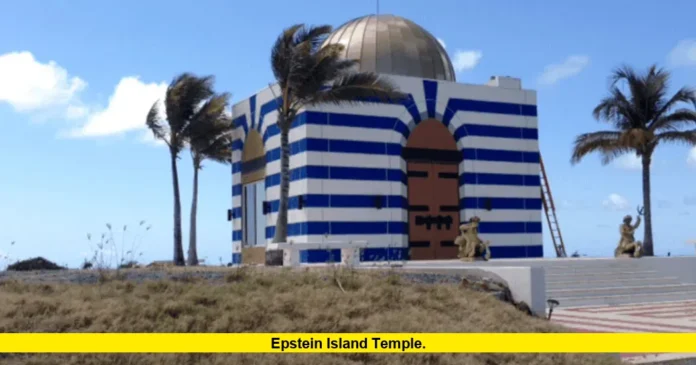

The Epstein island temple remains one of the most mysterious structures associated with Jeffrey Epstein’s private Caribbean property. Its blue-and-white striped exterior, distinctive golden dome, and unusual architectural design attracted worldwide attention, prompting questions about its original purpose and the activities that may have taken place inside.
Located on Little Saint James in the U.S. Virgin Islands, the building became a subject of intense public interest because of its connection to Epstein, whose criminal history and sexual abuse allegations brought international scrutiny to the island.
Newly examined documents released in 2026 have provided important details about the building’s design, the materials used to decorate it, and the terminology Epstein used when discussing its intended purpose. The records indicate that he repeatedly referred to the structure as a mosque, although it remains unclear whether it was ever used for Islamic worship.
Understanding the Epstein island temple requires separating documented information from speculation. Although the building’s appearance has fueled numerous theories, its architectural history offers a more concrete starting point for examining this unusual property.
What Is the Epstein Island Temple?
The Epstein island temple is a distinctive building on Little Saint James, a private island southeast of St. Thomas in the U.S. Virgin Islands.
Jeffrey Epstein acquired Little Saint James in the late 1990s and developed it into an extensive private estate. The property contained residential buildings, recreational facilities, service structures, landscaped areas, and other amenities.
Among these structures, the blue-and-white building became particularly recognizable because of its unusual exterior and dome.
Photographs show a rectangular building with alternating blue and white stripes, large openings, and a dome that originally had a golden appearance. Its architecture differed from the island’s other buildings, making it a recurring subject in news coverage and online discussions.
The word temple became a popular nickname because of its distinctive appearance. However, the nickname does not establish that the building was designed as a conventional temple or used for religious ceremonies.
Documents associated with its development describe different concepts, including a music room, pavilion, chapel, and mosque-inspired structure. These varying descriptions help explain why questions about its intended purpose persisted for years.
Latest Update on the Epstein Island Temple
One of the most significant developments in understanding the building emerged in 2026, when newly examined correspondence and other Epstein-related records offered additional information about its design.
The documents indicate that Epstein repeatedly referred to the structure as a mosque while discussing its interior decoration and architectural features.
Correspondence described efforts to obtain decorative tiles inspired by Islamic architecture. The building’s dome and other design elements also reflected Middle Eastern influences.
The records further indicate that Epstein pursued elaborate decorative objects associated with important Islamic religious sites. These included embroidered textiles reportedly connected to the Kaaba in Mecca, along with other materials intended for the building.
The significance of these findings lies in the additional context they provide. Rather than relying solely on the building’s unusual exterior, researchers can examine correspondence describing what Epstein wanted the structure to look like.
However, the documents do not settle every question. Although they indicate that Epstein called the building a mosque, they do not conclusively establish that it operated as a functioning place of Islamic worship.
The latest information therefore clarifies aspects of the building’s design without providing a complete account of everything that may have happened inside.
Why Was the Building Called a Temple?
The name became popular largely because of the building’s unusual architectural appearance.
Its striped walls, elevated position, and golden dome created a structure that looked different from a conventional private residence. Photographs of the island circulated widely after Epstein’s criminal activities became the subject of international attention.
As the images spread online, the building became associated with descriptions such as a mysterious temple or secret sanctuary.
These labels contributed to speculation about its purpose, particularly because Little Saint James was a private property with restricted access.
However, the terminology used on social media often differs from the language found in construction-related records and correspondence.
The building’s nickname should therefore be understood as a popular description rather than definitive proof of its architectural classification or function.
The distinction is important because an unusual-looking building does not automatically indicate that secret rituals or criminal activities occurred inside it.
Was the Epstein Island Temple Actually a Mosque?
The question of whether the building was a mosque has received renewed attention following the examination of correspondence released in 2026.
The available records indicate that Epstein used the term mosque when discussing the structure and sought design elements associated with Islamic architecture.
His correspondence included discussions about tiles, decorative details, and the appearance of the building’s interior. Other materials associated with the project referred to different uses, reflecting changes in the plans over time.
These details suggest that the building’s design developed through several stages rather than following one clearly established purpose from the beginning.
Nevertheless, the existence of mosque-inspired architecture does not prove that the building was used for regular religious services.
A building can incorporate architectural elements from a particular religious tradition without functioning as a place of worship. The available information does not conclusively establish whether Epstein intended the completed structure to serve that role.
The most accurate conclusion is that the building incorporated Islamic design influences and that Epstein referred to it as a mosque, while its precise practical use remains incompletely documented.
What Were the Religious Artifacts Associated With the Building?
The decorative materials associated with the Epstein island temple have become another important part of the story.
Correspondence examined in 2026 described efforts to acquire elaborate textiles and other objects connected to Islamic art and religious architecture.
Among the items discussed were pieces reportedly associated with the Kaaba, the sacred structure at the center of Islam’s holiest mosque in Mecca. The materials included embroidered textiles with significant religious associations.
Other correspondence concerned decorative tiles intended to create an aged appearance inspired by Islamic architectural traditions.
These details illustrate the lengths to which Epstein went to obtain distinctive decorative objects for his private property.
However, the acquisition of religious artifacts does not establish that the building functioned as a religious sanctuary. Nor does the presence of culturally significant objects independently demonstrate that a particular ceremony took place there.
The records provide information about Epstein’s collecting interests and the building’s intended aesthetic, but conclusions about its activities must be based on separate evidence.
Were Secret Rituals Conducted Inside the Epstein Island Temple?
Claims about secret ceremonies are among the most persistent theories associated with the building.
Online discussions have connected its unusual appearance to allegations involving occult practices, secret societies, and other sensational activities.
However, the available public evidence does not establish that the structure was used for satanic rituals or human sacrifice.
These claims should not be treated as established facts simply because the building looks unusual or because Epstein committed serious crimes.
Epstein’s sexual abuse and trafficking activities were the subject of criminal proceedings and extensive investigations. Those documented matters must be distinguished from allegations about the specific purpose of the temple-like building.
The distinction does not mean that every question about the property has been answered. Instead, it reflects the need to evaluate individual claims according to the evidence available.
Photographs can establish a building’s appearance, while architectural documents can reveal proposed designs. Correspondence can provide insight into the intentions of the people involved. None of these forms of evidence should automatically be treated as proof of unrelated criminal allegations.
Responsible reporting must distinguish between what is documented, what remains uncertain, and what is unsupported speculation.
What Happened to the Golden Dome?
The golden dome is one of the most recognizable features associated with the Epstein island temple.
Its appearance contributed to the building’s distinctive silhouette and helped fuel public curiosity about its purpose.
Historical photographs show the structure with a golden-colored dome, while later images indicate that the building’s exterior changed.
The dome was no longer present in widely circulated photographs by 2019. However, the precise circumstances surrounding its disappearance have not been conclusively established in the public information discussed here.
Claims that its removal proves a secret ceremony, the destruction of evidence, or another specific event require independent support.
Changes to a building can be documented through photographs, but those images do not necessarily explain why the changes occurred.
The dome’s disappearance therefore remains a separate question from the documented information about the building’s design.
How Is the Temple Connected to the Epstein Investigation?
Little Saint James became a central focus of public attention because of allegations concerning Epstein’s sexual exploitation and trafficking activities.
The island’s private setting, extensive facilities, and restricted access attracted scrutiny from investigators and journalists.
In 2019, federal investigators searched the property as part of the broader investigation into Epstein’s activities. The island contained numerous structures, and the search covered the property rather than focusing exclusively on the building commonly called the temple.
The building’s association with the investigation has contributed to continuing interest in its history. However, that connection should not be interpreted as proof that every allegation circulating about the structure is true.
The broader investigation involved allegations and evidence concerning Epstein’s conduct, associates, properties, and treatment of victims. Questions about the temple’s architectural purpose are related to the island’s history but remain a distinct subject.
Keeping these issues separate helps readers understand the significance of the building without confusing speculation with established findings.
What Do the Epstein Files Reveal About the Building?
The release of additional Epstein-related records in 2026 expanded the publicly available information about his properties, communications, and relationships.
For the island’s temple, the most relevant material concerns architectural planning, decorative acquisitions, and correspondence about its intended appearance.
These records help explain why the building’s purpose was debated for so long. Different descriptions appeared during its development, while later correspondence indicated that Epstein himself referred to it as a mosque.
The documents also provide a clearer picture of the effort devoted to its decoration, including the pursuit of distinctive materials and objects inspired by Islamic art.
Nevertheless, a large document release does not mean that every question has been resolved. Individual records must be interpreted in context, and statements contained in correspondence do not necessarily establish that a proposed plan was completed or carried out as intended.
The available information provides a stronger foundation for understanding the structure’s design, but its complete history and actual use remain subjects requiring careful examination.
Why the Epstein Island Temple Continues to Attract Attention
The building remains a subject of public fascination because several factors intersect in its history.
First, its architecture is unusual enough to attract attention even without the surrounding controversy.
Second, the changing descriptions of its intended purpose have created uncertainty about whether it was primarily a music room, pavilion, mosque-inspired building, or something else.
Third, Epstein’s criminal history has led many people to examine the island and its structures for additional information about his activities.
Finally, the release of new documents has renewed interest in questions that remained unresolved for years.
Together, these factors explain why the phrase Epstein island temple continues to generate online searches and discussion.
The most useful new information is not necessarily the most sensational. Records that explain the building’s design, materials, and development can offer meaningful insight without relying on unsupported allegations.
Conclusion: What We Know About the Epstein Island Temple
The Epstein island temple is a distinctive structure whose history has become intertwined with public interest in Jeffrey Epstein’s private Caribbean estate.
Newly examined correspondence provides important context about its architectural influences, decorative materials, and the fact that Epstein repeatedly referred to it as a mosque. However, the available evidence does not conclusively establish that it functioned as a place of worship or that sensational claims about secret rituals occurred inside it.
The building’s unusual appearance explains much of its notoriety, while the broader history of Little Saint James explains why it continues to attract scrutiny.
As additional records are examined, further details may clarify aspects of its construction and intended purpose. Until then, distinguishing documented information from unsupported speculation remains essential to understanding the mystery surrounding the structure.
What do you think the newly examined records reveal about the Epstein island temple? Share your thoughts in the comments and stay updated as more verified information emerges.