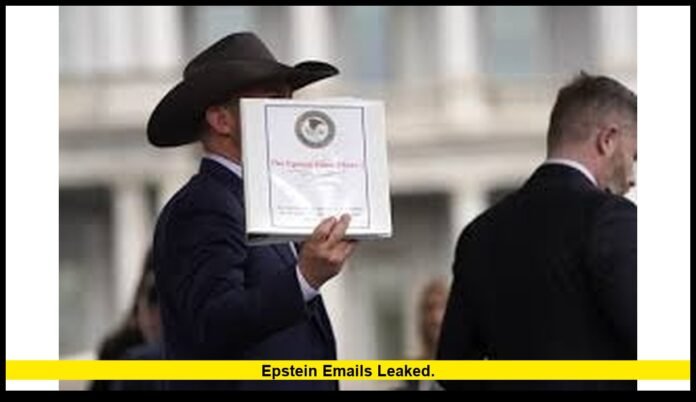

The shocking batch of Epstein emails leaked this week has set off an international firestorm, providing new insight into the late financier Jeffrey Epstein’s vast network of power and influence. These confidential communications, now in the hands of investigators and select media outlets, shed light on the relationships Epstein maintained with political leaders, global business figures, and high-profile celebrities—many of whom had previously denied any significant association with him.
The leak, believed to include thousands of messages spanning from 2002 to 2019, paints a disturbing picture of how Epstein operated behind closed doors, how his empire was sustained, and how some of the world’s most powerful individuals remained in his orbit long after his 2008 conviction for sex crimes.
Thousands of Epstein Emails Leaked, Revealing a Hidden Network of Influence
The Epstein emails leaked were obtained from a combination of Epstein’s private servers, his estate’s archives, and seized communications between his known associates. According to investigators, these emails document both routine personal exchanges and confidential discussions about travel, business dealings, and introductions to powerful individuals.
Among the most shocking details are email threads that reference Epstein arranging private meetings, coordinating travel for “guests,” and discussing financial transactions linked to shell companies and offshore accounts. The tone of the messages ranges from casual banter to coded exchanges, leading experts to believe Epstein was deliberately careful in concealing the nature of his operations.
One message allegedly shows Epstein referring to a “small dinner” at his Manhattan townhouse attended by a mixture of academics, politicians, and entertainers. Another contains discussions about flights to his private island in the U.S. Virgin Islands, with unnamed “high-value guests” on board. The emails also indicate that Epstein continued to cultivate these relationships even while under scrutiny from law enforcement and the press.
The Power Web: Who Appears in the Leaked Emails
The Epstein emails leaked appear to confirm what many investigators and journalists had suspected for years—Epstein maintained contact with a wide range of influential figures across industries, politics, and academia.
The list includes financiers, professors, corporate executives, and entertainment icons. Many of them have not been publicly accused of wrongdoing, but the volume and familiarity of the communications show that Epstein’s reach was far greater than anyone imagined.
Several threads suggest that Epstein used his reputation as a “philanthropist” to attract intellectual and political circles. He frequently discussed charitable donations, global education initiatives, and scientific research funding—topics that helped him gain legitimacy and maintain relationships even after his conviction.
In one particularly revealing exchange, Epstein’s assistant mentions “reassuring guests” that “Jeffrey’s situation is under control,” suggesting that many of his associates remained engaged with him despite public controversy.
Epstein’s Control of Information and Media
A major takeaway from the Epstein emails leaked is how carefully Epstein worked to shape public perception. The emails detail his efforts to manage his image and protect his powerful friends from association.
Several messages reveal coordination with media consultants, publicists, and even legal advisors to suppress damaging stories. In one email, Epstein instructs a PR representative to “make sure the focus remains on education and innovation,” referring to his foundation’s projects that he often used to sanitize his public profile.
The emails also show Epstein’s obsession with tracking the media narrative. He appeared to closely monitor stories about himself, sometimes reacting with anger or panic when journalists uncovered links to his criminal past. His correspondence with employees often includes instructions like “avoid photos,” “no comment,” and “remind them of our legal partnerships.”
Ghislaine Maxwell’s Central Role in the Leaked Emails
The leaked emails confirm that Ghislaine Maxwell, Epstein’s longtime associate and confidante, played a pivotal role in maintaining his social network. Her name appears in hundreds of exchanges, often organizing meetings, coordinating guest lists, and responding on Epstein’s behalf.
Many of these communications depict Maxwell as Epstein’s gatekeeper. She handled logistics for social gatherings, including invitations and travel, and sometimes corresponded directly with high-profile individuals to reassure them of confidentiality.
In several messages, Epstein praises Maxwell’s ability to “keep the circle tight” and “maintain discretion.” This aligns with testimony from victims and witnesses who described Maxwell as instrumental in recruiting young women and ensuring Epstein’s affairs remained hidden from public scrutiny.
Even after Epstein’s first conviction, Maxwell continued to manage elements of his operations—arranging meetings, handling scheduling, and corresponding with associates who seemed unconcerned about the seriousness of his charges.
Financial and Political Implications of the Leak
The Epstein emails leaked also contain references to complex financial arrangements that could have global ramifications. Some messages include discussions of offshore accounts, trust funds, and “investments” connected to Epstein’s network of businesses.
Investigators are now analyzing whether these accounts were used to conceal assets or to facilitate payments to accomplices and victims. The emails include phrases such as “secure transfer,” “educational grant,” and “consulting donation”—terminology that experts say may have been designed to disguise illegal or unethical financial activity.
In addition to the financial disclosures, several emails reference conversations with political figures about policy, travel, and “shared interests.” These communications have raised alarms about possible influence-peddling or access trading, particularly as some correspondents appear to have held government positions at the time.
Legal analysts predict that this new wave of leaks will lead to a deeper investigation into Epstein’s finances and how his network operated internationally through corporate structures and tax havens.
Renewed Calls for Full Transparency
The release of these communications has once again fueled public outrage and calls for transparency. Victims’ advocacy groups argue that all documents related to Epstein should be made public—without redactions—to expose everyone who may have aided or enabled his crimes.
Lawmakers in several states are now pushing for congressional hearings to examine the government’s previous handling of Epstein’s prosecution and to review any potential cover-ups.
Public sentiment is overwhelmingly in favor of full disclosure. Social media platforms have exploded with hashtags like #EpsteinEmails and #UnsealEverything, as users demand accountability for the powerful figures linked to Epstein’s orbit.
Victims’ attorneys say the leaks validate years of claims that Epstein’s power came not just from money but from secrets—information that could damage reputations or destroy careers if ever made public.
The International Dimension
The Epstein emails leaked also highlight how Epstein’s influence spanned across continents. Many of the communications involve arrangements for events or meetings in Europe, the Middle East, and Asia. These exchanges suggest that Epstein operated globally, maintaining multiple “safe zones” outside the United States where he could avoid scrutiny.
One series of emails references an “educational symposium” in Paris that appears to have been a front for private meetings with wealthy investors and political leaders. Another email thread mentions “visiting old friends in London,” referencing known associates who have since faced questions about their links to Epstein and Maxwell.
International law enforcement agencies are now reviewing the leaked files to determine whether any individuals within their jurisdictions played a role in Epstein’s trafficking network or financial crimes.
How the Leaks Could Affect Ongoing Cases
Legal experts believe that the leaked communications could directly influence active lawsuits involving Epstein’s estate and associates. Plaintiffs in several ongoing cases are already seeking to subpoena portions of the emails as potential evidence.
Attorneys representing victims have indicated that the emails may corroborate their clients’ accounts, particularly regarding how Epstein lured victims into his orbit using promises of connections and opportunities.
Moreover, prosecutors are expected to analyze the metadata of the emails—timestamps, IP addresses, and attachments—to confirm authenticity and trace Epstein’s communication patterns. This technical analysis could uncover additional names and establish timelines connecting Epstein’s activities across his various properties.
Public Reaction and Political Fallout
Public reaction to the Epstein emails leaked has been swift, emotional, and far-reaching. Across the United States, citizens and media commentators alike have expressed shock at the scope of Epstein’s influence and the apparent complicity of those who stayed silent.
Political analysts warn that the fallout could extend beyond reputational damage. If the emails confirm that elected officials or government agencies failed to act on evidence of Epstein’s crimes, there could be long-term implications for public trust in the justice system.
Several advocacy organizations have announced plans to hold public forums and online campaigns to keep pressure on authorities to release the remaining documents. The growing movement for “Epstein transparency” is now viewed as part of a broader fight for accountability among the world’s elite.
What Happens Next
The fallout from the Epstein emails leaked is just beginning. Investigators expect more materials to emerge as digital forensics teams continue to analyze Epstein’s recovered devices and server data. Law enforcement agencies in multiple countries are reportedly coordinating to share findings and track the individuals mentioned in the correspondence.
Federal prosecutors have not ruled out new charges against Epstein’s former associates. Meanwhile, the courts overseeing his estate are preparing to review whether the newly surfaced information could impact previous settlements or expose new liabilities.
For victims, these emails represent another step toward justice—but also a painful reminder of how long Epstein’s crimes went unchecked. The coming months are likely to bring more disclosures, more names, and potentially more accountability than ever before.
Conclusion
The Epstein emails leaked are more than just a data dump—they’re a window into a world where power, privilege, and secrecy intertwined to create one of the most disturbing criminal networks of the modern era. As investigators, journalists, and the public sift through these communications, the truth behind Epstein’s operations is slowly coming to light.
Each revelation underscores a painful but vital lesson: justice delayed is not justice denied, but it must come with full transparency.
Do you believe all Epstein documents should be released to the public? Share your thoughts below and follow for continued updates on this unfolding story.