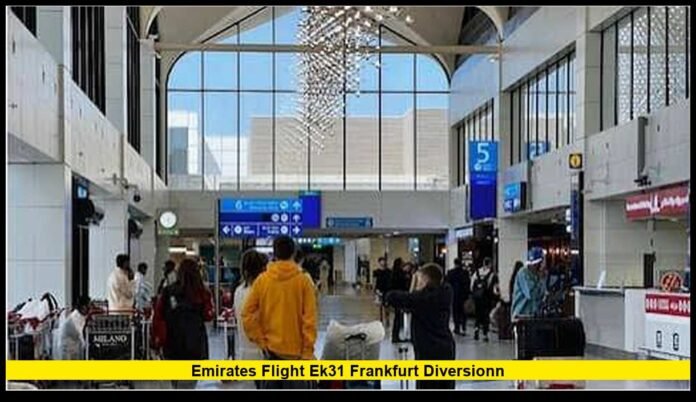

The emirates flight ek31 frankfurt diversion became a major aviation story on October 1 after an Emirates Airbus A380 traveling from Dubai to London Heathrow made an unexpected landing in Frankfurt following a passenger medical emergency. The aircraft had been several hours into its scheduled journey when the crew declared a general emergency, changed course toward Frankfurt and safely landed at the German airport so the passenger could receive further medical attention.
The incident temporarily disrupted the journey for everyone aboard EK31, but available information indicates that the aircraft itself landed safely and that the diversion was made to prioritize the health of the affected passenger. Emirates subsequently confirmed the reason for the unscheduled landing and said arrangements were being made for the flight to continue toward London.
Key Points at a Glance
╔════════════════════════════════════════════════════════════════════╗
║ – Emirates flight EK31 was traveling from Dubai to London Heathrow when it diverted to Frankfurt. ║
║ – The diversion was caused by a medical emergency involving a passenger. ║
║ – The aircraft was an Airbus A380-861 registered as A6-EDX. ║
║ – Flight-tracking information showed the aircraft transmitting Squawk 7700, the standard code for a general emergency. ║
║ – The aircraft landed safely at Frankfurt Airport after changing course over Europe. ║
║ – Cabin crew assisted the passenger during the flight before medical support was arranged in Frankfurt. ║
║ – The affected passenger left the aircraft in Frankfurt for additional medical attention. ║
║ – Emirates expected the flight to continue to London Heathrow after the unscheduled stop. ║
║ – The diversion caused delays for passengers traveling to London and potentially for connecting travelers. ║
╚════════════════════════════════════════════════════════════════════╝
What Happened to Emirates Flight EK31?
Emirates flight EK31 is a regular long-haul service connecting Dubai International Airport with London Heathrow Airport. On October 1, the flight departed Dubai and initially followed its expected route toward the United Kingdom.
The aircraft used for the service was an Airbus A380-861, one of the world’s largest commercial passenger aircraft. The particular aircraft involved was registered A6-EDX.
Several hours after departure, EK31 encountered an onboard medical situation serious enough to require an unscheduled landing. Instead of continuing toward London, the flight changed direction toward Frankfurt Airport.
Flight-tracking information showed the aircraft declaring a general emergency through its transponder system before descending from cruising altitude and heading toward Frankfurt.
The aircraft subsequently landed safely in Germany.
Why Did EK31 Divert to Frankfurt?
Emirates later confirmed that the reason for the diversion was a medical emergency involving a passenger.
The airline said its cabin crew assisted the passenger during the flight and that medical support was arranged ahead of the aircraft’s arrival in Frankfurt.
Once the aircraft landed, the passenger disembarked and was taken for additional medical attention.
Emirates did not publicly provide detailed information about the passenger’s medical condition. The airline also did not identify the passenger, which is consistent with the privacy concerns surrounding individual medical situations.
The decision to divert a long-haul flight can be made when a medical condition requires attention that cannot safely be delayed until the aircraft reaches its originally scheduled destination.
What Does Squawk 7700 Mean?
One of the first signs that something unusual was happening aboard EK31 came from flight-tracking data.
The aircraft transmitted Squawk 7700, an internationally recognized transponder code indicating a general emergency.
When pilots select 7700, air traffic controllers can immediately identify the aircraft as being in an emergency situation. This can help controllers provide priority handling, clear surrounding traffic and support the crew in reaching an appropriate airport.
Importantly, Squawk 7700 does not identify the specific cause of the emergency.
The code can be used for several types of serious situations, including medical emergencies, technical problems and other circumstances requiring immediate assistance.
In the case of EK31, Emirates later established that the emergency involved a passenger’s medical condition.
EK31 Was Flying an Airbus A380
The aircraft involved in the incident was an Airbus A380-861 operated by Emirates and registered A6-EDX.
The A380 is a double-deck wide-body aircraft designed for high-capacity international routes. Emirates is the world’s largest operator of the A380, making the aircraft a familiar sight on the airline’s long-haul network.
For passengers aboard EK31, the size of the aircraft also meant that the unscheduled landing involved coordination among the flight crew, cabin crew, airport personnel and medical responders.
Despite the emergency declaration, the aircraft completed the diversion safely.
There has been no confirmed indication that the A380 suffered a catastrophic aircraft failure during the incident.
How the Flight Path Changed
EK31 departed Dubai and was initially headed toward London Heathrow.
As the flight progressed through European airspace, the crew transmitted the emergency code and began changing the aircraft’s flight path.
Instead of continuing west toward London, the A380 headed toward Frankfurt.
The aircraft then descended from its high cruising altitude and approached Frankfurt Airport for an emergency landing.
Flight-tracking records show that the aircraft arrived at Frankfurt during the afternoon local time. It subsequently moved away from the runway and was handled on the ground while the medical situation was addressed.
The unscheduled stop changed what would normally be a straightforward Dubai-to-London journey into a multi-stage trip.
The Aircraft Landed Safely in Frankfurt
The most important development for passengers was that the A380 landed safely at Frankfurt.
The aircraft approached Frankfurt and landed without a reported accident or runway incident. After touchdown, the passenger requiring medical care was able to leave the aircraft for further treatment.
Airport and medical personnel were prepared to assist after arrival.
For the remaining passengers, the aircraft became temporarily part of an irregular operation, with Emirates needing to manage the additional ground time and arrange the continuation of the journey.
What Happened to the Passenger?
The passenger at the center of the medical emergency was assisted by the cabin crew while EK31 was still airborne.
Emirates said medical support was arranged for the aircraft’s arrival in Frankfurt. After landing, the passenger disembarked to receive further medical attention.
The airline has not released a detailed account of the passenger’s condition, and there is no confirmed public information establishing the nature or severity of the medical issue.
That distinction is important because early reports about an emergency flight can generate speculation before the operating airline provides an official explanation.
In this case, the confirmed information is limited to the existence of a passenger medical emergency and the subsequent safe diversion to Frankfurt.
Was There a Problem With the Plane?
The emergency declaration naturally raised questions about whether EK31 had experienced a mechanical or technical problem.
However, Emirates’ later explanation identified a passenger medical emergency as the reason for the diversion.
The transmission of Squawk 7700 should therefore not be interpreted automatically as evidence of an aircraft malfunction.
The code is designed to alert air traffic control to a general emergency. It does not reveal whether the cause is medical, mechanical or operational.
For EK31, the airline’s explanation provides the clearest account of why the crew chose to divert.
Why Frankfurt Was Selected
Frankfurt Airport is one of Europe’s largest aviation hubs and is equipped to handle wide-body aircraft, including very large long-haul jets.
When an aircraft needs to divert, the closest airport is not necessarily the airport selected. Flight crews and airline operations teams can consider several factors, including runway suitability, airport facilities, weather, air traffic conditions, emergency response capability and the ability to support passengers after landing.
For a medical emergency, access to appropriate medical services can be particularly important.
The selection of Frankfurt gave EK31 access to a major international airport while allowing the affected passenger to receive additional care without requiring the aircraft to continue to London.
What Did Emirates Say About the Diversion?
Emirates confirmed that flight EK31 had diverted from Dubai to London Heathrow to Frankfurt because of a medical emergency involving a passenger.
The airline said its cabin crew assisted the passenger during the flight and that medical support was arranged for the aircraft’s arrival.
After the aircraft landed safely, the passenger left the plane for further medical attention.
Emirates also apologized to passengers for the delay caused by the unexpected diversion.
The airline emphasized that the health and safety of passengers and crew remained its highest priority.
That response explains why the flight did not simply continue to Heathrow despite being several hours into its journey.
When Was EK31 Expected to Continue to London?
Following the Frankfurt landing, Emirates indicated that the flight was expected to resume its journey to London Heathrow at approximately 6 p.m. local Frankfurt time.
The precise timing of an onward flight can change during an irregular operation.
A diverted aircraft may require additional ground handling, passenger processing, crew coordination and operational checks before it can depart again.
Passengers may therefore see changes to departure information even after the airline has announced an expected continuation time.
Travelers with onward connections are particularly likely to be affected because even a relatively short diversion can cause missed connections or changes to subsequent reservations.
What Does the Diversion Mean for Passengers?
For passengers booked on EK31, the diversion meant a significant interruption to their planned Dubai-to-London journey.
Instead of landing directly at Heathrow, passengers first arrived at Frankfurt.
Depending on their individual itineraries, travelers could also have faced additional complications involving connecting flights, airport transfers, accommodation or other reservations.
Emirates was expected to manage the onward journey and provide updated arrangements as the situation developed.
Passengers traveling on affected services should rely on the latest information attached to their individual booking because general flight-status information may not reflect every passenger’s specific itinerary.
Could the Diversion Affect Connecting Flights?
Yes. An unexpected diversion can have consequences beyond the original flight.
Passengers who had connecting flights at Heathrow could potentially miss their planned connections if EK31 arrived later than scheduled.
Similarly, travelers with rail tickets, hotel reservations, airport transfers or other time-sensitive arrangements may need to make changes.
The exact consequences depend on each passenger’s itinerary.
A traveler continuing beyond London could be affected differently from someone whose final destination was Heathrow itself.
For this reason, passengers should check their individual booking status rather than relying solely on the original EK31 timetable.
Why Early Reports Can Be Confusing
The first reports surrounding an aircraft emergency often come from flight-tracking systems.
These systems can reveal that an aircraft has changed direction, descended unexpectedly or transmitted an emergency transponder code. However, such information does not necessarily explain what caused the emergency.
That is what happened with EK31.
The initial appearance of Squawk 7700 and the aircraft’s diversion to Frankfurt immediately indicated that something unusual had occurred. The precise reason was clarified later when Emirates confirmed the passenger medical emergency.
This is why early reports about aviation incidents should be distinguished from information subsequently confirmed by the airline.
What Travelers Should Know About the EK31 Incident
Anyone searching for the latest details about the emirates flight ek31 frankfurt diversion should focus on the confirmed sequence of events.
EK31 left Dubai for London Heathrow, encountered a passenger medical emergency, declared a general emergency, diverted to Frankfurt and landed safely.
The affected passenger was removed from the aircraft for further medical attention, while Emirates worked on arrangements to continue the flight toward London.
There is no confirmed indication from Emirates that the aircraft suffered a major accident or that the diversion was caused by a catastrophic mechanical failure.
The incident was therefore primarily a passenger medical emergency that required the aircraft to interrupt its scheduled route.
Why Medical Diversions Are Taken Seriously
Commercial aircraft operate under strict safety procedures, and cabin crews receive training to respond to medical situations during flights.
However, an aircraft is not a hospital, and certain conditions may require treatment that cannot be provided adequately onboard.
When a passenger’s condition becomes sufficiently serious, the crew can coordinate with medical professionals on the ground and air traffic control to arrange a diversion.
This can result in thousands of passengers being delayed, but the decision is made with the safety of the affected individual and everyone aboard in mind.
The EK31 incident illustrates how quickly a long-haul flight can change course when an onboard medical situation requires immediate attention.
Latest Status of Emirates EK31
The latest confirmed information shows that EK31 was safely diverted from its Dubai-to-London route to Frankfurt on October 1 after a passenger experienced a medical emergency.
The Airbus A380 landed safely, medical assistance was arranged, and the passenger disembarked for further care.
Emirates expected the flight to continue toward London Heathrow after the Frankfurt stop, although the diversion caused delays for passengers.
No detailed information about the passenger’s medical condition has been publicly released, and travelers should avoid relying on unverified claims about the incident.
For passengers affected by the disruption, the most important information remains their individual Emirates flight status and updated itinerary.
Final Takeaway
The Emirates EK31 incident was an unexpected medical diversion rather than a reported aircraft accident. The crew responded to the passenger emergency, coordinated medical assistance and diverted the A380 to Frankfurt, where it landed safely. Emirates then worked to resume the journey to London Heathrow while managing the resulting passenger delays.
The event also highlights the importance of emergency procedures in long-distance commercial aviation. A flight may be close to its destination, but when a passenger requires urgent medical attention, reaching a suitable airport can take priority over maintaining the original schedule.
Were you traveling on EK31 or affected by the Frankfurt diversion? Share your experience and keep checking back for the latest verified aviation updates.